
The short answer
For one Incheon day, choose the Open Port district or Songdo. The Open Port district is the better first choice for history, markets and a mostly walkable day from Incheon Station. Songdo suits a park-and-architecture day reached on Incheon Line 1. Ganghwa belongs in a separate plan because the island’s sights are spread out and require a fresh transport check.
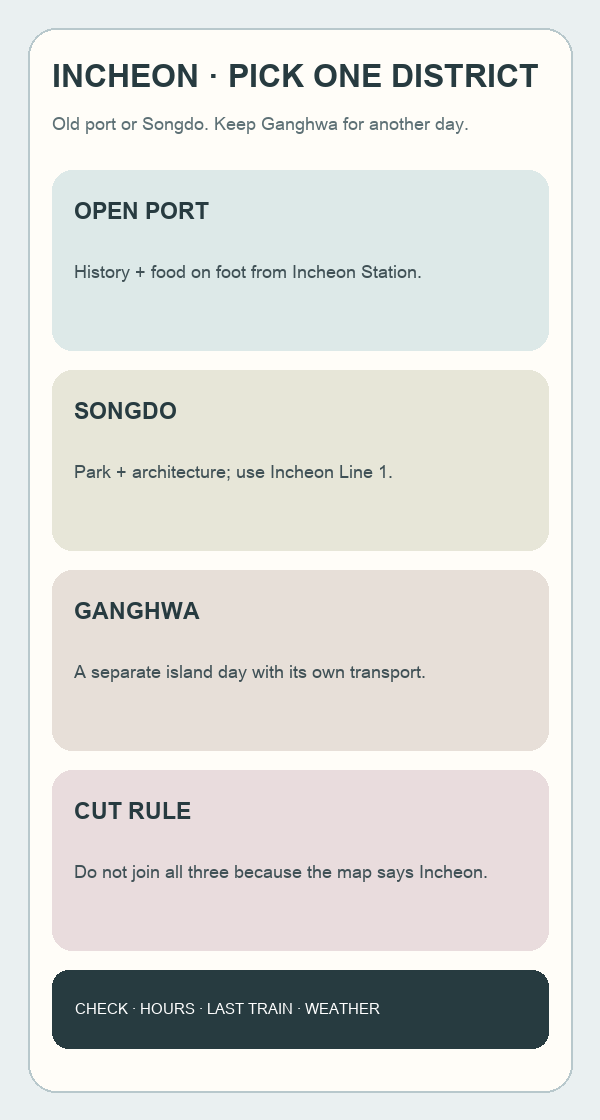
Pick by the question you want the day to answer
| District | Best reason to choose it | Transport backbone | What to cut |
|---|---|---|---|
| Open Port | History, street food and small museums | Walk from Incheon Station | Wolmi if the museum and market day is already full |
| Songdo | Central Park, skyline and contemporary architecture | Incheon Line 1 plus walking | Paid water activities if hours or weather do not fit |
| Ganghwa | Island history, landscape and a slower road trip | A separate live route or car plan | Any attempt to add central Incheon the same day |
This split is practical rather than a ranking. Incheon is a metropolitan city, and places sharing the same city name can still take a long transfer.
Open Port: build a walk, not a landmark race
Start at Incheon Station and keep the core compact: Chinatown and the Open Port streets, one museum or interpreted walk, then Sinpo International Market. Incheon Tour’s current history feature describes the Open Port Museum as a four-gallery introduction to the city’s change from the 1883 opening through the pre-colonial period. Its interpreter page lists the Open Port heritage walk among the city’s reservation-based interpretation options. Check the selected museum and interpreter slot directly; do not assume that every attraction shares one timetable.

Sinpo Market works as the food stop because it belongs to the same central cluster. The official market guide presents several longstanding foods and shops, but it is not a promise that one famous queue will suit your day. Check the stall or restaurant itself and keep a second choice.
Songdo: park first, optional activities second
Songdo Central Park is the anchor. Incheon Tour describes a 1.8 km artificial waterway, walking paths and the skyline around it. The official Songdo day-course guide adds the National Museum of World Writing Systems, Tri-bowl and sunset views as nearby options. That creates a coherent day without borrowing attractions from the old port.

Treat boats, water taxis and observation facilities as optional. The destination page identifies them, but operation can depend on the date, weather and operator. Recheck each activity before travel rather than making it the only reason for the trip.
Why Ganghwa is a different day
Incheon Tour’s Ganghwa guidebook spreads its material across prehistoric sites, fortifications, museums, tidal flats and mountain areas. That breadth is the warning: Ganghwa is not one more stop after Songdo. Choose two or three compatible places, verify their current opening and transport, and keep enough time for the trip back. This guide does not copy an old bus interval or parking price because those are travel-date decisions.
What completed visits add
- u/Ok_Pumpkin_7174, in a report published in April 2025 after a completed four-day Incheon stay, used subway, walking and taxis and found Songdo’s parks suitable for early walks. The narrow lesson is that Songdo can support its own day; the account does not set today’s fares or journey times.
- u/Educational-Sign-297, in a November 2025 post about one photographed Songdo visit the previous winter, described the area as worth visiting beyond an airport stop. That supports treating Songdo as a destination, not combining every recommended place.
- u/Specialist_Carrot600, in an April 2026 post with photos from a completed Central Park visit, shows the park as a real walking-and-view stop. A photo report cannot establish activity hours, crowd levels or a universal visit length.
The three accounts sharpen the choice but do not replace official operating pages.
A workable day in each district
Open Port: Incheon Station → Chinatown and Open Port streets → one museum or booked interpretation → Sinpo Market → return from the same district.
Songdo: Central Park → one nearby museum or architecture stop → sunset walk → return on the current rail route.
Ganghwa: confirm the day’s transport → two or three sites in one part of the island → leave a return buffer. Do not add central Incheon because a map label makes it look close.
Last checked: 2026-10-20.
Sources & verification
A source-based guide. Check the linked operator information again before you travel.
- Incheon Tour: Open Port history route and museum contextSources checked:
- Incheon Tour: Sinpo International Market guideSources checked:
- Incheon Tour: Songdo Central Park current destination pageSources checked:
- Incheon Tour: Songdo day-course guideSources checked:
- Incheon Tour: Ganghwa official guidebookSources checked:
- Incheon Tour: cultural interpreter reservation pageSources checked:
- u/Ok_Pumpkin_7174: completed four-day Incheon stay, report published April 2025Sources checked:
- u/Educational-Sign-297: completed photographed Songdo visit last winter, post published November 2025Sources checked:
- u/Specialist_Carrot600: completed Songdo Central Park visit, post published April 2026Sources checked:
Images are examples to aid understanding.
Help us keep this note useful
A quick response helps us decide what to clarify or recheck. No account or email is needed.