Rain in Sokcho is not a reason to fold the day; it is a cue to move the itinerary’s axis indoors. Spend fewer hours outside, mix in indoor exhibits, markets, cafes, and short taxi rides, and keep one or two essential daylight stops; the rest of the day still holds. Seoraksan goes into the plan after its cable car operation and trail control conditions have been checked.

A decision diagram for moving a Sokcho day indoors according to the rain forecast

How to move the day’s axis when it rains

The rainy-day principle in the sources points one way. Cut outdoor time and mix indoor exhibits with markets, cafes, and short taxi rides; because photo-focused stops lose value in the rain, narrow the daylight stops to the one or two that matter and spend the remaining time on food and rest.

For a stay of one night or longer, flipping the days is another option: one travel guide counts a first day centered on the market and beach and a second day on natural scenery as the course with less physical strain, and if the rain forecast clusters on the second day, swapping the order is enough. The course stays as drawn and the sequence moves, so the plan does not have to be rebuilt from scratch.

Seoraksan in the rain: how far you can go

The Gwongeumseong cable car meets the weather head-on. One summary records that operation can stop immediately in strong wind, fog, or rain, and that it may stop with no advance notice. The official tourism listing says operating hours are announced one day before on the website. The operator’s own rule points the same way: check real-time operation information before departure.

Trails are controlled when a weather advisory is in effect. Guidance says trails close under heavy rain, heavy snow, or typhoon advisories, and another source warns that right after heavy rain, trail control or slip hazards can linger, recommending the next day once the weather settles. The same source notes that a waterfall’s flow revives after rain, so when today does not work, the following day can be the better choice.

If you still go, the gear list narrows the risk. Rain jackets or umbrellas and non-slip shoes are listed as preparations, and the same source adds a specific caution about rockfall and slippery ground after rain. The operator also notes that the cabins have no air conditioning or heating; riding in soaked outerwear makes the cold land harder.

An example scene of the Seorak rock ridge and the cable car in the rain

The answer for when the cable car stops is worth settling in advance. One editorial guide reads a suspension as the signal to switch to a backup plan rather than a failed trip, and suggests picking one option that matches the family’s stamina and the weather: a short walk taken after checking national park guidance, an indoor day in Sokcho, or rest at the lodging. If the cable car does run, one tip is to buy the ticket early in the morning and spend the wait on a stroll around Sinheungsa, and a travelogue lays out a course that strings together the cable car, Sinheungsa, and a meal inside the park.

One traveler’s record from a long-range traverse adds a quieter data point: damp from the fog, exhausted, the views gone. Since Gwongeumseong’s worth sits in the panorama, a fog-and-rain forecast is also an early read on how much a cable car day will deliver.

Indoor attractions’ operating conditions: museums and the hot spring

The National Mountain Museum (국립산악박물관) and the Sokcho City Museum (속초시립박물관) are the representative indoor exhibition spaces the sources introduce as rainy-day candidates. The source recommends them as indoor spaces worth visiting in the rain, with mountain history exhibits, a children’s experience zone, and VR experiences. The same source records free dedicated parking, which also makes car access easier on a rainy day. One gap remains: the sources behind this post carry no re-verification date for the museums’ operating hours, closing days, or admission fees, so those figures stay out of this text, and confirming by phone (033-638-4459 / 033-639-2977) before visiting is the accurate route.

Cheoksan Hot Spring (척산온천) is the indoor option that dries out a damp day. The spa bath fee is what the source records as of May 2026: KRW 9,000 for adults on weekdays and about KRW 10,000 on weekends and holidays. The same source advises re-checking the exact fee on the official website or by phone right before visiting.

On the same basis, operating hours run from 06:00 to 20:00, and ticket sales close one hour before the end of business.

The facilities are open-air baths, event baths, a hanjeungmak dry sauna, and rest areas, with the average stay put at about 1.5 to 2 hours. A crowding note that weekday mornings from 10:00 to 11:00 are the quietest is worth using too.

The location helps on a rainy day too. One access note puts it about 5 minutes by car (about 3 km) from the entrance of Seoraksan Sogongwon (the source’s basis, May 2026), and the resort’s own parking lot is free. The realistic arrangement is to move from the mountain to the hot spring on an afternoon when the rain has passed. The same sources record that the Cheoksan foot-bath park is free with only the bath admission charged separately, so it works as a light drop-in option too.

The figures in the table below are each source’s values at its own reference date (the hot spring figures are as of May 2026 per the source).

Indoor attractions’ operating conditions: museums and the hot spring
Indoor axisConditions confirmed in the sourcesRole on a rainy day
Museums (mountain · city)Indoor exhibits, children’s experience zone · VR, free dedicated parkingThe axis that absorbs the most time
Cheoksan Hot Spring spaOpen-air baths · event baths · hanjeungmak · rest areas, about KRW 9,000 weekdays · KRW 10,000 weekendsThe full stop that dries out the damp day
Jungang Market · Tourist and Fishery MarketFood alley (dakgangjeong, ojingeo sundae, and more); the market is part of the rainy-day mixBreaks the walking into short pieces
Beachside cafesOcean-view cafes near Yeonggeumjeong and Oeongchi introduced as candidatesA comma between moves

An example of the indoor exhibition space of a mountain museum

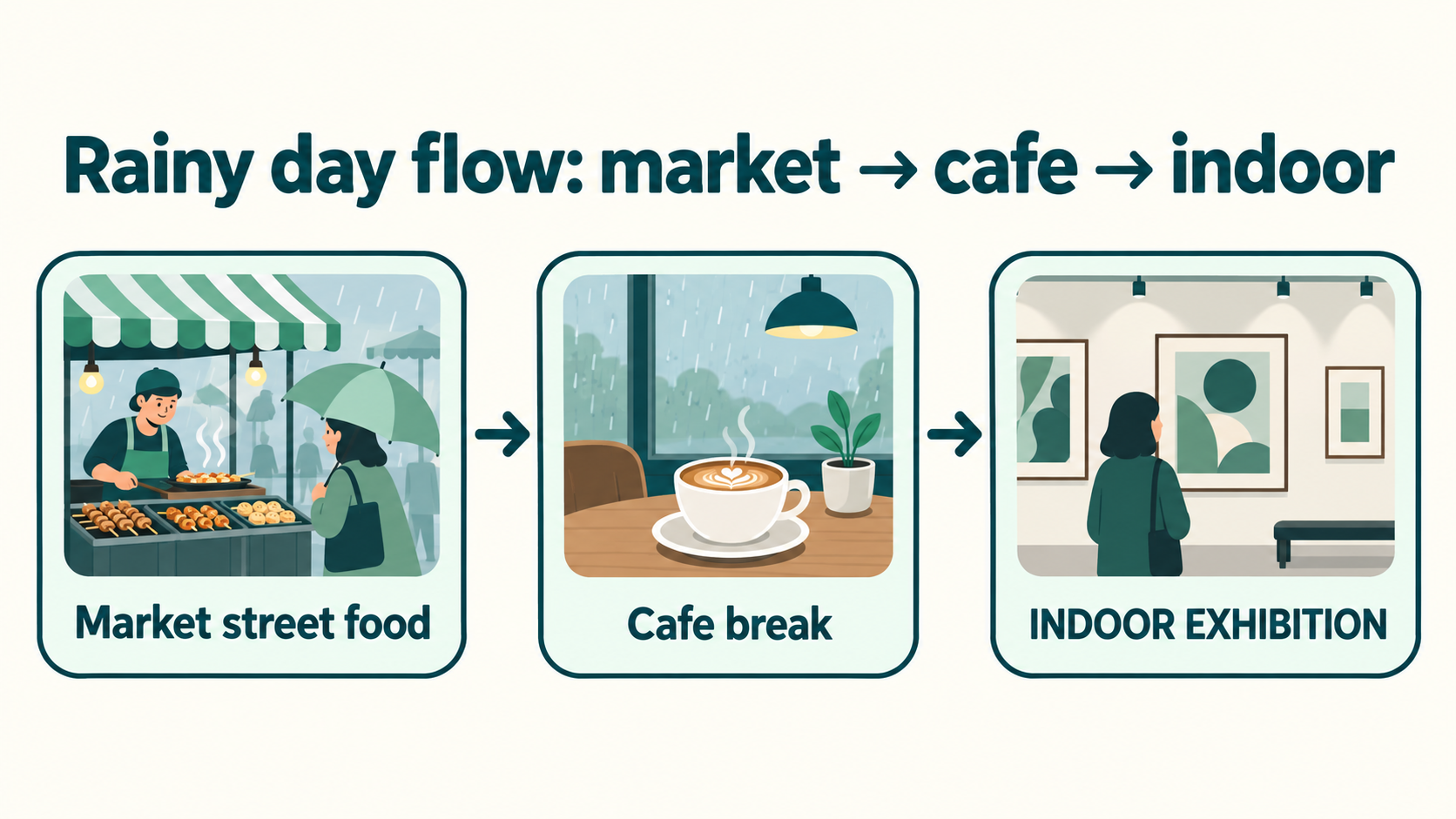
Markets and cafes: bundle them narrowly inside one area

On a rainy day, a narrow bundle beats a wide spread. Build the day from indoor exhibits, markets, cafes, and short taxi rides, and when the lodging area is within walking distance of the market, the time spent walking in the rain itself shrinks. A traveler who visited Sokcho repeatedly without a car recorded choosing, again and again, the lodging area behind the bus terminal within walking reach of the market.

Treat cafes as commas, not as destinations. Keep a spot to duck into between moves for when a queue builds or the rain strengthens; the candidates introduced are the ocean-view cafes toward Yeonggeumjeong and Oeongchi beach. For days that include the hot spring, there is also a routing proposal that runs spa, meal, cafe in that order.

A flow diagram bundling the market and cafe stops in one direction

Market food conditions are handled in a separate post of this cluster; this post keeps only the bundle. Fix one market to duck into before the rain strengthens and one cafe to rest at, and the rest can be adjusted on site without breaking the flow of the day.

Try moving the day this way

  • When rain shows in the forecast, swap the Seoraksan day and the indoor day first, and leave one or two outdoor stops you really want.
  • For Seoraksan, check the previous-day notice and real-time operation information; if operation stops, switch to a short walk, indoor Sokcho, or rest.
  • Pick one indoor axis, museum or hot spring, and bundle the market and cafe in the same direction.

Scope of sources and evidence

This post is an editing guide built only on travel material compiled on September 10, 2026. Independent visit accounts covering actual rainy-day routes were still lacking, and operating-hour and fee figures without a remaining verification date were left out of the text. The hot spring figures are the values as of May 2026 as stated by the source, and they do not guarantee current conditions.

  • Korea Playlist, Sokcho itinerary and rainy-day adjustments: source
  • Travel & AI Monetization Notes, Seoraksan waterfall course and rain cautions: source
  • travel.autotask.kr, Seoraksan hiking preparations and safety: source
  • kgosu.com, Seoraksan cable car operation and booking conditions: source
  • Korea Tourism Organization VisitKorea, Seoraksan Cable Car listing: source
  • Seorak Cable Car operator’s official site: source
  • Korea Travel List, Seoraksan trail control conditions: source
  • Travel a Piece, cable car wait-time tip: source
  • The Girl with a Big Bag, Seoraksan course record: source
  • Pension Stay editorial team, backup plans for cable car stoppages: source
  • livetrip, Sokcho indoor attractions and the foot-bath park: source
  • Knowledge Warehouse (dev-momo), Cheoksan Hot Spring guide: source
  • Journal5188, Sokcho two-day itinerary and day placement: source
  • Angie Magazine, visiting Sokcho without a car: source

Images are examples to aid understanding.

Sources & verification

A source-based guide. Check the linked operator information again before you travel.

  1. Korea Playlist, Sokcho itinerary and rainy-day adjustmentsSources checked:
  2. Travel & AI Monetization Notes, Seoraksan waterfall course and rain cautionsSources checked:
  3. travel.autotask.kr, Seoraksan hiking preparations and safetySources checked:
  4. kgosu.com, Seoraksan cable car operation and booking conditionsSources checked:
  5. Korea Tourism Organization VisitKorea, Seoraksan Cable Car listingSources checked:
  6. Seorak Cable Car operator's official siteSources checked:
  7. Korea Travel List, Seoraksan trail control conditionsSources checked:
  8. Travel a Piece, cable car wait-time tipSources checked:
  9. The Girl with a Big Bag, Seoraksan course recordSources checked:
  10. Pension Stay editorial team, backup plans for cable car stoppagesSources checked:
  11. livetrip, Sokcho indoor attractions and the foot-bath parkSources checked:
  12. Knowledge Warehouse (dev-momo), Cheoksan Hot Spring guideSources checked:
  13. Journal5188, Sokcho two-day itinerary and day placementSources checked:
  14. Angie Magazine, visiting Sokcho without a carSources checked:

Images are illustrative examples to aid understanding, not photographs of the actual facilities.

Continue planning