
There is still no direct train from Seoul to Sokcho in 2026. Buses leave from two starting points, the Seoul Express Bus Terminal in Gangnam and Dong Seoul Terminal, and take about 2 hours 10 minutes to 2 hours 30 minutes, while a car on the Seoul–Yangyang Expressway takes 2 to 2.5 hours. For an October foliage weekend, when you book and where you park decide the trip more than the timetable does. Below, the decision breaks into four parts: choosing a transport, telling the two terminals apart, connecting to Seoraksan, and when to book.
Bus, car, or train: the real differences in time and fare
Times and fares below reflect data checked in September 2026 unless a row notes otherwise.
| Mode | Departure to arrival | Time | Notes |
|---|---|---|---|
| Bus, Gangnam departure | Seoul Express Bus Terminal to Sokcho Express Bus Terminal (속초고속버스터미널, beach side) | about 2 hours 10 minutes to 2 hours 30 minutes, frequent departures | classes: standard, deluxe, premium |
| Bus, Dong Seoul departure | Dong Seoul Terminal to Sokcho Intercity Bus Terminal (속초시외버스터미널, town side) or Sokcho Express Bus Terminal | about 2 hours 20 minutes to 2 hours 30 minutes in the checked editorial sources | the current destination, departure count, class and fare must be checked in the operator booking screen |
| Car | via the Seoul–Yangyang Expressway | about 2 to 2.5 hours | check live navigation shortly before departure |
| Train | no direct service from Seoul (as of 2026) | KTX to Gangneung, then a bus connection | counting the transfer, one local guide calls the bus faster and simpler |

Seats widen in this order: standard at 4 across, deluxe at 3 across, and premium with seats that recline near flat, and premium runs less often. When the fare gap is not large, the tip from a local Sokcho guide is to take the deluxe, and a separate write-up describes premium as wider seats with a curtain and charging ports. By train you can ride the KTX to Gangneung and change to a bus, but the Dongseo high-speed railway linking Chuncheon and Sokcho (동서고속화철도) is still under construction and not yet open.
If you take the bus, which of the two terminals should you book
Sokcho has two bus terminals, and they sit far apart: Sokcho Express Bus Terminal, where the Gangnam express buses arrive, is right in front of Sokcho Beach, while Sokcho Intercity Bus Terminal, reached by intercity buses from Dong Seoul, is on the town side, so walking from one to the other is not realistic. Here the road forks: if Seoraksan is the goal, the express terminal is closer to the park, and if the town, the market, and Abai Village are the point, the intercity terminal is the better pick.
Among the buses from Dong Seoul, editorial accounts describe the intercity line as more frequent, but the current pattern was not verified against an operator timetable. Treat the departure count, first/last bus and fare as unknown until you check the booking screen for your date. The destination printed on your ticket decides which terminal you actually get off at, so telling Sokcho Express and Sokcho Intercity apart on the booking screen keeps your first plan of the day from slipping.
Does a car help or hurt in foliage season
Driving takes about as long as the bus: the Seoul–Yangyang Expressway runs about 2 to 2.5 hours, the road itself is in good shape, and the weekly congestion pattern is what matters.
Traffic can be substantially heavier on foliage weekends, but a current, date-specific delay estimate was not verified. Check a navigation app shortly before departure rather than adding a fixed hour.
Once you arrive, Seoraksan parking is the real foliage-season variable. The current capacity, fee and a reliable arrival cutoff for the Sogongwon lot were not verified in an official source, so check the park and local parking notices on the day.
If the lot is full, ask local parking or park staff about the current overflow arrangement rather than assuming a particular public lot. Entry-fee and foliage-timing claims also vary by route and season; use the Korea National Park Service visitor information for current notices. Crowds are commonly heavier on weekends and foliage dates, but a current cutoff was not verified. If driving and parking feel like too much, one option worth comparing is a same-day round-trip shuttle tour from Seoul.

From the terminal to Seoraksan, and when to book
Getting to Seoraksan without a car usually involves a local bus or taxi, but current route numbers, endpoints and operating hours were not verified against an official city timetable. Check the live local-transit result from your terminal on the travel date.
A taxi from either terminal is the simpler fallback when the local-bus result is unclear.
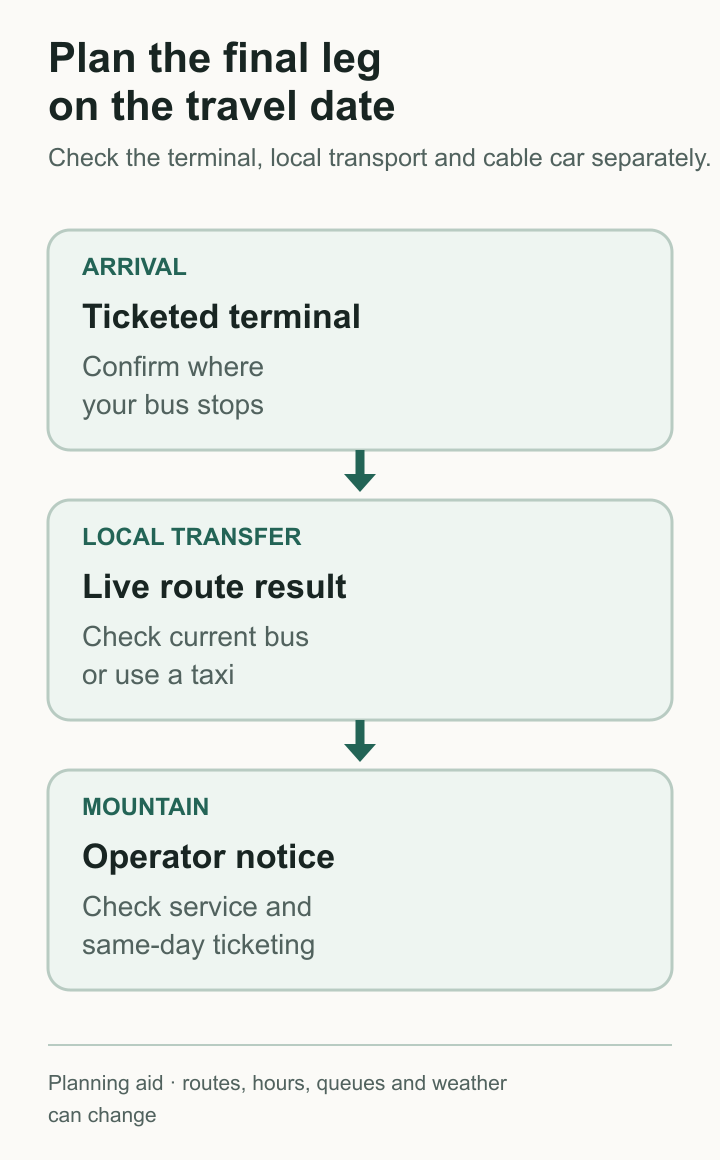
Inside the park, the Seoraksan Cable Car (설악산 케이블카) up to Gwongeumseong is the headline choice. The operator says there is no one-way ticket, tickets are issued on site, and the service is weather-dependent; check the live notice before setting out. Confirm the current fare on the operator page because it can change.
The operator and current travel reference describe the ride as about 5 minutes one way and 10 minutes round trip. Operating hours and queues are weather- and demand-dependent, so use the same-day notice rather than relying on a fixed 8:30–17:30 window.
Booking the round trip is the essential item for a foliage weekend. Check current seats and cancellation rules on the relevant operator booking screen (for example, Kobus or the Express Bus T-money app), and confirm the last local connection from the park before beginning a late hike.
What three completed trips add
Angie Magazine’s record of seven car-free Sokcho stays supports using the town side as a practical base for markets and daily needs. The Girl with a Big Bag’s repeated Seoul–Sokcho bus trips support checking the exact arrival terminal and the onward Seoraksan leg as separate decisions. A completed r/koreatravel report that combined Sokcho with an Ulsanbawi hike supports giving the mountain its own time block instead of treating it as a quick add-on after arrival. Together, these accounts show that a car-free trip is workable, but they do not establish a current timetable, traffic delay, or guaranteed transfer.
How to decide
- If Seoraksan is the center of the trip, take the bus to the express terminal, or if you drive, plan to reach the parking lot early in the morning.
- If Sokcho’s town and beach are the point, take the intercity bus from Dong Seoul and arrive at the town-side terminal.
- For foliage weekends, book both directions as a round trip before your date gets close, and verify the local-bus route and last departure on the travel date.
Scope and sources
Times and fares in this guide reflect data checked in September 2026; for actual departures, seats left, and whether a service runs, the booking screen and the operator’s own notices come first.
- Sokcho Mulhoe (속초항아리물회), the complete guide to getting from Seoul to Sokcho: https://mulhoe.co.kr/stories/seoul-to-sokcho/
- bustrain, Dong Seoul to Sokcho Express Bus Terminal timetable: https://bustrain.kr/expressbus/6
- HeySeorak, Seoul to Sokcho Bus 2026: https://heyseorak.com/blog/seoul-to-sokcho-bus-2026
- Angie Magazine, Sokcho Without a Car: https://angiemagazine.com/sokcho-guesthouses-without-a-car/
- Yums Itchy Feet, How to Get from Seoul to Sokcho by Bus: https://yumsitchyfeet.com/how-to-get-to-sokcho-from-seoul/
- kgosu, Seoraksan Cable Car and parking guide: https://www.kgosu.com/2026/05/2026_0762635579.html
- Korea Travel List, Seoraksan National Park: https://koreatravellist.com/ko/places/seoraksan-national-park
- Jjagjyeon (딱주연), Sokcho Seoraksan cable car fares, booking, and parking: https://bobjyeon.tistory.com/788
- Korea Tourism Organization VisitKorea, Seoraksan Cable Car: https://english.visitkorea.or.kr/svc/whereToGo/locIntrdn/rgnContentsView.do?vcontsId=97439
- The Girl with a Big Bag, Seoul to Sokcho Seoraksan Bus Guide: https://thegirlwithabigbag.com/seoul-to-sokcho-seoraksan-bus-guide/
- r/koreatravel trip report, Sokcho and Ulsanbawi: https://www.reddit.com/r/koreatravel/comments/1ne31sj/
- Sandogam, Seoraksan guide: https://sandogam.com/m/seoraksan/
- Seoraksan Cable Car official operator: https://www.sorakcablecar.co.kr/
- Korea National Park Service, Seoraksan visitor information: https://seorak.knps.or.kr/front/portal/visit/visitCourseMain.do?menuNo=7020093&parkId=120400
Put these notes into a Seoul 2-day itinerary →
Sources & verification
A source-based guide. Check the linked operator information again before you travel.
- Sokcho Mulhoe (속초항아리물회), the complete guide to getting from Seoul to SokchoSources checked:
- bustrain, Dong Seoul to Sokcho Express Bus Terminal timetableSources checked:
- HeySeorak, Seoul to Sokcho Bus 2026Sources checked:
- Angie Magazine, Sokcho Without a CarSources checked:
- Yums Itchy Feet, How to Get from Seoul to Sokcho by BusSources checked:
- kgosu, Seoraksan Cable Car and parking guideSources checked:
- Korea Travel List, Seoraksan National ParkSources checked:
- Jjagjyeon (딱주연), Sokcho Seoraksan cable car fares, booking, and parkingSources checked:
- Korea Tourism Organization VisitKorea, Seoraksan Cable CarSources checked:
- The Girl with a Big Bag, Seoul to Sokcho Seoraksan Bus GuideSources checked:
- Sandogam, Seoraksan guideSources checked:
- Seoraksan Cable Car official operatorSources checked:
- Korea National Park Service, Seoraksan visitor informationSources checked:
- Angie Magazine, seven car-free Sokcho staysSources checked:
- The Girl with a Big Bag, completed Seoul-Sokcho bus tripsSources checked:
- r/koreatravel trip report, Sokcho and UlsanbawiSources checked:
Images are examples to aid understanding.
Help us keep this note useful
A quick response helps us decide what to clarify or recheck. No account or email is needed.