“I want to do an autumn trip near Seoul, but I don’t have a car. Is there an autumn spot I can reach by subway? And hiking feels like a lot—is there a route I can walk gently?” If that’s you, the answer is the Bukhansan Dulle-gil (the Bukhansan Ring Trail). This trail lets you savor the autumn leaves at the foot of the mountain without climbing to the summit, and it connects directly—by bus or on foot—to Gupabal and Bulgwang Stations on Line 3 and to Bukhansan Ui Station on the Ui LRT. As the quintessential suburban autumn trail reachable from within Seoul, it has no admission fee, and you can walk as much of a section as you like and turn back, making it perfect as an introduction to day-trip autumn walking. Here we lay out the difficulty and time required for each section, plus the foliage peak timing.
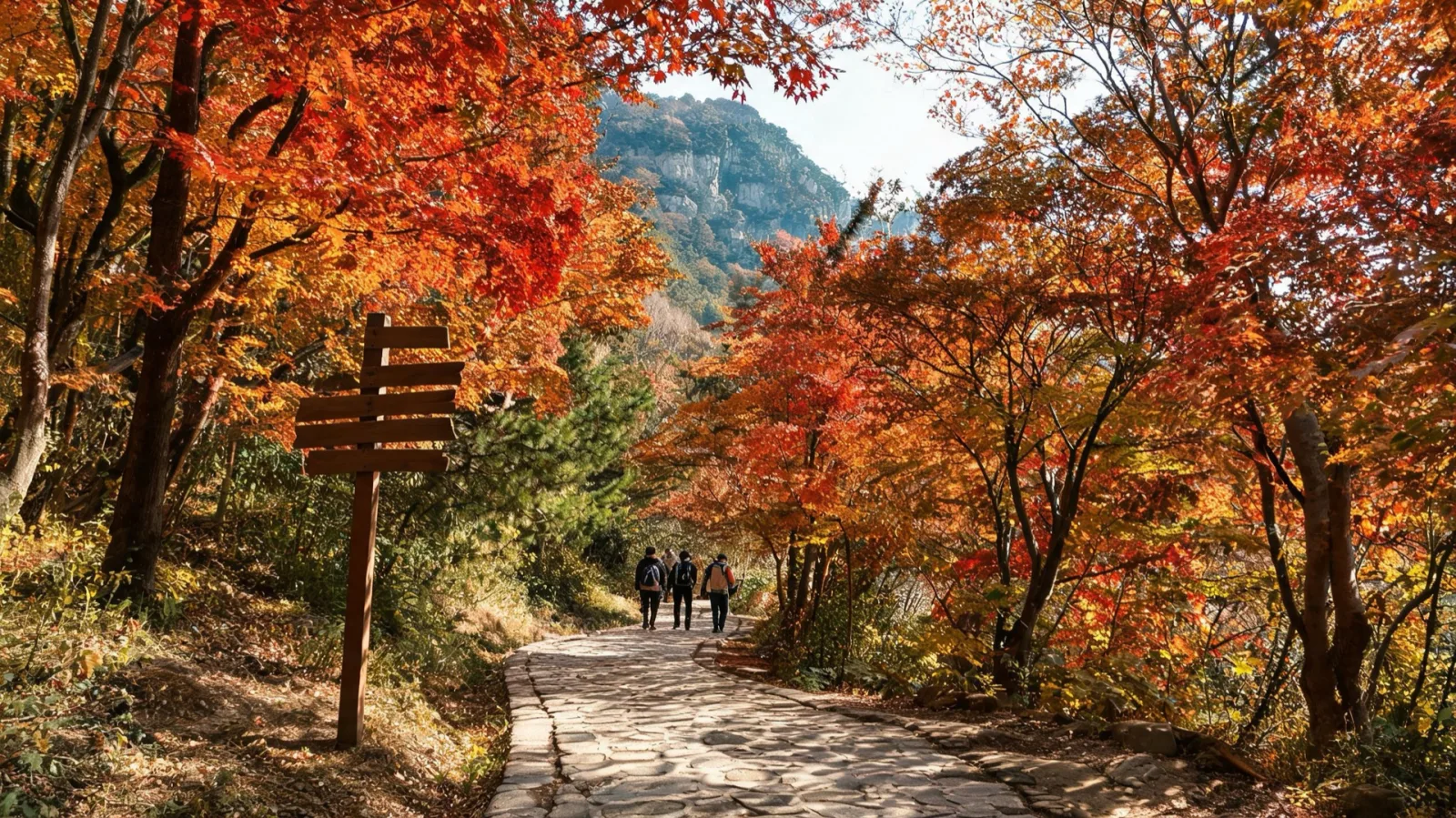
Why the Bukhansan Dulle-gil Is an Autumn Spot You Can Reach by Subway
The Bukhansan Dulle-gil is not a hiking trail that burrows into the mountain; it’s a 21-section, roughly 70 km network of walking paths that links villages and forests along the foothills of Bukhansan National Park. Unlike hiking with long stair climbs, it alternates gentle uphill stretches with flat ground, and each section begins and ends near a subway station or bus stop, so you can pick just the section you want and walk it.
During foliage season, the roadside maples, oak forests, and ginkgo trees turn color in tiers, and from mid-trail viewpoints you can see the Seoul city skyline together with the autumn leaves. If you add gates such as the Daeseomun and Daenammun of Bukhansanseong Fortress to your route, you can combine a historical walk in one go. The fact that national park admission is free is another reason it draws crowds as a day-hiking autumn route from Seoul.
Essential Information for Bukhansan Autumn Foliage
| Item | Details |
|---|---|
| Foliage season | In an average year, first color mid-October, peak late October–early November (varies a lot each year; in 2025 the peak was November 4 — check the Korea Forest Service foliage forecast map before you set out) |
| Admission | Free (no fee for national park trails) |
| Hours | Open at all times (for safety, do not hike before sunrise or after sunset) |
| Reservations | No reservation system (special mountain zones such as Insubong for rock climbing are separately controlled) |
| Parking | Extremely congested on foliage-season weekends — subway and bus are recommended |
⚠️ Access to Baegundae and Bibong may be restricted in bad weather. Check fees and closure information before your visit on the official websites of the Korea National Park Service and the Korea Forest Service foliage forecast map.
Recommended Sections of the Bukhansan Dulle-gil — Difficulty and Time Table
| Section | Distance | Difficulty | Time | Features |
|---|---|---|---|---|
| Section 9, “Masil-gil” (Jingwansa Eco Bridge–Bangpae Training Unit) | 1.5 km | Easy | About 40 min–1 hr | Recommended for beginners and children |
| Sections 9+10 linked (includes “Naesimyo-yeok-gil”) | 5.8 km | Easy–Moderate | About 2 hr 30 min | Good for a half-day walk |
| Section 11, “Hyoja-gil” | 3.3 km | Easy–Moderate | About 1 hr | Short but dense forest path |
| Section 8, “Gureum Jeongwon-gil” (Bulgwang Station access) | Linked sections | Easy | 1–2 hr | Starts a 10-minute walk from Bukhansan Ecological Park |
| Bukhansanseong beginner route (Visitor Support Center–Daeseomun–Daenammun round trip) | 5.2 km | Moderate | 2–3 hr | Gates and foliage together |
| Baegundae (836.5 m) round trip (from Gupabal side) | 3.4 km one way | Moderate–Hard | 4–6 hr | For summit challengers; take care on the ridge just before the top |
Bukhansan Autumn Routes — Morning / Afternoon / Evening
Morning (09:00–12:00): Dulle-gil Sections 9 + 10. From Exit 1 or 2 of Gupabal Station on Line 3, take bus No. 704 or Yangju 37 to the Bukhansanseong entrance, then walk about 10 minutes to the Visitor Support Center. Section 9, “Masil-gil,” which starts at the Jingwansa Eco Bridge, is a gentle 1.5 km, and continuing on to Section 10, “Naesimyo-yeok-gil,” completes a 5.8 km, roughly 2 hr 30 min half-day route.
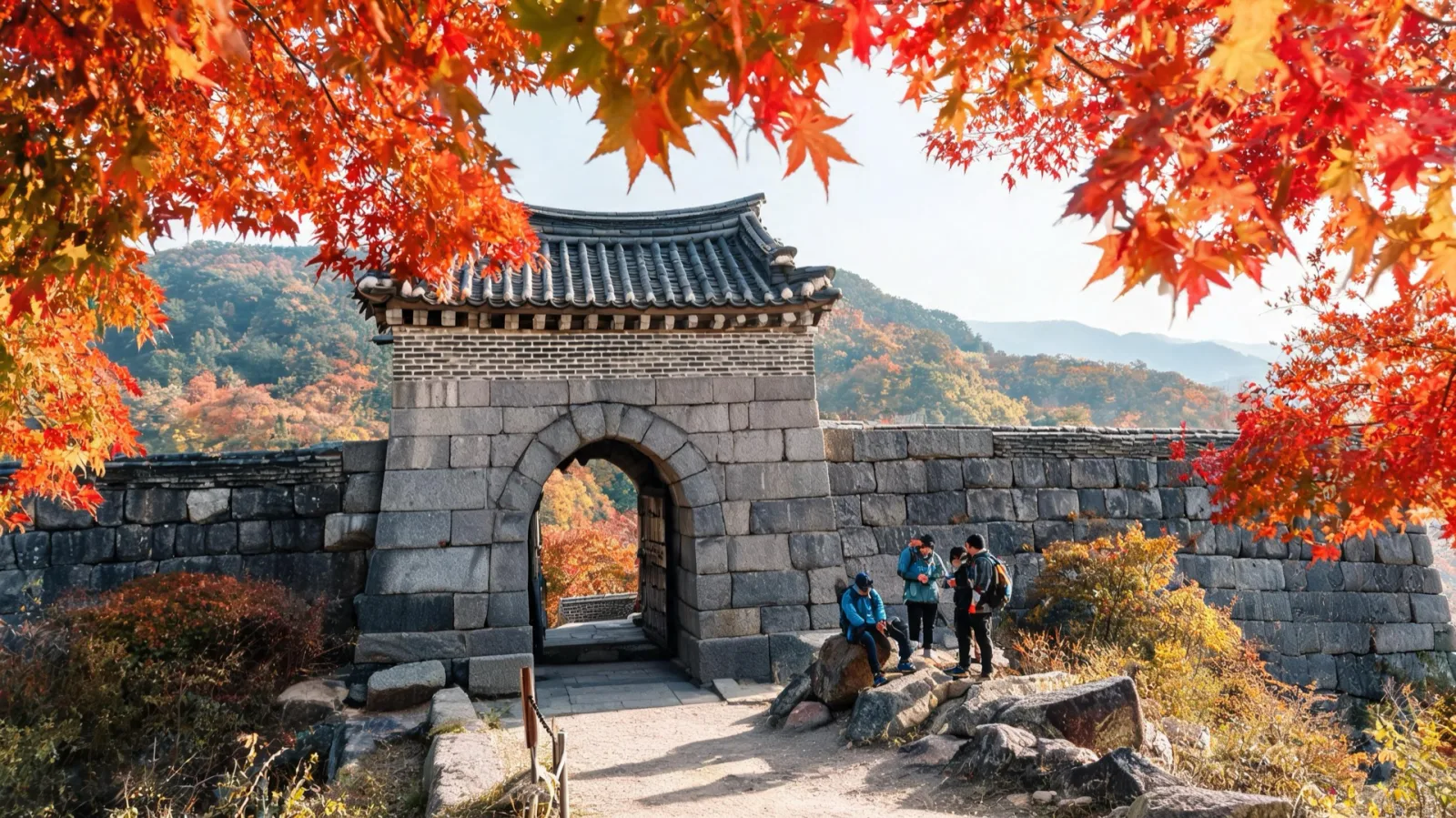
Afternoon (12:00–15:30): Lunch + Section 11 or a walk to the Bukhansanseong gates. After lunch, depending on your energy, walk more of Section 11, “Hyoja-gil” (3.3 km, about 1 hour), or take the 5.2 km beginner route from the Visitor Support Center to Daeseomun and Daenammun to see the foliage around the gates. If you’re confident in your hiking, choose the Baegundae round trip (4–6 hours). However, the ridge just before Baegundae has zones where approaching the cliffs is prohibited, so don’t overdo it.
Evening (15:30–18:00): Descend + Yeonsinnae and Bulgwang commercial areas. Walk out from the trail’s endpoint toward Bulgwang Station and finish with warm gukbap (rice soup) and sanchae jeongsik (mountain-vegetable set meal) at the Yeonsinnae alley market or the shops near Gupabal Station.
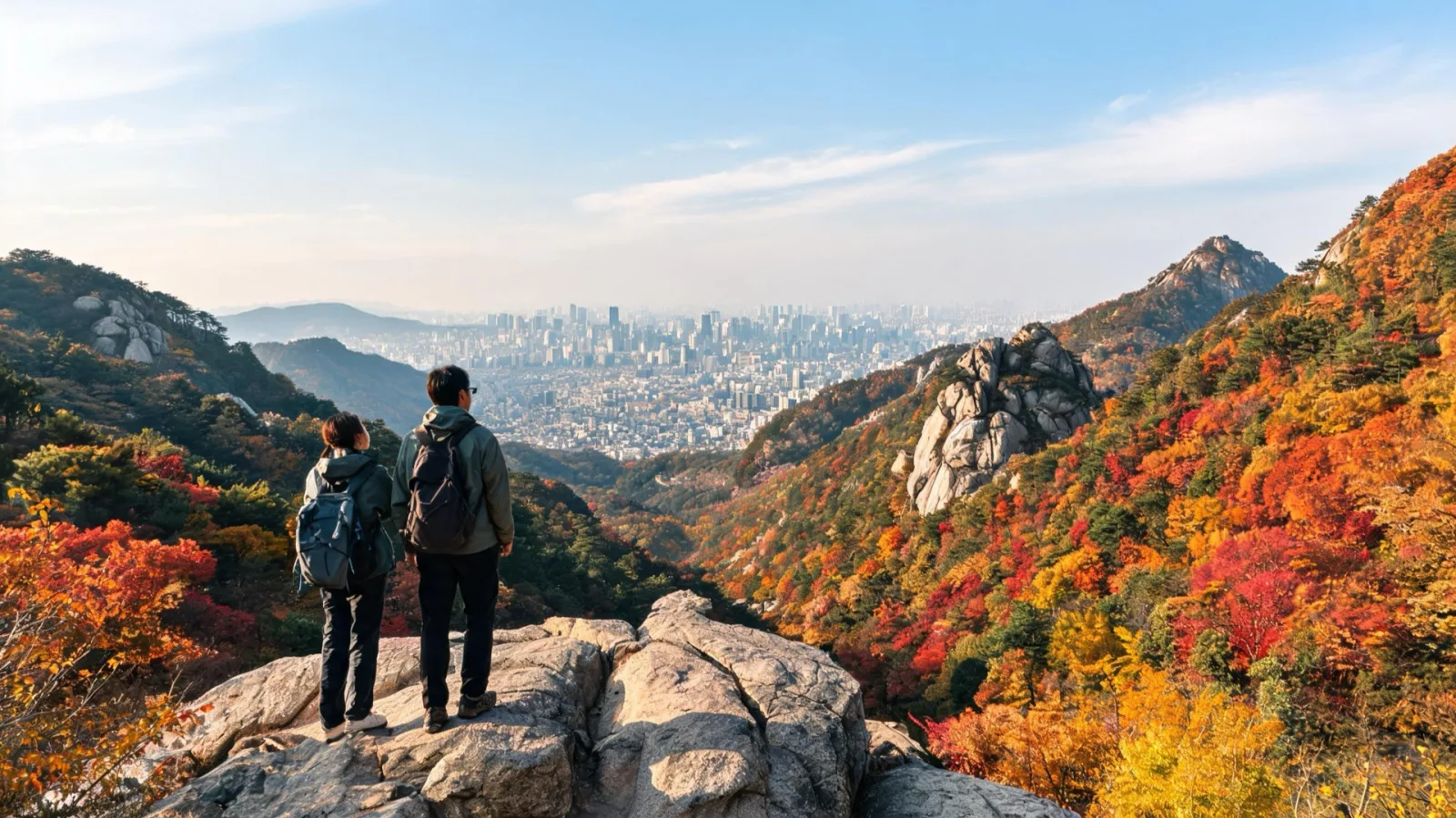
If you would like some history with the fortress walk, join the guided Bukhansanseong royal procession path tour on MyRealTrip at 15,000 KRW. It covers the same afternoon route described here, from the visitor centre through Daeseomun toward Daenammun, and it is the only Bukhansan guiding product on the platform; the 15,000 KRW is a guide fee on top of a park that charges no admission, so it adds to the day rather than replacing it. Nothing else is included, so bring your own lunch, snacks and water, and drivers still pay for parking. You make your own way to the Bukhansanseong entrance, by bus 704 or Yangju 37 from Gupabal Station as described above, and the commentary is in Korean, so treat it as a walk with local context rather than an English-language tour. The booking page is in Korean.
Restaurants and Cafés Near the Bukhansan Dulle-gil
- Gupabal Station–Solbat Park area — A cluster of shops at the entrance offering gukbap and sanchae jeongsik; good for meals before and after hiking.
- Ui-dong entrance — Densely packed with cafés and eateries, convenient to visit after walking the Baegundae route.
- Around Yeonsinnae and Bulgwang Station — Plenty of traditional tea houses, snack shops, and cafés in the Yeonsinnae alley market, popular as a finale to a Dulle-gil walk.
Getting to the Bukhansan Dulle-gil (Including Tips for International Travelers)
Subway (the key access):
-
Gupabal Station, Line 3, Exit 1 or 2 → bus No. 704 or Yangju 37 → Bukhansanseong entrance, then about a 10-minute walk to the Visitor Support Center
-
Bukhansan Ui Station, Ui LRT — Access to the Baegundae route (Ui-dong entrance); about a 40-minute walk from the station to the Visitor Support Center
-
Bulgwang Station, Line 3 — A 10-minute walk to Bukhansan Ecological Park, convenient for starting Section 8, “Gureum Jeongwon-gil”
-
Several Dulle-gil sections can also be reached from Bulgwang Station and Hwagyesa Station on Line 4.
From central Seoul (Jongno, Myeongdong), Line 3 reaches Gupabal Station in about 25–35 minutes—remarkable access for an autumn trip near Seoul.
Tips for international travelers: ① Search your map app for the section number, like “Bukhansan Dulle-gil Section 9,” and the starting point comes right up. ② For English guides, refer to the Seoul trekking site and hiking guide sites for international visitors. ③ There are few snack bars inside the national park, so prepare water and snacks in advance. ④ Beginners should stick to the Daeseomun–Daenammun section and skip the cliff routes (Bibong, Insubong). ⑤ From December to February, icy sections may be closed.
Tips and Precautions for a Bukhansan Autumn Outing
- The foliage timing varies greatly. In an average year the peak is late October–early November, but in some years it shifts into the first week of November depending on temperatures. Check the Korea Forest Service foliage forecast map before you set out.
- It’s easier to give up on weekend parking. Public transport is practically the correct answer—make the most of the advantage of an autumn outing reachable by subway.
- A per-section stamp “passport” event is in operation, so pick one up at the starting-point information center and collect stamps as you walk for extra fun.
- Allow extra time for the summit route (Baegundae). If your descent runs late it gets dark and safety is at risk.
- Take your trash home — that’s basic national park etiquette.
Frequently Asked Questions (FAQ) About a Bukhansan Dulle-gil Autumn Trip
Q1. When is Bukhansan’s foliage peak? In an average year, late October–early November. It varies a lot year to year, and in 2025 the peak came on November 4, so be sure to check the Korea Forest Service foliage forecast map before visiting.
Q2. Does the Bukhansan Dulle-gil require admission or reservations? Admission is free and it’s not reservation-based. However, rock-climbing zones in special mountain areas such as Insubong are separately controlled.
Q3. What’s the best station for an autumn outing reachable by subway? The representative ones are Gupabal Station on Line 3 (connecting to bus No. 704 or Yangju 37), Bukhansan Ui Station on the Ui LRT (Baegundae route), and Bulgwang Station on Line 3 (Section 8).
Q4. Which Dulle-gil section do you recommend for beginners? Section 9, “Masil-gil,” at 1.5 km, is the easiest, and Sections 9+10 linked (5.8 km, about 2 hr 30 min) is well suited to a half-day walk.
Q5. Can I go with children? Low-difficulty sections such as Sections 9 and 11 are suitable for walking with children. The Baegundae summit route is recommended for adults at intermediate level or above.
Final Checklist Before You Set Out
- Check this week’s foliage status on the Korea Forest Service foliage forecast map
- Choose your target section (Section 9 / Sections 9+10 / Section 11 / Bukhansanseong / Baegundae)
- Save your subway and bus routes (Gupabal Station bus 704 or Yangju 37 / Bulgwang Station)
- Prepare water, snacks, and non-slip sneakers (few snack bars)
- Check sunset time and plan your descent
- If it’s a weekend, commit to public transport instead of parking
An autumn outing reachable by subway—the Bukhansan Dulle-gil is the answer. It’s a route where you can fully take in the romance of an autumn trip near Seoul without any mountain climbing. This autumn, start your Dulle-gil walk from the subway station nearest you.
Sources & verification
A source-based guide. Check the linked operator information again before you travel.
- Bukhansan National Park — Korea National Park ServiceSources checked:
- Bukhansan National Park — Bukhansanseong route service guideSources checked:
- Bukhansan National Park Trail Difficulty by Course — Korea National Park ServiceSources checked:
- Korea Forest Service — Official SiteSources checked:
Images are illustrative examples to aid understanding, not photographs of the actual facilities.
Continue planning
Seoul to Gangneung: KTX or car — when to take which
KTX or car to Gangneung? If the plan stays near the station, Gyeongpo and Anmok, take the KTX-Eum; for Jumunjin, Jeongdongjin or heavy luggage, drive.
How to Get from Seoul to Sokcho and Seoraksan: Bus vs. Car vs. Train
No direct train reaches Sokcho: compare bus terminals and travel times, driving on the Seoul–Yangyang Expressway, the Seoraksan connection, and when to book.
Seoul Winter Itinerary: From Namsan Tower's Night View to the Cheonggyecheon Christmas Light Festival
A Seoul winter night route: the Namsan Tower view, the Cheonggyecheon lantern festival and the Gwanghwamun Christmas market, plus clothing and transport tips.
Help us keep this note useful
A quick response helps us decide what to clarify or recheck. No account or email is needed.