
Give yourself one free autumn day in Seoul and the saved places on your map line up quickly. Gyeongbokgung under the turning trees, the Bukchon lane where tiled roofs step down the hill, a café in Samcheong-dong. Push a little further and you start wanting a Bukchon sunset and a palace after dark as well. Autumn always seems to look best as the sun gets low.
Between late October and early November, though, three clocks run in this part of town. Gyeongbokgung stops letting people in at 5 pm in October and at 4 pm from November. The Bukchon lane everyone photographs closes to visitors at 5 pm. The sun sets around 5:30. By the time the light is at its best, that lane is already shut.
So this is the order I would suggest. Go into Gyeongbokgung at 9 am and give it about two hours, walk up into Bukchon’s lanes from the Anguk side around 11:30, then come down on the Samcheong-dong side. Lunch comes after that. Save the end of the day for Samcheong-dong-gil, outside the restricted zone, where ginkgo trees line the palace’s stone wall. If your dates are flexible, aim for 30 October to 6 November and avoid Tuesday 3 November, when the palace is closed. Here is why, one clock at a time.
From 29 October to 15 November, Gyeongbokgung is free
Start with the date. During the Korea Grand Festival, from Thursday 29 October to Sunday 15 November 2026, the Royal Palaces and Tombs Center opens Gyeongbokgung free of charge, except on its Tuesday closing days. Royal Palaces and Tombs Center notice Changdeokgung, Changgyeonggung, Deoksugung, Jongmyo and the royal tombs are free over the same dates too; only the special Huwon (Secret Garden) tour at Changdeokgung is left out. Normally a foreign adult aged 19–64 pays 3,000 won for Gyeongbokgung, so that is what each of you saves. The real reason to care about the dates is something else.
The opening hours change right in the middle of this period. In October the palace is open 09:00–18:00 with last entry at 17:00; in November it is 09:00–17:00 with last entry at 16:00. That makes 29–31 October the only three days that are both free and on the October timetable. From 1 November the entry is just as free, but you get an hour less inside. The regular guided tours are also shortened by 30 minutes during the festival.
The trees turn in that same window. In its forecast of 22 September, the Korea Forest Service put the nationwide ginkgo peak (the point when half the leaves have turned) at 30 October and maples at 31 October. Korea Forest Service A citizen reporter for Seoul Media Hub wrote in November 2025 that colour in central Seoul deepens from the end of October, looks best in early November and lasts into the middle of the month. Seoul Media Hub, November 2025 Too early is a real risk. PiPi, who flew in from Taipei for a 29 October to 3 November 2024 trip, wrote on the Taiwanese forum Dcard that Seoul’s leaves had not fully turned by the end of October. PiPi on Dcard
So I would aim for 30 October to 6 November. The start of that range overlaps the ginkgo forecast and the October hours; the end is when central Seoul’s colour is at its deepest. Tuesday 3 November is out, because Gyeongbokgung closes on Tuesdays. If your free day is a Tuesday, switch to the Changdeokgung version further down. To compare timing elsewhere in Korea, see the Korea autumn foliage guide.
One note if you were planning to wear hanbok. Hanbok wearers normally get in free, but during the festival everyone does. Whether to rent one, and what counts as hanbok at the gate, is a separate decision: see the Gyeongbokgung hanbok guide. If you do rent, Hanboknam’s branch a minute’s walk from Gyeongbokgung Station takes bookings on Klook. On 23 October its rentals started at 8,100 won, the last return was 18:30, and the time spent choosing a hanbok and having your hair done does not count toward the rental period.
Gyeongbokgung: in at opening, two hours inside
Be at the gate for the 9 am opening. It is a two-minute walk from exit 5 of Gyeongbokgung Station on Subway Line 3. Directions PiPi had a two-hour hanbok rental, went into every section taking photos, and reached Geoncheonggung at the very back of the palace. By the time PiPi got back out it was nearly two hours and time to rush the hanbok back. Even without a rental clock, allow two hours. That is what it takes to reach the back of the grounds and return.
Until 31 October you cannot step onto the raised stone platform (woldae) of Geunjeongjeon, the throne hall. The palace closed it because peak-season crowds risk damaging the stone balustrades. Look at the hall from the front and keep going.
The reason not to leave the palace for the afternoon is November’s early last entry. Paolo of The Wknd Travel wrote about a November 2024 trip with friends: they booked the 2:30 pm English tour of Changdeokgung’s Secret Garden and explored Bukchon while waiting. They also tried to visit Gyeongbokgung, but got there after it had closed. The Wknd Travel If anything in your afternoon has a fixed time, Gyeongbokgung has to come before it. Even if nothing does, two hours in the morning make the rest of the day easier.
If you were hoping for Gyeongbokgung at night, check your plans. The 2026 autumn night opening ran from 2 September to 2 October, with 3,000 tickets a day sold online through NOL Ticket and 300 a day sold on site to foreign visitors only. Night opening notice As of 7 October, the palace’s notice board lists no later night session. Do not build the day around night-ticket advice from older posts.
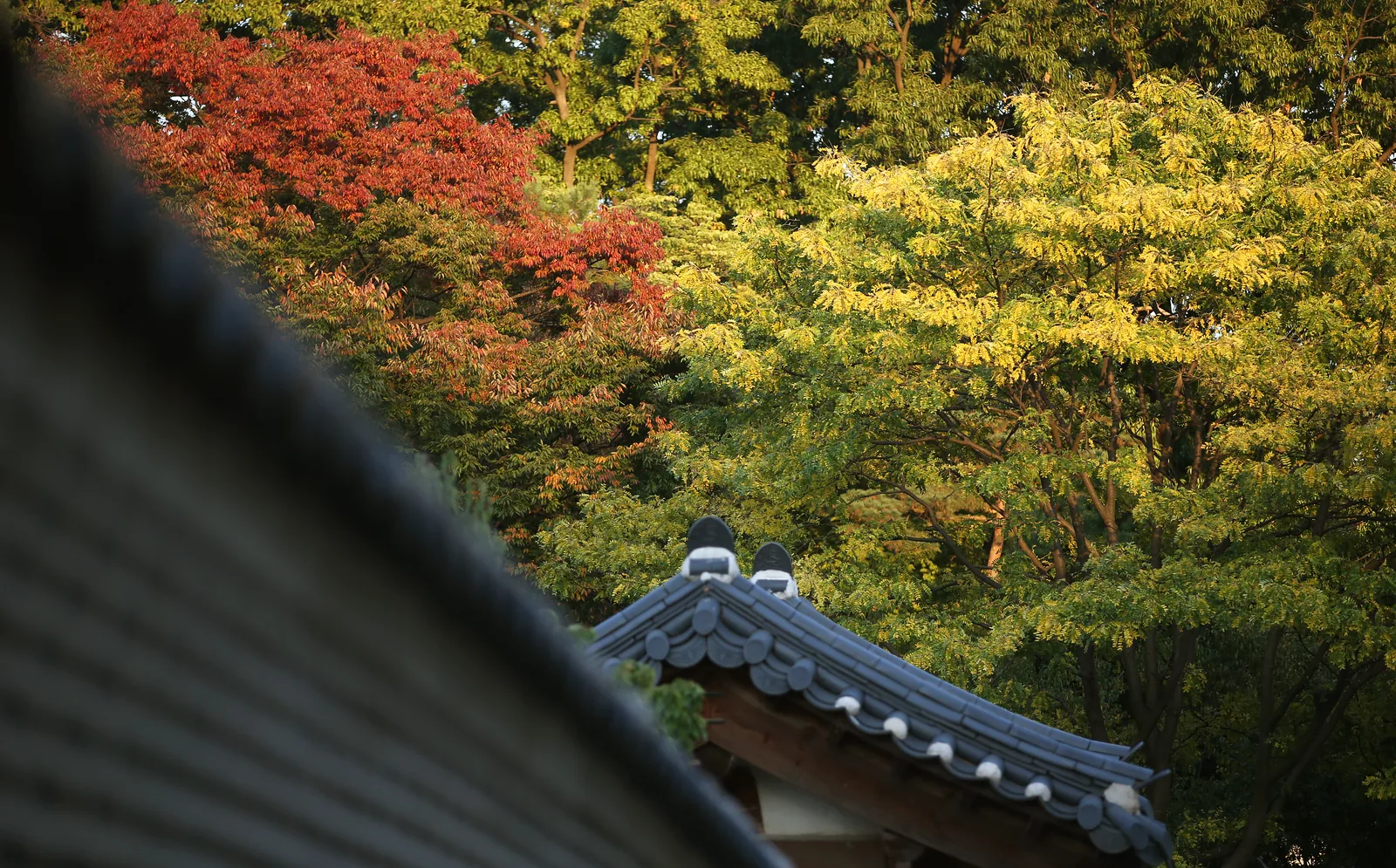

Bukchon: not at 10 sharp, at 11:30
Not all of Bukchon has visiting hours. The restriction covers the “red zone” around Bukchon-ro 11-gil, about 34,000 square meters. Tourists may not enter it from 5 pm to 10 am the next morning, and since 1 March 2025 the fine for doing so is 100,000 won. Seoul Metropolitan Government The city’s Korean notice gives the visiting hours as 10:00–17:00. A Seoul Media Hub article describes the red zone as part of Samcheong-dong and Gahoe-dong behind Jeongdok Library, the hanok streets with Namsan in the distance where crowds take their photos. Seoul Media Hub In other words, the sloping lane you see when you search for Bukchon is inside it.
Turn up at 10 and you walk in with everyone else who was waiting for 10. Money Today reported that on 4 November 2024, just after the restriction began, about 180 tourists had gathered at the entrance by 9:50 am and poured into the lane together at 10. Money Today, November 2024 Starting at the palace at 9 keeps you out of that moment without trying.
Work out your margin too. Enter the red zone at 11:30 and you have five and a half hours before the 5 pm cutoff; at 1 pm, four hours; at 3 pm, two. That does not include walking up to the lane or stopping for photos. Go straight up from the palace and you will not be hurrying in the lane, and lunch can wait until you come down.
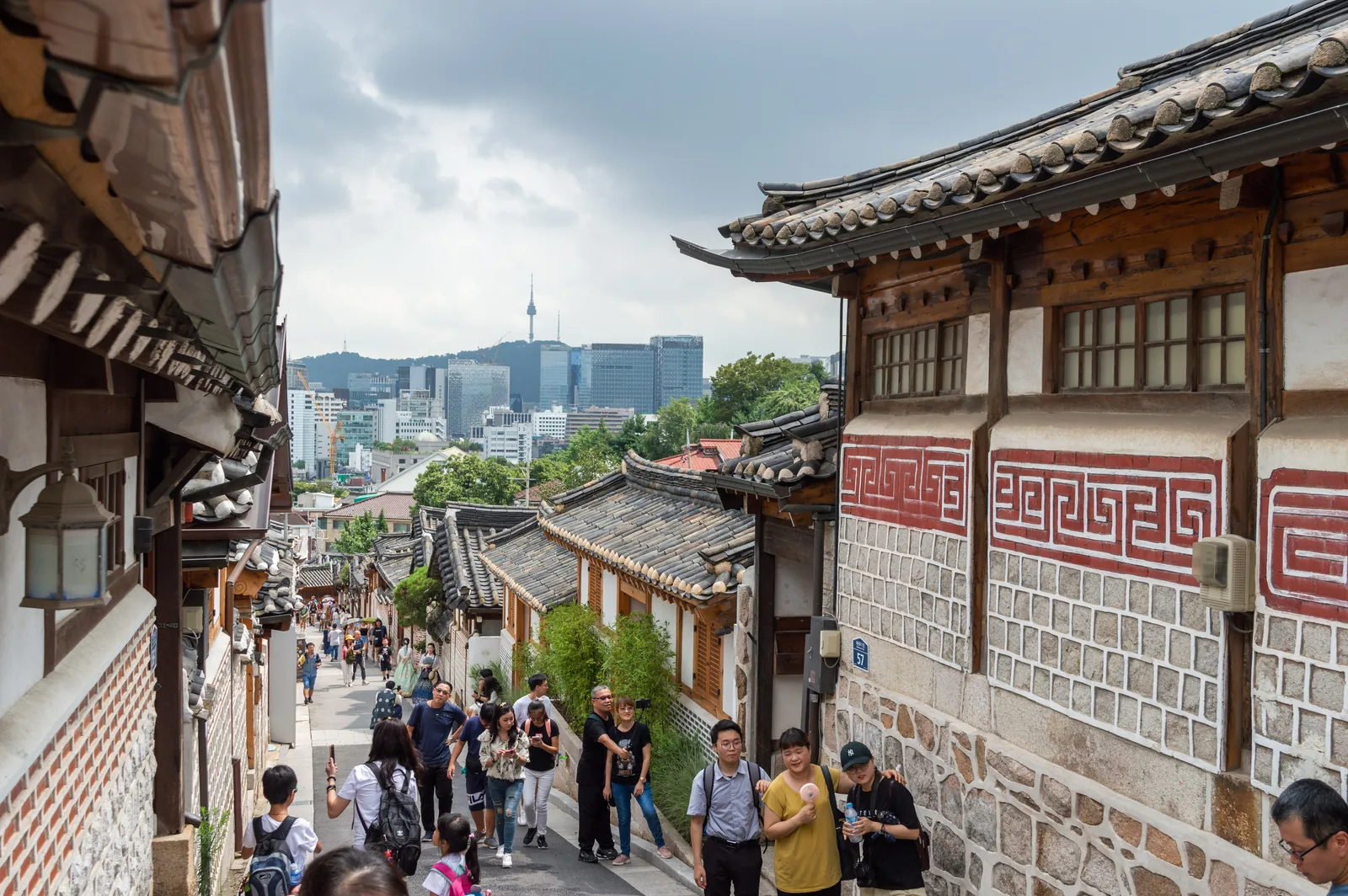

People live in this lane. Of the 166 buildings in the red zone, 123 are detached homes. Visit Seoul asks visitors to keep the noise down, especially around 31 Gahoe-dong, to keep groups to 10 people or fewer, and not to photograph or film the inside of houses even when the doors are open. Visit Seoul Take your photos in the lane and leave the gates and steps clear.
There is one more reason to put lunch later. After the palace, PiPi reached a well-known samgyetang (ginseng chicken soup) restaurant at about 12:40 and stood in a long queue for around half an hour; by the time PiPi left just after 2 pm, there was no queue at all. PiPi’s advice was to come after 1:30 pm. See the lanes first and eat after 1:30, and you miss both the red-zone deadline and the lunch queue.
Up from Anguk, down to Samcheong-dong
Walking out of the palace through Samcheong-dong and up into Bukchon looks like the natural route on a map, but it ends in stone steps and a steep climb. PiPi came up the steps from the Samcheong-dong side to reach Bukchon’s famous slope. According to PiPi, the approach from Anguk Station looked gentler, with visitors in wheelchairs coming up that way, while the Samcheong-dong side felt steeper than 45 degrees, and the way back down was more slopes and stairs.
I would let the gentle side take the climb. From the palace, head toward Anguk Station first; the official directions put exit 1 of Anguk Station six minutes on foot from Gyeongbokgung. Go up into the red zone from the Anguk side, see the lanes, then come down the steps toward Samcheong-dong. The steps are not easy going down either. But you never have to climb the steep side, and the last stop of the day is on the Samcheong-dong side anyway.
If your knees complain, or you have a stroller, drop the Samcheong-dong steps altogether: go up from Anguk and come back down the same way. Leave Seochon, west of the palace, for another day as well. PiPi had planned to walk from Seochon around the palace and up through Samcheong-dong, ran short of time, and took a bus for that stretch instead, reaching only one of the Seochon shops on the list.
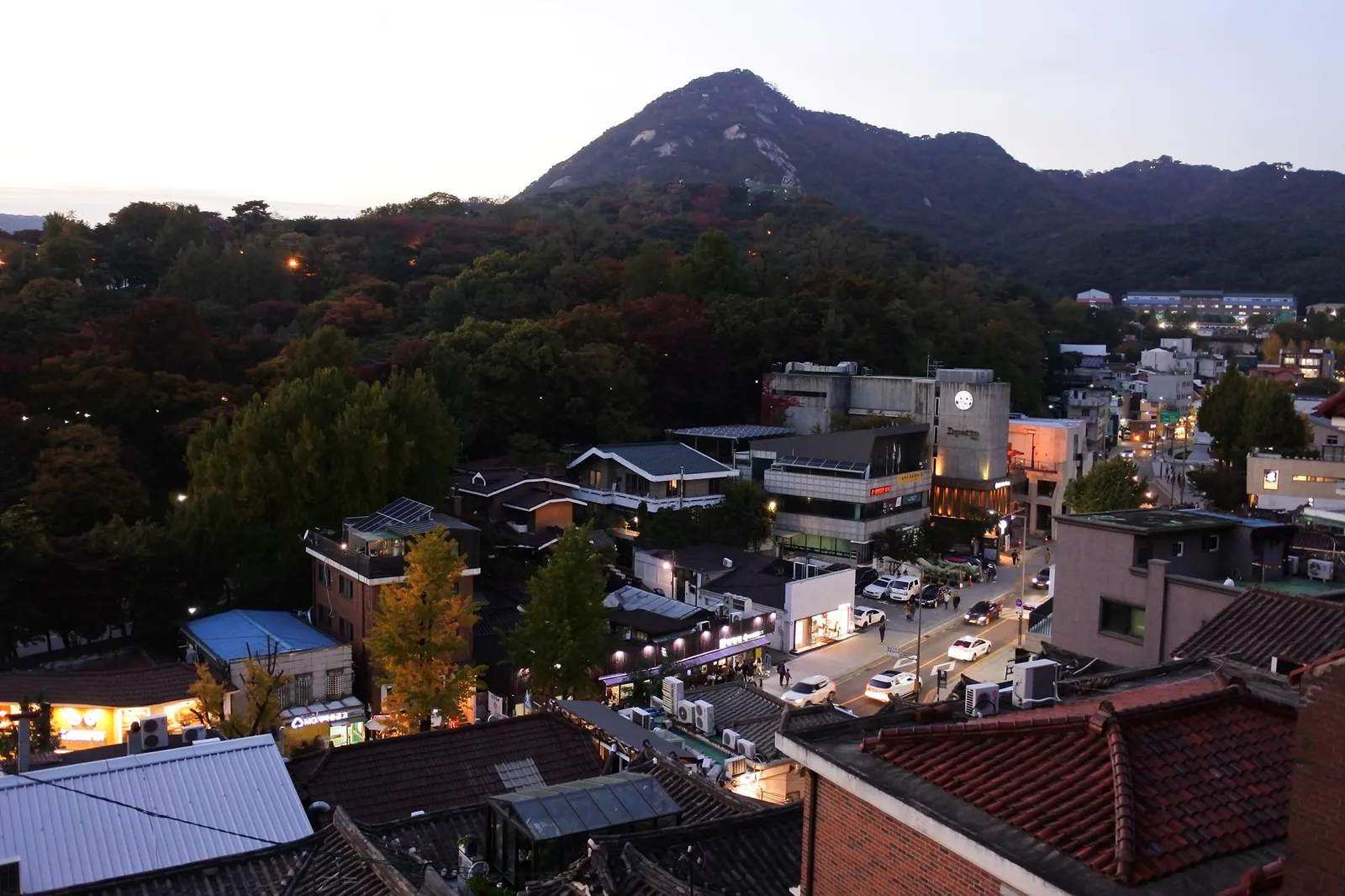

Give the sunset to the palace wall
Between the red zone’s 5 pm closing and sunset there is a little over half an hour. Sunset in Seoul is at 17:36 on 30 October, 17:35 on 31 October, 17:34 on 1 November and 17:29 on 6 November. Korea Astronomy and Space Science Institute The nearest place to spend that last light is Samcheong-dong-gil.
Seoul’s list of autumn foliage streets includes Samcheong-dong-gil, which runs from Dongsipjagak to Samcheong Park. Ginkgo trees turn yellow in front of the National Museum of Modern and Contemporary Art and on every bend of the road. Seoul Media Hub, 2021 A 2023 Seoul Media Hub piece says an autumn walk into Samcheong-dong starts with the ginkgo trees by the palace’s stone wall. Seoul Media Hub, 2023 This street is outside the Bukchon-ro 11-gil red zone, and no visiting hours have been announced for it. You cannot walk the red zone at dusk, so spend the sunset between the palace wall and the ginkgo trees instead.
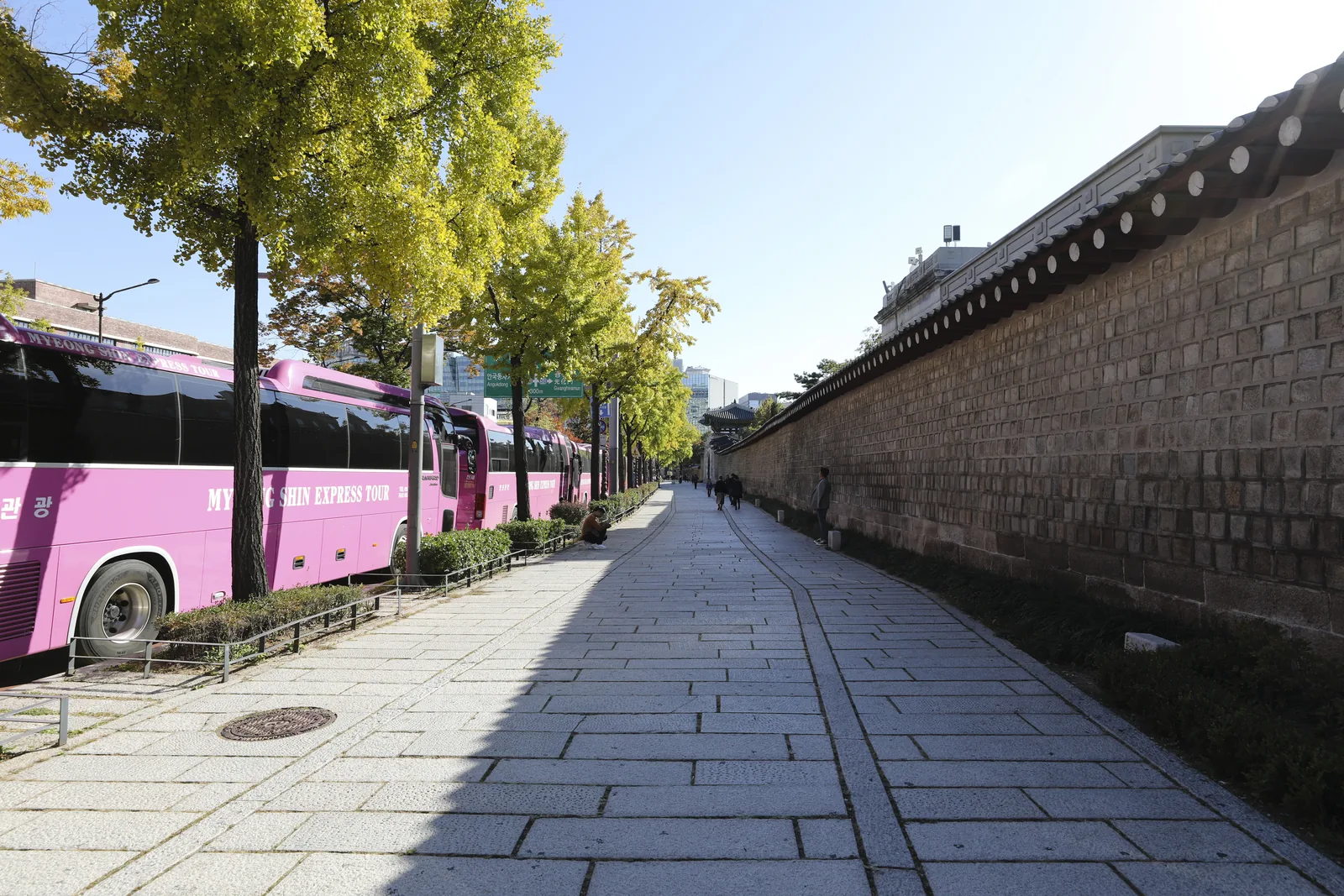

Come down into Samcheong-dong, have a late lunch, spend the afternoon in a café or one of the galleries, then walk slowly along Samcheong-dong-gil toward Dongsipjagak. Once the sun is down, cross toward Anguk or Insadong for dinner. If you want ideas, the Jongno food guide covers the area.
Laid out by the clock, the day looks like this. Treat it as reference points rather than a timetable.
| Time | What to do | Keep in mind |
|---|---|---|
| 09:00 | Gyeongbokgung, all the way to the back | Last entry 17:00 in October, 16:00 in November |
| 11:00 | Walk toward Anguk Station | Anguk exit 1 is 6 minutes from the palace |
| 11:30 | Up into Bukchon-ro 11-gil from the Anguk side | Tourist hours 10:00–17:00 |
| 13:30 | Down the steps to Samcheong-dong, lunch | If the steps are too much, go back the way you came |
| 16:30 | Samcheong-dong-gil, the wall and the ginkgos | Sunset 17:29–17:36 |
| After 17:30 | Dinner around Anguk or Insadong |
For 30 October to 6 November 2026. Hours and sunset times checked on 7 October 2026.
If it is a Tuesday, or you want a palace at night
On a Tuesday, start at Changdeokgung. Gyeongbokgung closes on Tuesdays, but Changdeokgung closes on Mondays. Opening hours It is free during the festival too, apart from the Secret Garden special tour. In November Changdeokgung is open 09:00–17:30, last entry 16:30. Bukchon sits between Gyeongbokgung and Changdeokgung. On a Tuesday, spend the morning at Changdeokgung and cross into Bukchon from there. In 2026, 3 and 10 November are Tuesdays.
For a palace after dark, go to Deoksugung. General admission runs 09:00–21:00 all year, with last entry at 20:00; only the interior tour of Seokjojeon needs booking ahead. It closes on Mondays. Adult admission is 1,000 won, and it is free from 29 October to 15 November. Deoksugung has roof and wall works scheduled from 21 September to 19 November on the south outer wall between Daehanmun and the Ungyo site and on Pyeongseongmun, subject to change, and Pyeongseongmun gate is closed from 25 October. Deoksugung notice Changgyeonggung also keeps general admission open until 21:00, but its evening general viewing is suspended from 10 to 15 November.
A transit card is enough
This day is almost all on foot. One subway ride to Gyeongbokgung Station in the morning and one from Anguk back to your hotel in the evening, and that is it. With a Korean transit card such as T-money, the base fare within 10 km is 1,550 won a ride, so 3,100 won for the two; a single-journey ticket costs 100 won more per ride. Seoul Metro fares A one-day Climate Card pass is 5,000 won, plus 3,000 won for the physical card the first time. For this day on its own, the pass loses. A one-day pass also only lasts until the last train of the day you charge it. Climate Card
If you will ride a lot over the whole trip, do that sum separately. Since 17 March 2026, 440 new vending machines at 273 stations on Lines 1–8 accept international Visa and Mastercard cards for buying a Climate Card and charging short-term passes, with an average fee of about 3.7%. Seoul Metropolitan Government, March 2026 The short-term passes come in 1, 2, 3, 5 and 7 days. The 30-day pass stopped taking top-ups on 31 August 2026. The card does not work on the Sinbundang Line, subway lines outside Seoul, or intercity and airport buses.
Nobody can promise you the exact day the leaves peak. What you can know in advance is how the clocks run. The palace in the morning, the lanes at midday, the sunset on the wall. Split the day that way, and the places on your list stop taking time from each other.
Opening hours, the free-entry period, Bukchon visiting hours and transit fares as checked on 7 October 2026.
Put these notes into a Seoul 2-day itinerary →
Sources & verification
A source-based guide. Check the linked operator information again before you travel.
- Royal Palaces and Tombs Center: Gyeongbokgung operations in October and November 2026Sources checked:
- Royal Palaces and Tombs Center: free admission at all palaces, 29 October to 15 November 2026Sources checked:
- Royal Palaces and Tombs Center: opening hours and closing daysSources checked:
- Royal Palaces and Tombs Center: admission feesSources checked:
- Royal Palaces and Tombs Center: Gyeongbokgung directionsSources checked:
- Royal Palaces and Tombs Center: Gyeongbokgung 2026 autumn night opening (2 September to 2 October)Sources checked:
- Royal Palaces and Tombs Center: Geunjeongjeon platform closed to 31 October 2026Sources checked:
- Royal Palaces and Tombs Center: Deoksugung outer wall works (21 September to 19 November 2026)Sources checked:
- Seoul Metropolitan Government: Bukchon special management area visiting hoursSources checked:
- Seoul Metropolitan Government: Bukchon visiting hours notice (Korean)Sources checked:
- Visit Seoul: Bukchon Hanok VillageSources checked:
- Seoul Media Hub: the Bukchon red zone (citizen reporter, November 2024)Sources checked:
- Money Today: the first mornings of the Bukchon red zone (6 November 2024)Sources checked:
- Korea Forest Service: 2026 foliage peak forecast (22 September 2026)Sources checked:
- Seoul Media Hub: city-centre foliage walk (citizen reporter, 6 November 2025)Sources checked:
- Seoul Media Hub: Seoul foliage streets including Samcheong-dong-gil (19 November 2021)Sources checked:
- Seoul Media Hub: Samcheong-dong in autumn (citizen reporter, 26 October 2023)Sources checked:
- Korea Astronomy and Space Science Institute: Seoul sunrise and sunset, October and November 2026Sources checked:
- Seoul Metropolitan Government: Climate CardSources checked:
- Seoul Metropolitan Government: international cards accepted for Climate Cards (17 March 2026)Sources checked:
- Seoul Metro: faresSources checked:
- PiPi on Dcard: Seoul foliage trip, 29 October to 3 November 2024Sources checked:
- Paolo, The Wknd Travel: Bukchon and Changdeokgung, November 2024 trip (published 3 April 2025)Sources checked:
Help us keep this note useful
A quick response helps us decide what to clarify or recheck. No account or email is needed.