Seoraksan foliage starts, in a typical year, at the Daecheongbong summit in late September and peaks in the Cheonbuldong Valley in mid-October; the Ulsanbawi course keeps going from mid-October into early November on the guidance that reproduces the park service’s own figures. Because this is the earliest foliage in South Korea, the timing is easy to miss, and with a swing of 1–2 weeks every year, the closest thing to a right answer is to put the re-check into the schedule itself: reset the timing with the Korea Meteorological Administration’s foliage forecast and the national park service’s notices one week before departure. For crowds, several guides converge on the same answer — enter before 08:30 on weekends, or go on a weekday morning.
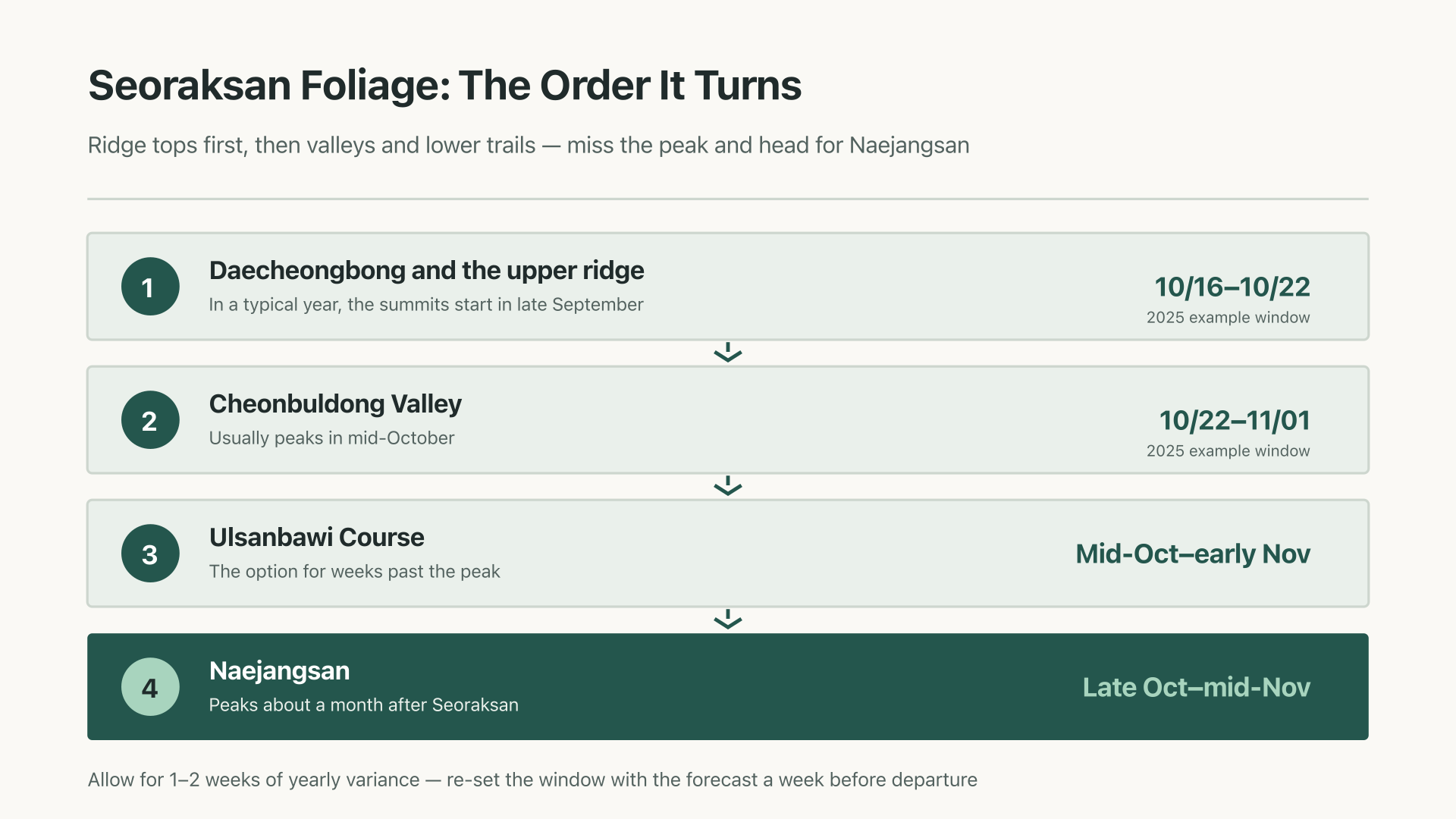
The section-by-section peak calendar: what turns, when
Even on one mountain, the timing splits by altitude. The Sandogam guide lays it out as: color starts at the Daecheongbong summit in late September in a typical year, and the Cheonbuldong Valley peaks in mid-October; a foliage guide reads it as a usual start in early October with the peak falling between mid and late October. Overlap the two and the second through fourth weeks of October come out as the core stretch of Seoraksan foliage; one roundup adds that the color itself carries on from mid-October into early November.
Checked in September 2026, the section-by-section guidance lines up like this. Daecheongbong and the upper ridge: in a typical year, color starts from the Daecheongbong summit in late September, and the 2025 guidance offered the upper ridge 10/1610/22 as an example window. Cheonbuldong Valley: peaks in mid-October in a typical year, with the 2025 guidance listing 10/2211/01. The Ulsanbawi course: mid-October to early November on the guidance reproducing the park service’s figures. Naejangsan: late October to early-to-mid November.
The numbers in the table are a record of years gone by, not a fixed promise — hold on to that first. The 2025 windows — the upper ridge at 10/1610/22 and the valley at 10/2211/01 — are example values, back-calculated from the official rule that the year’s first color was observed on October 2 and that the peak usually arrives 14–20 days after the start; and the perceived peaks at the slope’s start over the past three years also moved every year: October 26, 2022, October 25, 2023, and October 28, 2024. So use the calendar as the planning baseline that says roughly which week a section shows its color, and leave fixing the dates to the forecast right before departure — that is what the premises of these sources add up to.
The official peak season sits on the same stretch. On the camping fee schedule, peak season is set as October 1 through November 15, and it reads as a signal that facility operations treat the same period as the foliage season.
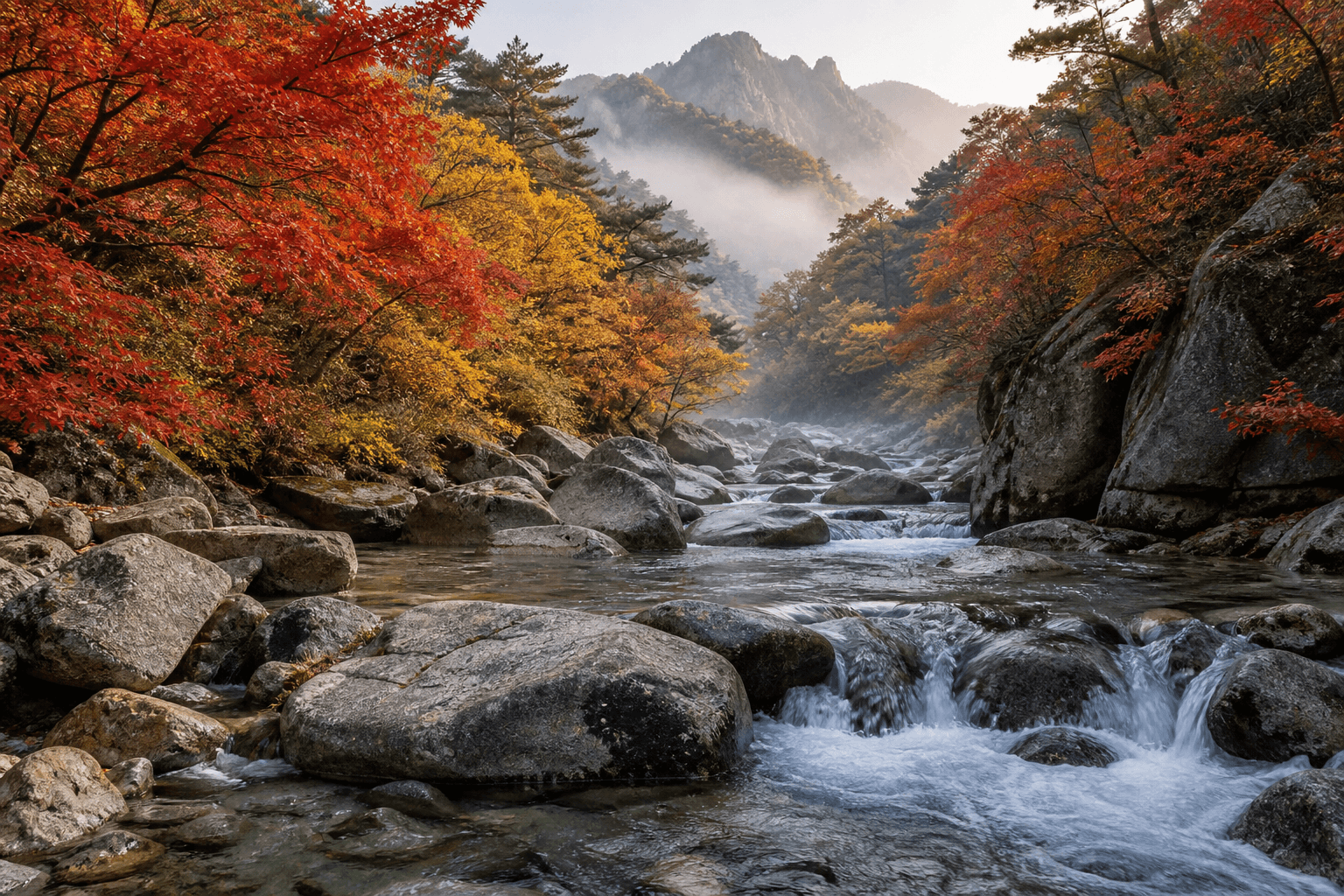
The KMA forecast and park notices: when to look again
Foliage guides set the re-check point with the peak’s drift built in. The representative guidance is to re-check the Korea Meteorological Administration’s foliage forecast and the national park service’s notices one week before departure, since a swing of 1–2 weeks happens every year; and one firsthand record adds that Seoraksan, the first mountain in South Korea to turn, usually peaks somewhere between mid-October and early November — which is also when trail and shelter reservations get most crowded.
Separately from the forecast, some sections should not get their dates locked in advance. Courses heading for Daecheongbong close in the late-autumn fire-control period — November 15 to December 15 on the 2026 guidance — and since those control dates move a little every year, the premise is that the park service website is checked first. In a year when the foliage slides into November, read the notices for any overlap with this period before you lock the itinerary.
What staggered peaks leave you when a week slips
The calendar’s practical hint: the windows are offset from section to section. One record has the ridge turning first in late October with the valley and lower slopes following within a week, and the Ulsanbawi side is guided as best from mid-October to early November, so even if you pass the ridge’s peak week, room remains to switch to the valley and lower courses. Add the roundup that the color carries on from mid-October into early November, and a one-week error does not turn the whole trip into a failure.
Variables that shape what is left after the miss are on record too. After strong gusts or rain, leaf-fall accelerates and the schedule can move up by 2–4 days; and when the timing misses, the choice on offer is to swing toward a foliage destination whose peak runs late October to early-to-mid November, Naejangsan being the example. The same thinking backs the note that Seoraksan and Naejangsan peaks sit about a month apart, so no small number of people visit both in a single year.
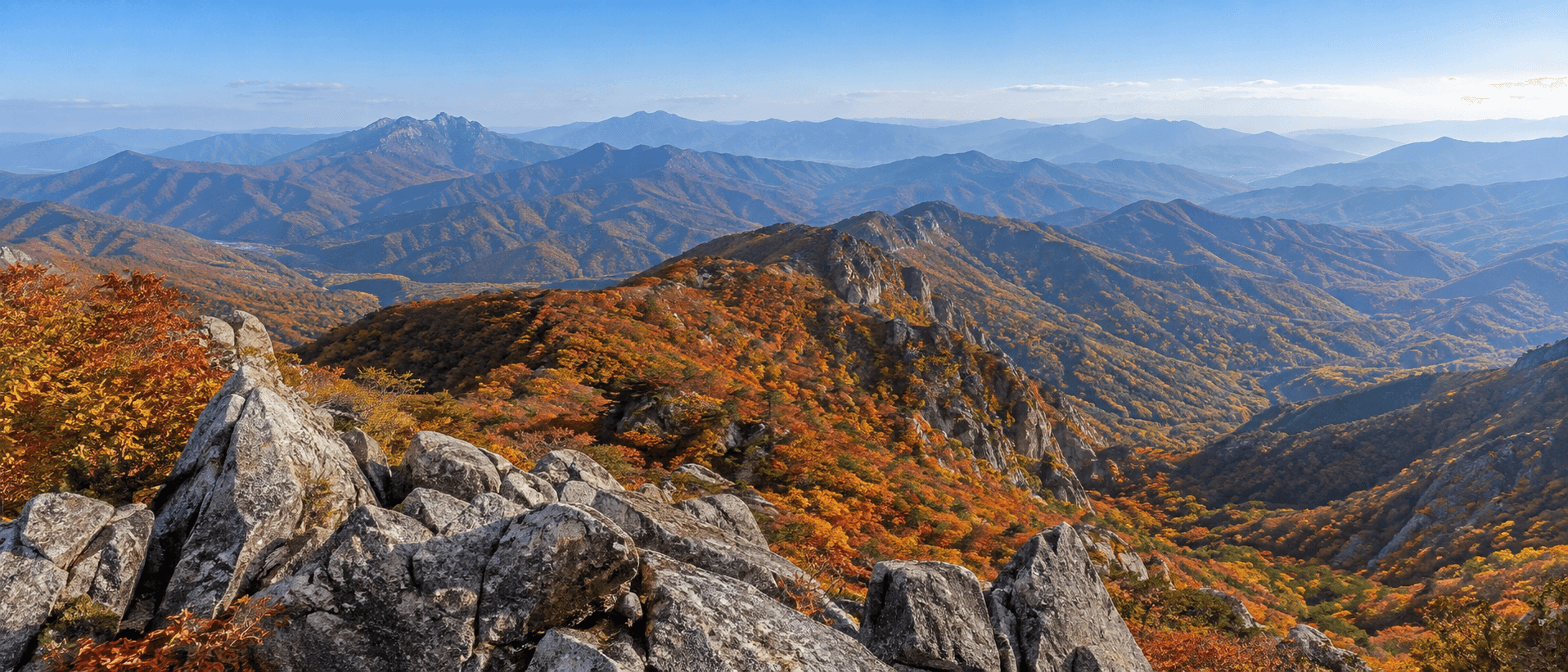
Beating weekend crowds: picking the hour and the day
Lay the time of day over the calendar and the crowd answer is complete. A foliage guide puts entering before 08:30 on weekends as the easiest option, and one record has the Seorak-dong public parking lot hitting full before 08:30 with high frequency on peak weekends. The baseline goes earlier still: the national park is very crowded every weekend, and arriving before 07:00 comes strongly recommended; another guide recommends public transport on the logic that lots fill fast after 07:00. The foliage guides’ remark that peak season is busy even on weekdays, so prepare in advance, points the same way.
Change the day of the week and the slack grows. For a quiet visit, a weekday morning is far easier than a peak foliage weekend, one record says; and a guide adds that peak-weekend rooms are often already full 2–3 weeks out, so confirming at least 3 weeks ahead and taking a weekday night is the safe play. The official guidance that weekends, public holidays, and the foliage season draw heavy tourist traffic, so plan ahead, underpins the same judgment.
For a car-free trip, the bus timetable becomes the baseline of the descent plan. Buses for Sokcho run at frequent intervals from Seoul’s East Seoul and Gangnam express bus terminals, and from Sokcho, city buses 7 and 7-1 run as far as Seorak-dong Sogongwon (on the Korea Forest Service’s guidance); another roundup has the first bus at 06:30, the last departure from Seoraksan at 20:35, and headways of roughly 17–20 minutes. Factor in the record of people missing their spot in the cable car line while waiting for parking, and in the peak weeks the way to cut standing time is to aim at a morning arrival on this bus.
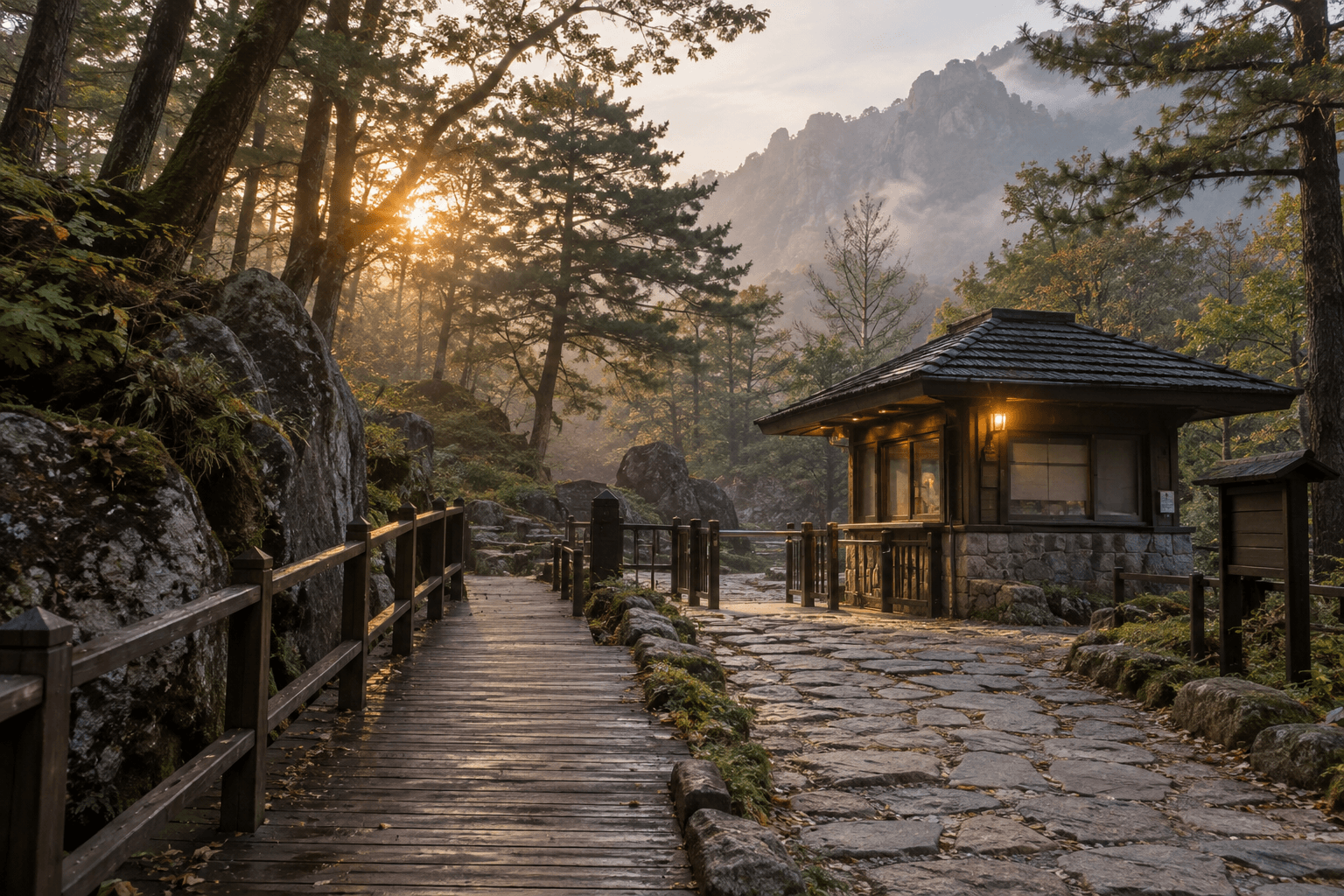
The cable car is a stretch that needs its own wait management. In peak season and on weekends it can sell out at open-run speed, so arriving before opening is the safest bet on weekends and in foliage season; the wait is summarized as low right after opening, rising fast by mid-morning, and possibly long in the afternoon. The official guidance on how to use it is unambiguous: purchase at the on-site ticket counter only, with no advance reservation, and round-trip tickets only; since operation changes with the weather, the premise is to check the real-time operation information before setting out. The round-trip fare is posted at KRW 16,000 for adults (as checked in September 2026), and the same material lists the operating hours as 09:00~17:30, subject to change with weather and season.
The record keeps a fallback for the failed parking hunt too: on October 2025 weekends, cars parked at the B and C district lots and rode a free shuttle to Sogongwon under a temporary operation — whether the same measure runs this year is something the notices of your visit week will have to settle.
Scope of this guide: compiled on September 13, 2026, from the sources listed below. Timing, fare, and operation figures carry their check point in the text and are subject to re-confirmation; the 2026 foliage outlook and the Chuseok holiday dates are not covered here because these sources do not include them.
How to set it up
- Fit the October dates onto the calendar’s core stretch: Daecheongbong and the ridge in the earlier week, Cheonbuldong and Ulsanbawi in the later one.
- Re-set the window with the KMA foliage forecast and the national park service’s notices one week before departure.
- Visit before 08:30 on weekends or on a weekday morning; for the cable car, arrive before opening and count on on-site ticketing.
Sources checked for this guide
- Sandogam, Seoraksan (season windows, fire-control closure, bus access): https://sandogam.com/m/seoraksan/
- Korea Travel List, Seoraksan National Park (reproducing Korea National Park Service and Sokcho city material): https://koreatravellist.com/ko/places/seoraksan-national-park
- Webring, Seoraksan and Naejangsan autumn foliage guide: https://mywebring.com/autumn-foliage-travel-seoraksan-naejangsan-guide/
- goodinfo-fider, Seoraksan foliage 2025 and Dinosaur Ridge guide: https://goodinfo-fider.tistory.com/entry/%EC%84%A4%EC%95%85%EC%82%B0-%EB%8B%A8%ED%92%8D-2025-%EA%B3%B5%EB%A3%A1%EB%8A%A5%EC%84%A0-%EC%B4%88%EB%B3%B4-%EB%8C%80%EC%95%88-%EC%BD%94%EC%8A%A4%C2%B7%EB%B3%B5%EC%9E%A5-%EA%B0%80%EC%9D%B4%EB%93%9C?category=1331761
- Discover Real Korea, Seoraksan Daecheongbong hike: https://discoverrealkorea.com/seoraksan-daecheongbong-hike/
- VISITKOREA, Seoraksan: https://english.visitkorea.or.kr/svc/whereToGo/locIntrdn/rgnContentsView.do?vcontsId=97439
- oseo77, Sokcho Seoraksan autumn foliage guide: https://oseo77.tistory.com/13
- Yeohaenghanjogak, foliage shuttle and cable car use: https://v.daum.net/v/Zj39oZJqhh
- 20hp, 2026 Seoraksan open-run notes: https://20hp.tistory.com/entry/2026-%EC%84%A4%EC%95%85%EC%82%B0-%EC%98%A4%ED%94%88%EB%9F%B0-%EC%B4%9D%EC%A0%95%EB%A6%AC-%F0%9F%8F%94%EF%B8%8F
- Travel and AI notes, Towangseong Falls visit notes: https://dohwj70.tistory.com/86
- Seorak Cable Car operator site: https://www.sorakcablecar.co.kr/
Images are examples to aid understanding.
Last checked: 2026-09-13
Sources & verification
A source-based guide. Check the linked operator information again before you travel.
- Sandogam, Seoraksan guide (season windows, fire-control closure, bus access)Sources checked:
- Korea Travel List, Seoraksan National Park (reproducing Korea National Park Service and Sokcho city material)Sources checked:
- Webring, Seoraksan and Naejangsan autumn foliage guideSources checked:
- goodinfo-fider, Seoraksan foliage 2025 and Dinosaur Ridge guideSources checked:
- VISITKOREA, Seoraksan and cable car guidanceSources checked:
- oseo77, Sokcho Seoraksan autumn foliage guideSources checked:
- Yeohaenghanjogak, foliage shuttle and cable car useSources checked:
- Seorak Cable Car operator siteSources checked:
Illustrations are examples to aid understanding, not photographs taken on site. Actual photographs have separate source credits.
Continue planning
Choosing an autumn foliage mountain: Namsan Sky Forest Trail vs. a Seoraksan day trip from Seoul
Namsan Sky Forest Trail or a Seoraksan day trip from Seoul: the choice splits by half a day versus the whole day, with hours, access, physical demand and foliage timing compared.
Seoraksan Fall Foliage with Your Parents: Picking a Gentle Course
The stairs decide the course: the cable car to Gwongeumseong plus a flat Sinheungsa walk covers Seoraksan foliage with your parents, best between mid-October and early November.
A 1-Night, 2-Day Trip from Seoul to Sokcho & Seoraksan — With Bus and Car Itineraries
A two-day Seoul-to-Sokcho itinerary: express bus versus driving, where to base yourself, an hour-by-hour schedule for both days, and realistic costs.
Help us keep this note useful
A quick response helps us decide what to clarify or recheck. No account or email is needed.