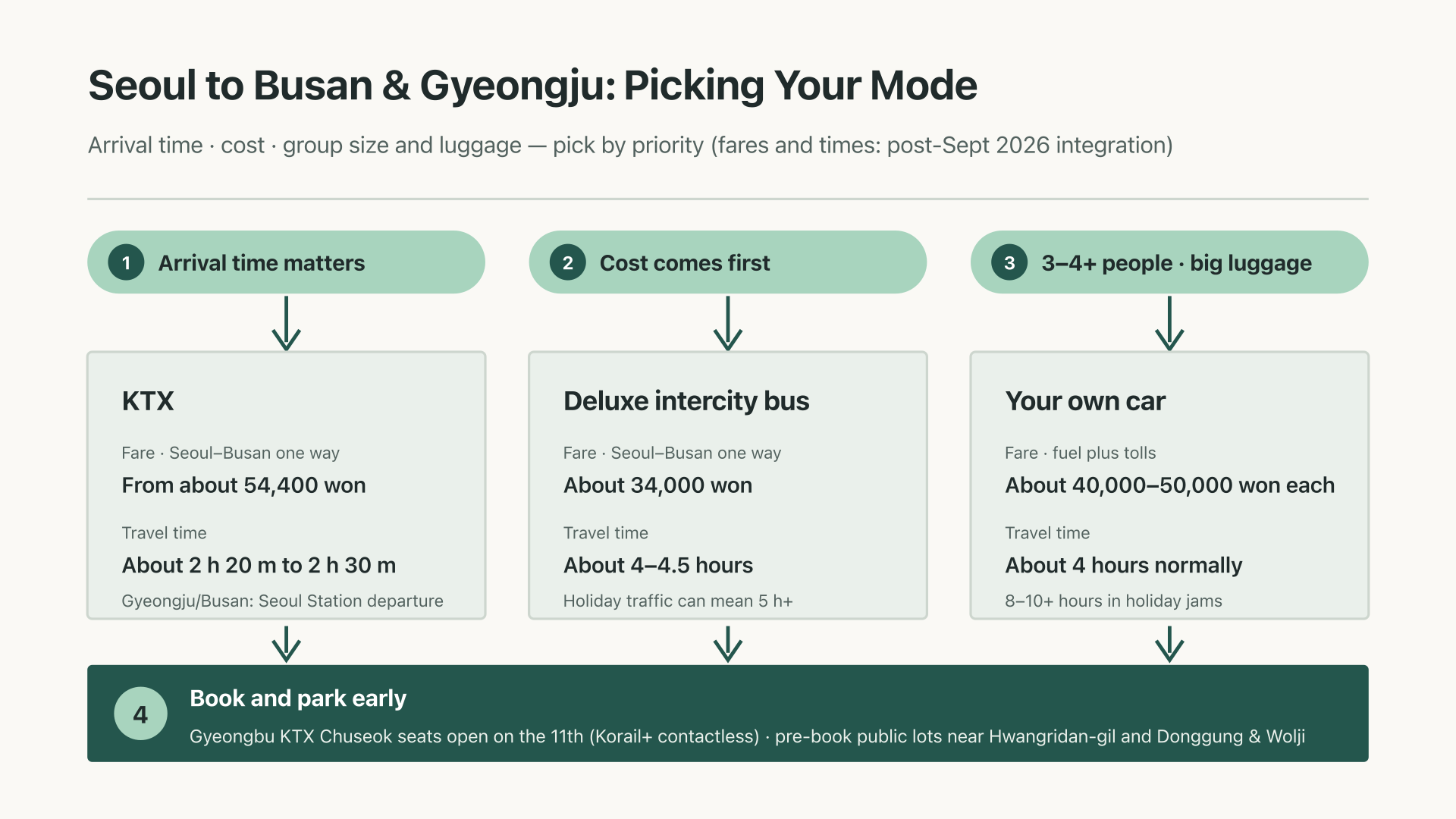
If arrival time matters most, build the trip around the KTX; if cost comes first, take the express bus; and for a family of three or four or more, or with lots of luggage, a car is the stronger base in the available comparisons. On Seoul–Busan alone, the KTX costs from about ₩54,400 one way and takes about 2 hours 20 minutes to 2 hours 30 minutes, while the express bus (udeung grade) costs about ₩34,000 and takes about 4 hours to 4 hours 30 minutes. On top of that, Korail and SR began operating as one system on September 1, 2026, the Seoul–Busan fare came down from ₩59,800 to around ₩54,400, and the Chuseok holiday (September 24–27) falls right after the merger, so this year differs from previous years before anything else.
Bus and KTX: the gap in time and fare
The table below uses the post-merger basis of September 2026.
| Choice | Fare (Seoul–Busan basis) | Travel time |
|---|---|---|
| KTX | from about ₩54,400 one way | about 2 hours 20 minutes to 2 hours 30 minutes |
| Express bus (udeung) | about ₩34,000 | about 4 hours to 4 hours 30 minutes; 5 hours or more in holiday congestion |
| Car | fuel plus tolls, roughly the ₩40,000–50,000 range per person | 4 hours normally, 8–10 hours or more in holiday congestion |
Comparing tickets alone makes it easy to miss what you actually spend. A calculator estimate that includes station and terminal transfers, parking, and holiday congestion scenarios puts the Seoul–Busan round trip at about ₩137,600 per person for the KTX, ₩64,000 for the express bus, and ₩74,150 for the car, and those numbers are reference estimates that change with the booking date and traffic conditions. Another comparison has the bus taking roughly 1–2 hours longer in exchange for a fare of around half. Trains toward Gyeongju and Busan depart from Seoul Station as the general rule, so check the departure station before booking. The fares and times in the table are post-merger figures checked on September 7, 2026.
Chuseok train tickets open on different days by route
General sales for Chuseok trains run for five days from September 7 to 11, from 07:00 to 13:00 (based on the Korail notice checked on September 7, 2026). Sales days are divided by route: Gyeongbu-line KTX (departing and arriving at Seoul) opens on the 11th, and KTX on the Gyeongjeon, Gangneung, Donghae, Jungang, and Jungbu Naeryuk lines opens on the 8th, while KTX departing or arriving at Suseo on the Gyeongbu, Gyeongjeon, Donghae, Honam, and Jeolla lines opens on the 10th. On sections where routes overlap, such as Seoul–Dongdaegu, booking is possible across two days, the 8th and the 11th.
Each booking must be completed within 3 minutes of opening the dedicated web page, payment opens at midnight on the 12th, and standard tickets must be paid by the 15th. If online booking feels unfamiliar, call the holiday reservation hotline, 1544-8545, instead. During the sales period station counters do not open, and tickets are sold only through the contactless Korail+ (코레일+) app and website, with leftover seats sold at counters after 15:00 on September 11 as well. The same source asks existing SR-only members to switch to the integrated membership in advance. Supply grows too: at least 15,000 added seats on weekdays and 17,000 on weekends, plus 23 added trains on weekdays and 25–26 on weekends, which should ease the fight for seats along with the merger (based on material published in August 2026). Outside the holiday period, KTX booking opens up to 2 months before the travel date, and booking at least 2 weeks ahead is offered as a general tip for weekend and holiday trips, so mark the sales days on your calendar first.
From Gyeongju Station, take a taxi or bus into town
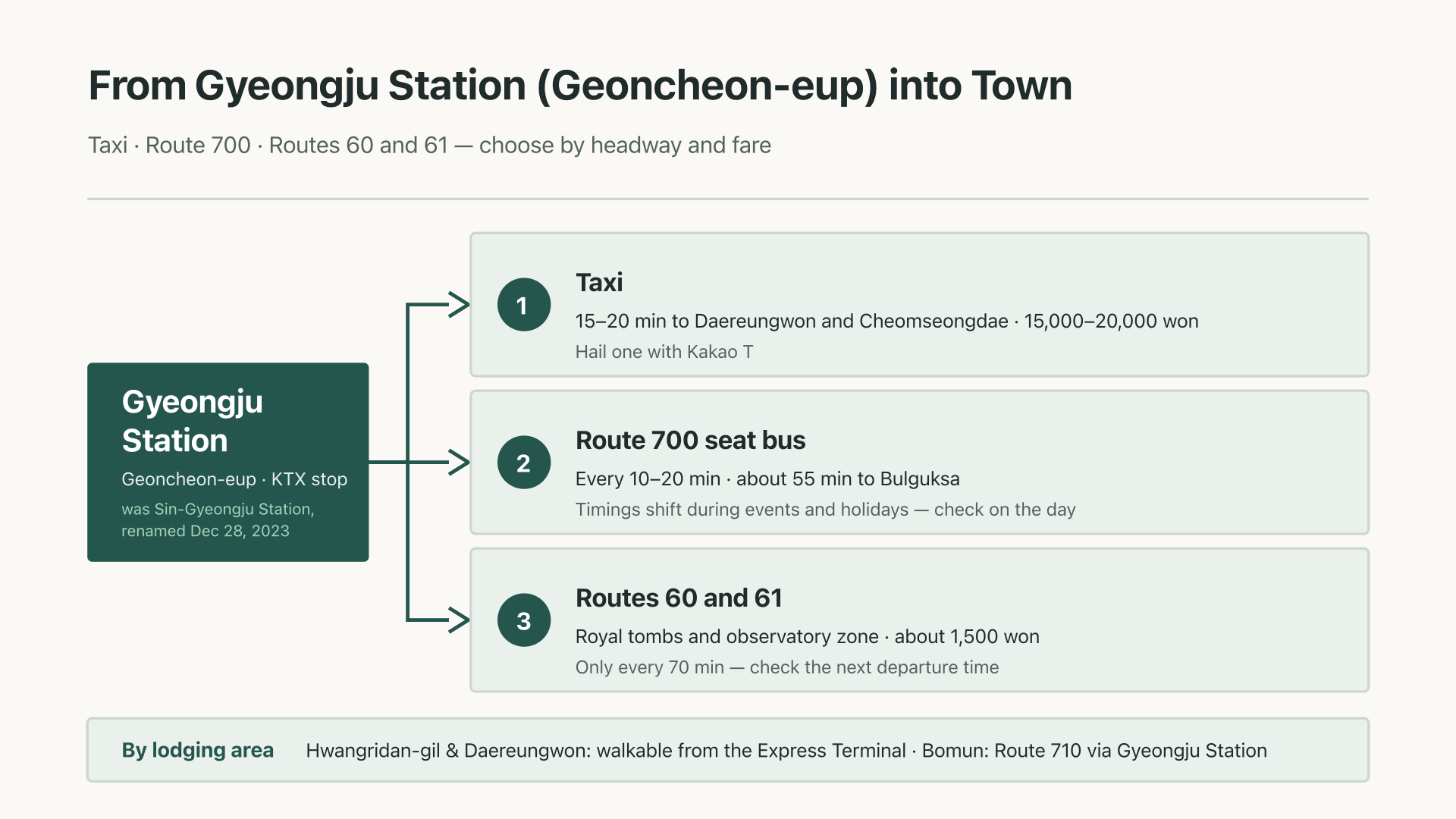
Gyeongju Station, where the KTX stops, is located in Geoncheon-eup, so getting downtown adds a 20–40 minute bus ride or a taxi costing in the ₩15,000s (mid-to-high ₩20,000s toward Bomun). The name “Singyeongju” disappeared as of December 28, 2023 and was changed to Gyeongju Station, so search for Gyeongju Station (경주역) when booking. The Seoul–Gyeongju section runs about 29 times a day from the first train at 05:13 to the last at 21:33, and takes about 1 hour 57 minutes to 3 hours 15 minutes (weekday schedule of September 1, 2026; material collected in September 2026).
Sources draw the station-to-town options a little differently. Bus 700 runs at 10–20 minute intervals, but one source says frequencies change often during events and holidays, so checking on the day of departure is the safe option; a separate guide puts a taxi to the downtown sights (Daereungwon and Cheomseongdae) at about 15–20 minutes and ₩15,000–20,000, with rides called through Kakao T. Buses 60 and 61 run from the station to the royal tombs and observatory area for about ₩1,500, but they come only every 70 minutes, so check the next departure before boarding. For Bulguksa, bus 700 takes about 55 minutes end to end, and bus 10 takes 35–45 minutes one way at intervals of about 20 minutes, a larger time loss than the downtown courses. Where you stay is the other fork: one comparison says that if you stay near Hwangnidan-gil and Daereungwon, the walkable Gyeongju Express Bus Terminal is convenient, while for the Bomun Tourist Complex the Gyeongju Station side, with its 710 shuttle bus, works well.
When continuing from Busan to Gyeongju, the two cities are 30–40 minutes apart by KTX, so the legs can be booked separately. One more note: paid lockers at stations and terminals are often full in peak season and around holidays, so build luggage drop-off right after arrival into your first-day plan.
When driving is the better option
If the family is three or four or more, or there is a lot of luggage (gifts, baby supplies, and so on), one comparison says the car comes out ahead on per-person cost, and a calculator that reflects group size and congestion scenarios finds that from three adults up, the car can become cheaper than public transit. For Seoul–Gyeongju by car, one guide lists about 4 to 5 hours of driving, about ₩30,000 in round-trip tolls, and ₩70,000–100,000 in fuel; a separate guide notes that on holidays the usual 4-hour distance often stretches past 8–10 hours or more, which is why many people move their departure up to dawn or late night.
In town, moving the car between sights reduces actual viewing time through parking waits and one-way streets, so the advice there is to leave the car in one public parking lot and group the day by zone. A separate source says parking is easier if you enter before or after the weekend congestion hours of 10:00–12:00, and another piece of advice is that a car day trip adds parking legs, so decide on public parking lots near Hwangnidan-gil and Donggung and Wolji in advance. Picking up a rental car at Gyeongju Station shortens the moves between sights to the 10–20 minute range, according to a rental car guide, and the same source says driver age, license holding requirements, and deposit ratios differ by company, so ask in advance.
How to decide
- Arrival time first, KTX; cost first, express bus; three or four or more travelers or heavy luggage, car as the base.
- For Chuseok tickets, mark the route-specific sales day (the 11th for Gyeongbu-line KTX) on the calendar and book contactless through Korail+.
- For Gyeongju, take a taxi or bus 700 from Gyeongju Station into town, and set the arrival approach by stay zone (Hwangnidan-gil or Bomun).
Sources and scope This is an editorial guide built from the evidence bundle collected on September 13, 2026. Questions with few independent on-the-ground reviews (booking-day crowds, driving times) were answered with official booking procedures and side-by-side editorial comparisons, and all fares and frequencies reflect their sources’ stated bases (September 2026 merger, August 2026 publication, September 1, 2026 weekday timetable), so recheck each official channel before booking.
Images are examples to aid understanding.
Last checked: 2026-09-13
Sources & verification
A source-based guide. Check the linked operator information again before you travel.
- Korail, 2026 Chuseok train ticket booking noticeSources checked:
- Trainfo Bebop, Seoul to Gyeongju KTX timetable and faresSources checked:
- Cleaveliving, Chuseok holiday train vs bus vs car vs flight comparison (2026)Sources checked:
- Bigyocalc, holiday hometown trip cost calculatorSources checked:
- LACHA Guide, getting from Seoul to the regions: KTX vs express busSources checked:
- Korea by Train, Gyeongju day trip from SeoulSources checked:
- LOOXK, Seoul and Gyeongju by KTXSources checked:
- Plus Rent-a-car blog, Gyeongju 1-night 2-day rental car courseSources checked:
Illustrations are examples to aid understanding, not photographs taken on site. Actual photographs have separate source credits.
Continue planning
Autumn in Gyeongju: From Bulguksa's Foliage to a Cheomseongdae Night Walk
Autumn in Gyeongju: peak foliage at Bulguksa and Seokguram, pink muhly and the night media art at Cheomseongdae, the Daereungwon tomb walk, and transport tips.
Busan Autumn Trip: From Haeundae Dalmaji-gil's Fall Foliage to a Walk on Dongbaekseom Island
A Busan autumn day: foliage on Haeundae's Dalmaji-gil, a Dongbaekseom walk, the Cheongsapo beach train and Sky Capsule, then sunset from X the Sky.
Busan Winter Trip: A Complete Guide to the Gwangandaegyo Bridge Night View and Busan Christmas Festival Itineraries
A Busan winter route: Gwangandaegyo bridge lights, the Saturday drone show, Haeundae Christmas festivals, plus Gamcheon and Huinnyeoul villages by day.
Help us keep this note useful
A quick response helps us decide what to clarify or recheck. No account or email is needed.