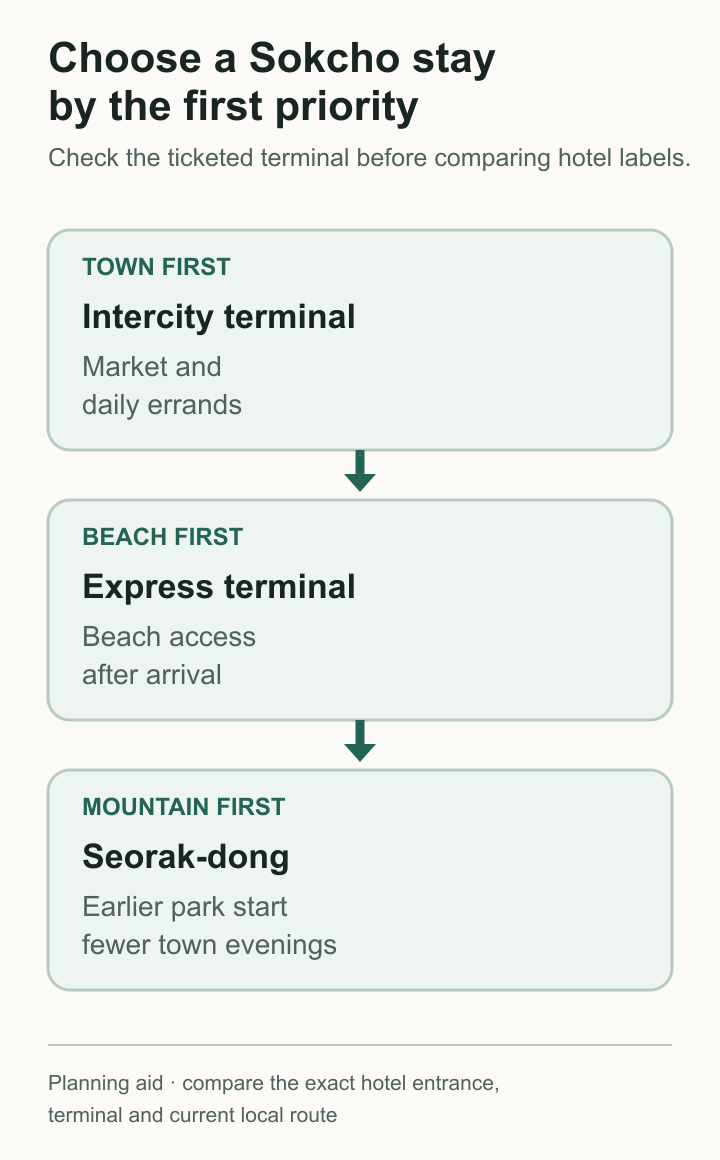
Sokcho is compact, so it is quicker to pick the base area by the longest movement of the trip than by comparing distances. That said, one guide points out that not every gap is pleasant on foot after a hike. If the sea, the market and food are the focus, the first comparison is central Sokcho around Sokcho Beach, Cheongchoho Lake and the intercity bus terminal; if hiking is the focus, the Mt. Seorak entrance area (Seorakdong); if raw fish and harbor atmosphere are the focus, the area near Daepo Port.
October changes the calculation. July and August are the busiest months at Sokcho Beach, but October, when Seoraksan’s foliage turns red and orange, is the busiest period specifically for Seorakdong, so booking timing deserves as much attention as the choice of area.

How the stay areas divide
For first-time visitors, the stay areas are usually explained as three: Sokcho Beach, the Tourist Market/Cheongchoho area, and the Mt. Seorak entrance. As for Daepo Port, it is introduced as a separate option: a harbor strip where crab restaurants gather, opening early in the morning and staying alive late at night. What each area gives and takes is summarized below.
| Area | What you gain | What you give up |
|---|---|---|
| Sokcho Beach | Sunrise, beach walks, cafes, terminal access | The market is not right at the door |
| Tourist Market / Cheongchoho | Food, evening walks, central buses and taxis | Less of a beach atmosphere |
| Mt. Seorak entrance | An early start on the trail | Without a car, the second day’s coast and market runs get awkward |
A second source lands in the same place. The park village of Seorakdong is closest to the trailheads but limits evening dining options, while the Sokcho Beach area has more restaurants, cafes and convenience stores, which makes it the better base for most travelers. Accommodation itself clusters most densely along the Sokcho Beach/Expo Tower stretch, where cafe density and support for foreign visitors are also concentrated. An area name alone will not tell you where a property’s entrance is, so on the booking screen, put the hotel address into a map and compare the distance to your first destination before trusting the area label.
If the sea and the market anchor the trip
Traveling without a car puts the block behind the intercity bus terminal on the list. One travel writer visited Sokcho seven times across four seasons without a car and kept staying at two guesthouses behind the terminal, Sokcho Hutte (속초휘테) and The House; the writer records that all seven arrivals ended within walking distance of the same bus stop without a single one planned that way. The same record continues: both guesthouses are also within walking distance of Sokcho Tourist and Fishery Market (속초관광수산시장).
There is one thing to sort out before the room itself: there are two arrival terminals. Sokcho has two bus terminals about 3 km apart (checked September 2026); express buses from Gangnam divide toward Sokcho Express Bus Terminal near the beach, and intercity buses from Dong Seoul toward Sokcho Intercity Bus Terminal in the town center. Which one you get is decided by the destination field on the ticket. The express terminal is closer to Seoraksan National Park, and the intercity terminal is closer to town sights such as the market, Abai Village (아바이마을) and the seaside pavilion Yeonggeumjeong (영금정).
Lodging options also differ from area to area. Along the Sokcho Beach stretch, names such as Cassia Sokcho, Lotte Resort Sokcho and Ramada by Wyndham Gangwon Sokcho are introduced, and there are stays around Cheongchoho as well, such as Sokcho Marina Hotel on Cheongchohoban-ro (청초호반로). If you point the trip at Daepo Port, the weight of the area is food: mulhoe and sliced raw fish at Daepo and Dongmyeong ports, and abai sundae in Abai Village. The gaetbae ferry to Abai Village is described as board first from the town side and pay after landing; weather and on-site operations can change this, so do not time the return trip tightly around the crossing.
If you drive, the calculation shifts a little. One guide advises leaving the car at the accommodation and walking around: Sokcho Beach parking gets serious in peak season.

If Mt. Seorak is the purpose
When hiking is the axis of the itinerary, the meaning of staying in Seorakdong is simple. Lodging sits within walking distance of the Sogongwon ticket office at the park entrance, so the advantage of this area is explained as being able to start the hike before the day-trip buses from Seoul arrive. In exchange, restaurant choice is limited, evenings are quiet, and reaching the market, Sokcho Beach or Daepo Port takes a bus or taxi.
One more input makes planning easier: the bus schedule. City buses 7 and 7-1 departing from Jangsadong (장사동) pass both terminals and end at the Seoraksan parking lot; the first bus is 06:30, the last bus from Seoraksan is 20:35, and buses run roughly every 17–20 minutes (checked September 2026). Buses toward Sogongwon can be taken from both terminals, but there is also guidance that routes and intervals can change by season, so checking the day’s timetable before departure helps.
For a cable-car-centered day, morning timing makes the actual difference. It is about 20 minutes by car from central Sokcho to Sogongwon (설악산소공원), the park entrance (checked September 2026), and in peak season the Sogongwon parking lot frequently fills before 9 a.m. (same check). One source puts the autumn-foliage wait for the cable car at a common 1–2 hours (same check). The cable car sells round-trip tickets only, and if weather suspends operations, unused tickets are refunded in full (same check). Another tip: secure a time slot on the official reservation site in advance.
For a long hike, the lodging becomes the skeleton of the itinerary. Dawn attempts on Daecheongbong (대청봉) are organized as staying in Sokcho or Seorakdong the night before and moving before dawn. There is an evaluation that the Osaek (오색) course is a good starting point for reaching the summit right at first light, and the same account records the evening difference: staying in Osaek means returning by taxi to a quiet hot-spring village, and staying in Sokcho means returning to town by bus or taxi. Osaek is a village with a few mountain-vegetable set-menu restaurants, and lodging inquiries for the hot-spring district are directed to Osaek Greenyard (오색그린야드).
Foliage timing also enters the area decision. A source relaying the national park service’s guidance puts the best foliage window for the Ulsanbawi (울산바위) course from mid-October to early November (checked September 2026).

Booking for October: what to check first
Booking competition differs by area. Since October is the period when Seorakdong is especially busy, the more the itinerary centers on hiking, the more it pays to move up the booking. One guide notes that peak-foliage weekend rooms are often already sold out, and that a weekday night is safer.
Transport reservations tie in as well. Express buses from Gangnam take about 2 hours 10 minutes to 2 hours 30 minutes, and intercity buses from Dong Seoul about 2 hours 20 minutes (checked September 2026).
On weekends and in peak season, book the bus ahead; Friday afternoon and Saturday morning departures are often without seats on the day. As of 2026, there is no direct train connecting Seoul and Sokcho.
Prices are based on different standards in each source, so one guide says to use live booking rates instead of article averages, and points out that Friday and Saturday pricing can move fast. After booking, one checklist advises re-confirming check-in time and parking availability in the reservation details.
One more data point. A trip report that crammed mountain and sea into a single day to save on lodging describes an itinerary that punished the body, with muscle soreness lasting for days, and recommends 1–2 nights when time allows. Choosing where to stay comes back to the question of where to put that single night.

Sources and scope This guide is an editorial overview built from sources collected in an evidence bundle dated September 10, 2026. Some of the area-comparison, Seoraksan and booking questions were in a partial state with limited independent experience data, and figures without a verification month — fares, distances, travel times — were left out of the text. Figures marked “checked September 2026” carry the checking date of the underlying source and are not a guarantee of current conditions.
- The South Korea Guide, where to stay in Sokcho and peak-season notes: https://www.thesouthkoreaguide.com/city/sokcho/where-to-stay/
- Angie Magazine, car-free Sokcho and the guesthouses behind the intercity bus terminal: https://angiemagazine.com/sokcho-guesthouses-without-a-car/
- Journal5188, a 1-night, 2-day Sokcho course, stay areas and parking: https://journal5188.com/sokcho-1night-2days-travel-course/
- Sandogam, Sokcho and Osaek bases and food: https://sandogam.com/m/seoraksan/
- Webring, foliage-season bookings and Seoraksan transport: https://mywebring.com/autumn-foliage-travel-seoraksan-naejangsan-guide/
- HeySeorak, Sokcho weekend trips and stay-area comparison: https://heyseorak.com/blog/sokcho-weekend-trip
- HeySeorak, where to stay near Mt. Seorak: https://heyseorak.com/blog/seoraksan-where-to-stay
- Korea Travel List, Seoraksan buses and foliage timing: https://koreatravellist.com/ko/places/seoraksan-national-park
- Mulhoe.co.kr, Seoul–Sokcho transport and the two terminals: https://mulhoe.co.kr/stories/seoul-to-sokcho/
- Yums Itchy Feet, Sokcho arrival terminals and a one-day route record: https://yumsitchyfeet.com/how-to-get-to-sokcho-from-seoul/
- Trip.com, Sokcho Marina Hotel listing: https://in.trip.com/hotels/sokcho-si-hotel-detail-131969488/sokcho-marina-hotel/review.html
- Korea Go Now, Seorakdong vs Sokcho Beach stays: https://koreagonow.com/sokcho-and-seoraksan/
- Korea Journeys, planning Sokcho and Seoraksan: https://koreajourneys.com/sokcho-to-seoraksan-planning-your-perfect-east-coast-korea-trip/
- Discover Real Korea, a Day-0 setup for the Daecheongbong hike: https://discoverrealkorea.com/seoraksan-daecheongbong-hike/
- The Girl with a Big Bag, the Osaek course and evenings by lodging: https://thegirlwithabigbag.com/seoraksan-itinerary/
- kgosu.com, cable car fares, parking, waits and refunds: https://www.kgosu.com/2026/05/2026_0762635579.html
- Ddakjuyeon (딱주연), Sogongwon parking and cable car access: https://bobjyeon.tistory.com/788
- 여행과 AI수익화 실전노트, Seoraksan public transport and the last bus: https://dohwj70.tistory.com/86
How to decide
- Sea, market and food as the focus: central Sokcho on the Sokcho Beach, Cheongchoho and intercity terminal side.
- Hiking as the focus: Seorakdong; compare Osaek as well for sunrise courses.
- Before booking, match the arrival terminal on the ticket (express or intercity) and the hotel address on a map first.
Images are examples to aid understanding.
Sources & verification
A source-based guide. Check the linked operator information again before you travel.
- The South Korea Guide, where to stay in Sokcho and peak-season notesSources checked:
- Angie Magazine, car-free Sokcho and the guesthouses behind the intercity bus terminalSources checked:
- Journal5188, a 1-night, 2-day Sokcho course, stay areas and parkingSources checked:
- Sandogam, Sokcho and Osaek bases and foodSources checked:
- Webring, foliage-season bookings and Seoraksan transportSources checked:
- HeySeorak, Sokcho weekend trips and stay-area comparisonSources checked:
- HeySeorak, where to stay near Mt. SeorakSources checked:
- Korea Travel List, Seoraksan buses and foliage timingSources checked:
- Mulhoe.co.kr, Seoul–Sokcho transport and the two terminalsSources checked:
- Yums Itchy Feet, Sokcho arrival terminals and a one-day route recordSources checked:
- Trip.com, Sokcho Marina Hotel listingSources checked:
- Korea Go Now, Seorakdong vs Sokcho Beach staysSources checked:
- Korea Journeys, planning Sokcho and SeoraksanSources checked:
- Discover Real Korea, a Day-0 setup for the Daecheongbong hikeSources checked:
- The Girl with a Big Bag, the Osaek course and evenings by lodgingSources checked:
- kgosu.com, cable car fares, parking, waits and refundsSources checked:
- Ddakjuyeon (딱주연), Sogongwon parking and cable car accessSources checked:
- 여행과 AI수익화 실전노트, Seoraksan public transport and the last busSources checked:
Images are illustrative examples to aid understanding, not photographs of the actual facilities.
Continue planning
How to Get from Seoul to Sokcho and Seoraksan: Bus vs. Car vs. Train
No direct train reaches Sokcho: compare bus terminals and travel times, driving on the Seoul–Yangyang Expressway, the Seoraksan connection, and when to book.
Sokcho food: what to eat at Jungang Market and the Tourist & Fishery Market
Sokcho's markets split the work: dakgangjeong and sundae at Jungang Market, raw fish at the Tourist & Fishery Market centers, plus timing for the October crowds.
Gangneung lodging: Gyeongpo, Anmok, or Gangneung Station?
Compare Gangneung lodging areas by how you will move: Gangneung Station for transport, Gyeongpo for beach and lake walks, Anmok for cafes in front of the sea.
Help us keep this note useful
A quick response helps us decide what to clarify or recheck. No account or email is needed.