
Three weeks before a Busan trip, you open the Blue Line Park booking calendar and every date is a row of sold-out windows. That is what the calendar looked like on the afternoon of 7 October 2026. For the Sky Capsule from Mipo, from 8 October to 8 November, only two windows were left, not counting extra evening windows added for the fireworks night.
This is where travelers split. Set an alarm for the Tuesday-morning release? Keep refreshing the calendar for cancellations? Or give up on the capsule and take the Beach Train or the path?
The capsule is a slow ride: about 30 minutes for the 2 km between Mipo and Cheongsapo. Right beside its track runs a free walking path along the same sea. So here is the order I would suggest. Walk from Mipo to Cheongsapo, and ride on the way back. If there are two or more of you and you have a ticket, take a capsule from Cheongsapo back to Mipo in a window that starts roughly 40 to 60 minutes before sunset. If you have no ticket, take the Beach Train back from Cheongsapo. Either way your afternoon ends at Mipo, and if you ride the train, the return direction is the cheaper ticket.
Why this direction, the realistic ways to get a capsule ticket, and how the cost changes with group size come next.
Released at 07:00 on Tuesday, gone within a day
Online Sky Capsule tickets open every Tuesday at 07:00 Korea time, for the whole Monday-to-Sunday week four weeks later. That is 06:00 on Tuesday in Taipei, Hong Kong and Singapore, and 22:00 on Monday UTC. The remaining autumn releases fall like this:
| Sales open (Tuesday, 07:00 Korea time) | Dates released |
|---|---|
| 13 October 2026 | 9–15 November |
| 20 October 2026 | 16–22 November |
| 27 October 2026 | 23–29 November |
To see how fast they go, we opened every entry window at both stations, from 8 October to 8 November, on the official booking calendar at about 14:30 Korea time on 7 October.
- From Mipo: between 8 October and 1 November, one window was left, 13:00 on 11 October. Everything else was sold out.
- From Cheongsapo: there were places on 14 October (16:30, 17:30 and 18:00 windows), 15 October (08:30, 09:00) and 16 October (14:00). The 17:30 window on 14 October is just before that day’s sunset at 17:51.
- 2–8 November: this week went on sale the day before, at 07:00 on 6 October. About 31 hours later every regular window at both stations was sold out, except one from Mipo at 17:30 on 7 November.
For the October dates, Cheongsapo had six windows left and Mipo had one. That gap matters again when you choose a direction.
Saturday 7 November was the exception. It is the night of the 21st Busan Fireworks Festival, held around Gwangalli Beach, Igidae and Dongbaek Island. The booking screen showed three extra evening windows that day, and two of them, 18:30–19:00 and 19:00–19:30, still had tickets. Sunset that day is 17:24 and civil twilight ends at 17:51, so after 18:30 the sea is already dark. Neither the festival overview nor Blue Line Park’s notices gave a fireworks start time or announced extended capsule hours as of 7 October. If you are spending that evening in Haeundae anyway, a night capsule is worth trying for. If the daytime sea is the point, don’t move your plans for it.
If you miss the release, you have two more chances.
- Cancellations. Cancelling three or more days before the ride gets a full refund; from two days before, a fee applies. On 7 October the leftover places were not on the next few days but scattered 4 to 9 days out. Don’t watch only your date: check both stations’ calendars, more than once.
- Same-day tickets on site. Ticket offices sell a small number first come, first served. A note under the English booking calendar says that within four hours, tickets can only be bought at the on-site ticket offices, so a window that starts soon has to be bought on site, not online. A traveler on Reddit in April 2026 wrote that same-day tickets are easy to buy at the Mipo kiosk between 9 and 10 am, and that the kiosk queue moves quickly and takes credit cards. That was before the first window moved to 08:30 on 1 May 2026. If you are after a same-day ticket, being at Mipo for the 08:30 first window is the safer plan.
Why walk out and ride back
The Sky Capsule runs one way between Mipo and Cheongsapo. You can board only at the station on your ticket, and the time you book is not a departure time but a 30-minute entry window. Everyone who arrives within it boards in turn. At weekends and on public holidays you may board somewhat later than your window.
In late October you ride straight at the sunset
We worked out the direction. A straight line from Cheongsapo station to Mipo station points at about 259°, a little south of due west. This autumn, Busan’s sunset azimuth is about 263° on 10 October, 258° on 20 October and 254° on 31 October. From mid to late October, a capsule leaving Cheongsapo heads almost straight at the setting sun. By late November the sunset azimuth drops to 244°, so the sun sits a little to your left. In that direction lie Haeundae’s high-rises and Dongbaek Island, not an open horizon, and the track bends with the coast. Think of it as riding towards light sinking behind towers, not a sun dropping into the sea.
Leave from Mipo at that hour and the sun is behind you. Travelers say the Mipo direction uses the outer, sea-side track and has the better view. In daylight, Mipo is a fine start. At sunset I would pick Cheongsapo.
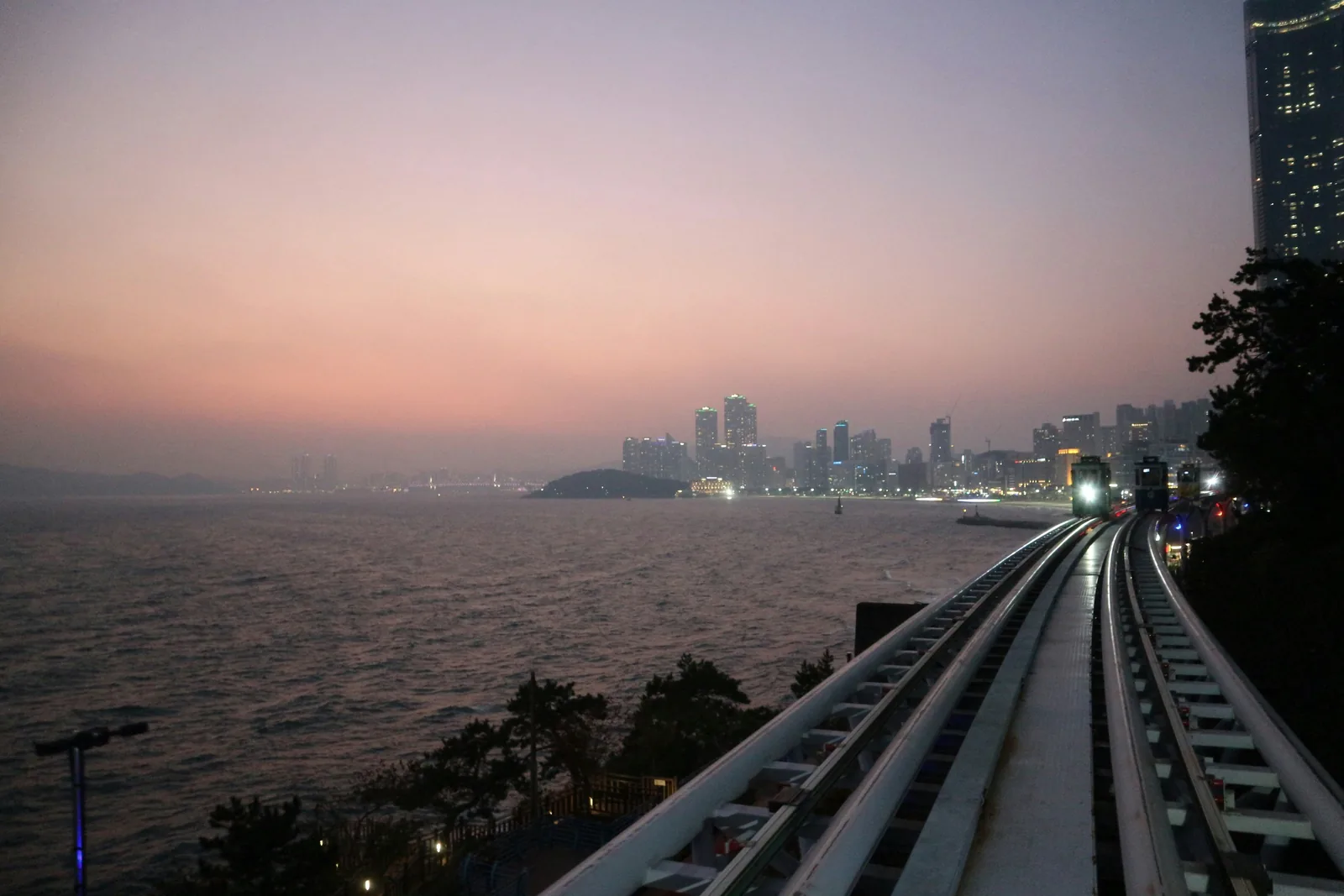
The queue differs too. On an August 2026 Reddit thread about a sunset booking, under a reply about queuing at Mipo, one traveler added that they had been stuck in a massive queue and almost missed the sunset. Another, who rode the reverse way, had only a couple of groups ahead at sunset. The person who gave the Mipo advice added that the reverse seemed less crowded and that the inner track does not make much difference. On 7 October, too, Cheongsapo had more tickets left.
The ride back is the cheaper ticket
Under the fares in force since 1 May 2026, a single Beach Train ride costs ₩10,000 from Mipo or Songjeong and ₩8,000 from Cheongsapo and the small stops in between. For the same 2 km by train, Cheongsapo to Mipo is ₩2,000 cheaper. If you take the train only once and skip the capsule, walking out from Mipo and riding back from Cheongsapo is the cheapest order.
Ending at Mipo means no last-train worry
Blue Line Park’s usage rules warn that if a long capsule queue makes you arrive late, you may struggle to catch the last train. That catches people who ride the capsule from Mipo late in the afternoon and plan to take the train back from Cheongsapo. Ride the capsule from Cheongsapo instead and you get off at Mipo, at the east end of Haeundae Beach. There is no train to catch.
The path is better than it sounds
The path beside the tracks is called the Haeundae Green Railway. It follows the old Donghae Nambu Line for 4.8 km from Mipo to Songjeong, can be walked in both directions, and is free. Mipo to Cheongsapo is about 2 km; the Daritdol Skywalk is another 0.6 km past Cheongsapo.
Sometimes it is the capsule rider who envies the walkers. A traveler on Reddit in April 2025, who had taken the train and the capsule and walked part of the coastal path, wrote that they found themselves looking out of the capsule in envy at all the people on the walking path. They added that you can walk faster than the capsules, and that next time they might do the whole coastal walk.
If I were riding the capsule only once, I would walk the first stretch, while the sea is new, and leave the ride back at dusk to the capsule. You see the same coast twice, at two different speeds.

Which window to book before sunset
Book a window that starts roughly 40 to 60 minutes before sunset. Even if the queue means you board a little late, the sun goes down during your 30 minutes on the track. Sunset and the end of civil twilight below are the Korea Astronomy and Space Science Institute’s figures for Busan.
| Date (2026) | Sunset | Sky dark | Window to book | Last window that day |
|---|---|---|---|---|
| 10 October | 17:56 | 18:21 | 17:00–17:30 | 18:00–18:30 |
| 20 October | 17:43 | 18:09 | 17:00–17:30 | 18:00–18:30 |
| 31 October | 17:31 | 17:57 | 16:30–17:00 | 18:00–18:30 |
| 10 November | 17:22 | 17:48 | 16:30–17:00 | 17:30–18:00 |
| 20 November | 17:15 | 17:42 | 16:30–17:00 | 17:30–18:00 |
| 30 November | 17:12 | 17:40 | 16:30–17:00 | 17:30–18:00 |
Entry windows run 08:30–18:30 in October and 08:30–18:00 from November. On the last window of an autumn day, the sky goes dark while you are on the track. If the sea is what you are paying for, skip the last window.
The Beach Train leaves Mipo from 09:00 to 19:30 in October and 09:00 to 19:00 in November. The last train from Cheongsapo to Mipo is at 19:42 in October and 19:25 in November. Both rides run in rain but can stop for heavy rain and typhoons.
Group size decides the price
The capsule is priced per car; the Beach Train per person. So the cost per head swings with the size of your group. We checked the adult fares in force since 1 May 2026 on the official fare page on 7 October.
- Sky Capsule, one way: ₩50,000 for a two-seat car, ₩55,000 for three, ₩60,000 for four
- Beach Train: single ride ₩10,000 (₩8,000 from Cheongsapo and the small stops), two rides ₩14,000, all stops ₩16,000
- Package (one-way capsule plus all-stops Beach Train): ₩73,000 for two, ₩92,000 for three, ₩111,000 for four
Here is the cost per adult for each way of covering Mipo to Cheongsapo and back.
| Mipo–Cheongsapo and back, per adult | 1 person | 2 people | 4 people |
|---|---|---|---|
| Walk both ways | free | free | free |
| Walk out, train back from Cheongsapo | ₩8,000 | ₩8,000 | ₩8,000 |
| Walk out, capsule back | ₩50,000 | ₩25,000 | ₩15,000 |
| Capsule from Mipo, train back from Cheongsapo | ₩58,000 | ₩33,000 | ₩23,000 |
| Train from Mipo, capsule back from Cheongsapo | ₩60,000 | ₩35,000 | ₩25,000 |
| Package | not sold | ₩36,500 | ₩27,750 |
| Capsule both ways | ₩100,000 | ₩50,000 | ₩30,000 |
Three things in this table change the decision.
- Alone, I would skip the capsule. Capsules are sold from the two-seat size up, so a solo rider still pays ₩50,000 for the smallest car. Walking out and taking the train back costs ₩8,000.
- Four people pay the least each. A four-seat car costs ₩10,000 more than a two-seat one, and Blue Line Park says the two-, three- and four-seat cars have the same space inside. The more of you there are, the less room each person has.
- The package only pays if you go on to Songjeong. For two, the ₩73,000 package costs ₩7,000 more than a ₩50,000 capsule plus two ₩8,000 train tickets back from Cheongsapo (₩66,000). For four, the gap is ₩19,000. It is ₩9,000 (two people) or ₩13,000 (four) cheaper than buying the capsule and an all-stops ticket for each person separately, so choose it only if you will ride on to Songjeong or hop off at the skywalks.
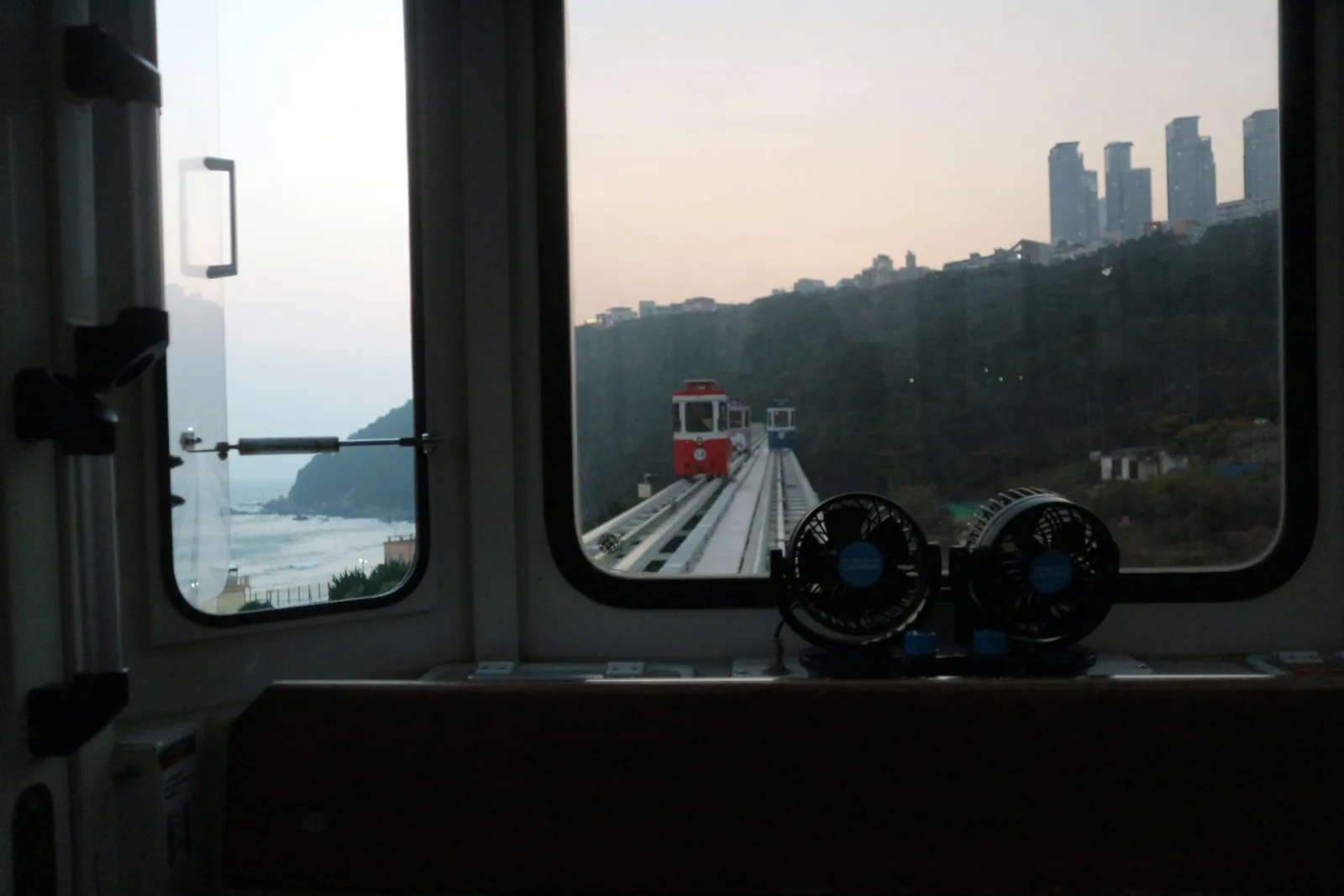
Children under 36 months ride free but count towards the capsule’s limit of four. A group of five has to split into a two-seat and a three-seat car, unless one of the five is a child aged seven or under (born in 2020 or later); then all five can ride in a four-seat car.
Paying with a foreign card
You can book in English on the official site, but its English FAQ warns that, because the authentication method changed, some cards may not be accepted. When a foreign card fails, the obvious fallback is a booking platform such as Klook. On 7 October, though, Klook’s Blue Line Park product sold only Beach Train tickets. The product name mentions the Sky Capsule, but the only options were Beach Train rides from Mipo or from Songjeong. For the capsule, you need the official site or the ticket office.
If you want a Beach Train seat settled before you go, you can book Blue Line Park Beach Train tickets on Klook. On 7 October, for a sample date of 20 October, a single adult ride was ₩9,800, a little under the park’s ₩10,000; round trips started at ₩13,700 and all-stops tickets at ₩15,700. You choose a departure time when you buy, and cancellation is free up to 24 hours before. Children aged 3 and over pay the adult rate. If you only need the one ride from Cheongsapo back to Mipo, the ₩8,000 ticket on site is cheaper.
Dalmaji-gil, on another day, up the hill
On the hill above the tracks runs Dalmaji-gil, an 8 km road over Wausan from Haeundae to Songjeong, lined with cherry and pine trees, cafés and galleries, with Haewoljeong Pavilion at the top of the pass. Visit Busan, the city’s tourism site, writes about its yellow leaves in autumn. Busan colors later than the mountains of central Korea; our foliage timing calendar compares the regions.
For a half day, I would leave out the hill road and keep to the coastal path below. Dalmaji-gil is a road with traffic, so it is a long walk, and the easier way up to Haewoljeong is a town bus from Haeundae Station. If you have more than a day in Busan, go up on a different morning. Fitting Haeundae together with the rest of Busan over two days is covered in our Busan attractions guide.

A half-day order: Thursday 15 October as an example
Take Thursday 15 October 2026, sunset 17:49. The window used here was already sold out when we checked on 7 October, so treat it as a pattern and shift the date. If two of you have a 17:00–17:30 capsule from Cheongsapo, you pay ₩50,000, or ₩25,000 each.
| Time | What | Notes |
|---|---|---|
| 14:30 | Start at Mipo and walk the Green Railway | Mipo is about 800 m, 10–15 minutes, from exit 7 of Jung-dong Station on subway Line 2 |
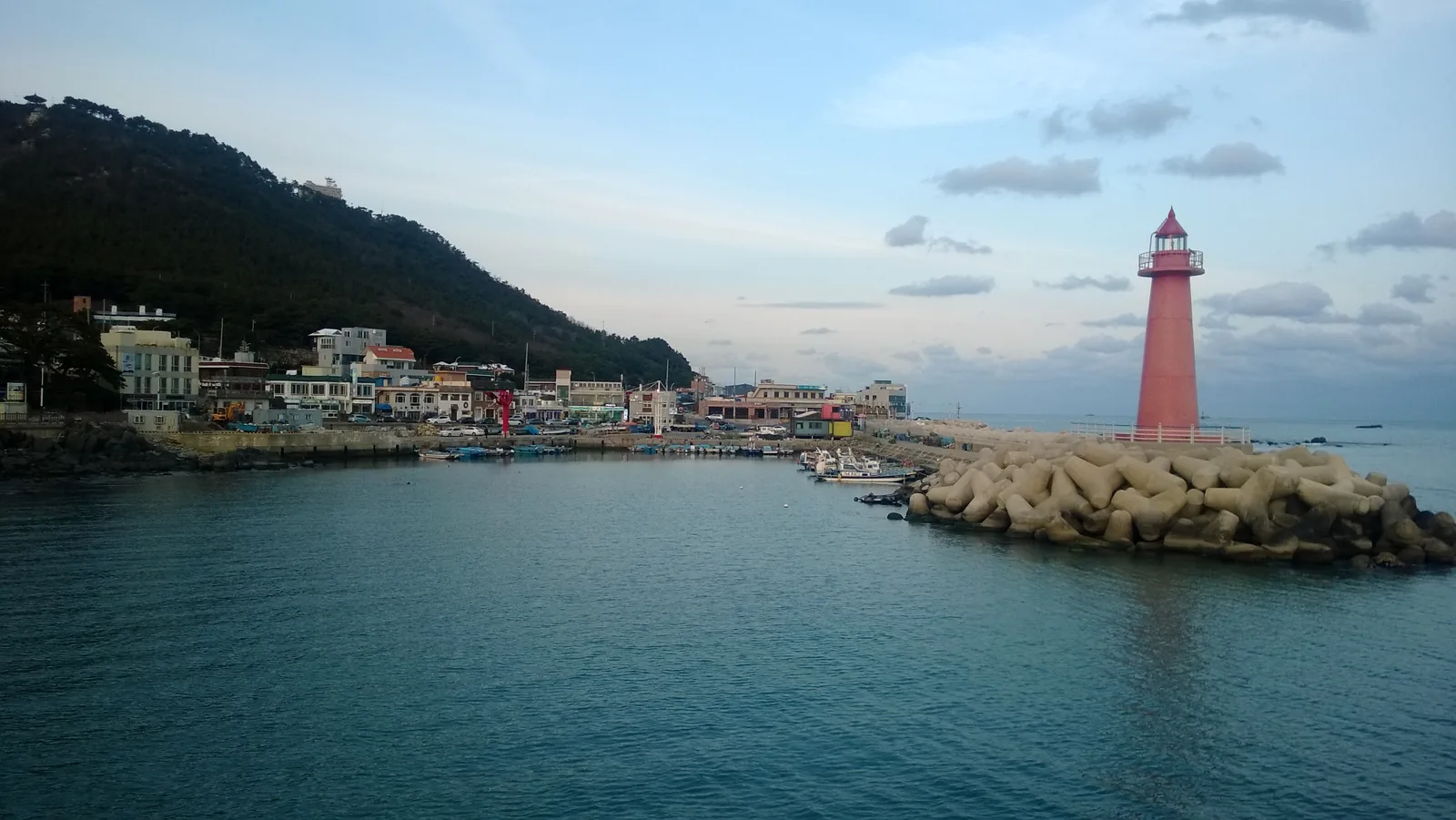
| about 15:10 | Arrive at Cheongsapo | About 2 km; the harbor and its lighthouses |
| 15:30–16:30 | Daritdol Skywalk and back | 0.6 km from Cheongsapo; open 07:00–21:00 from September to November |
| 16:50 | Reach the Cheongsapo capsule station | Entry from 17:00; have the QR ticket ready on your phone |
| about 17:10–17:45 | Capsule to Mipo | Heading west, into the sunset |
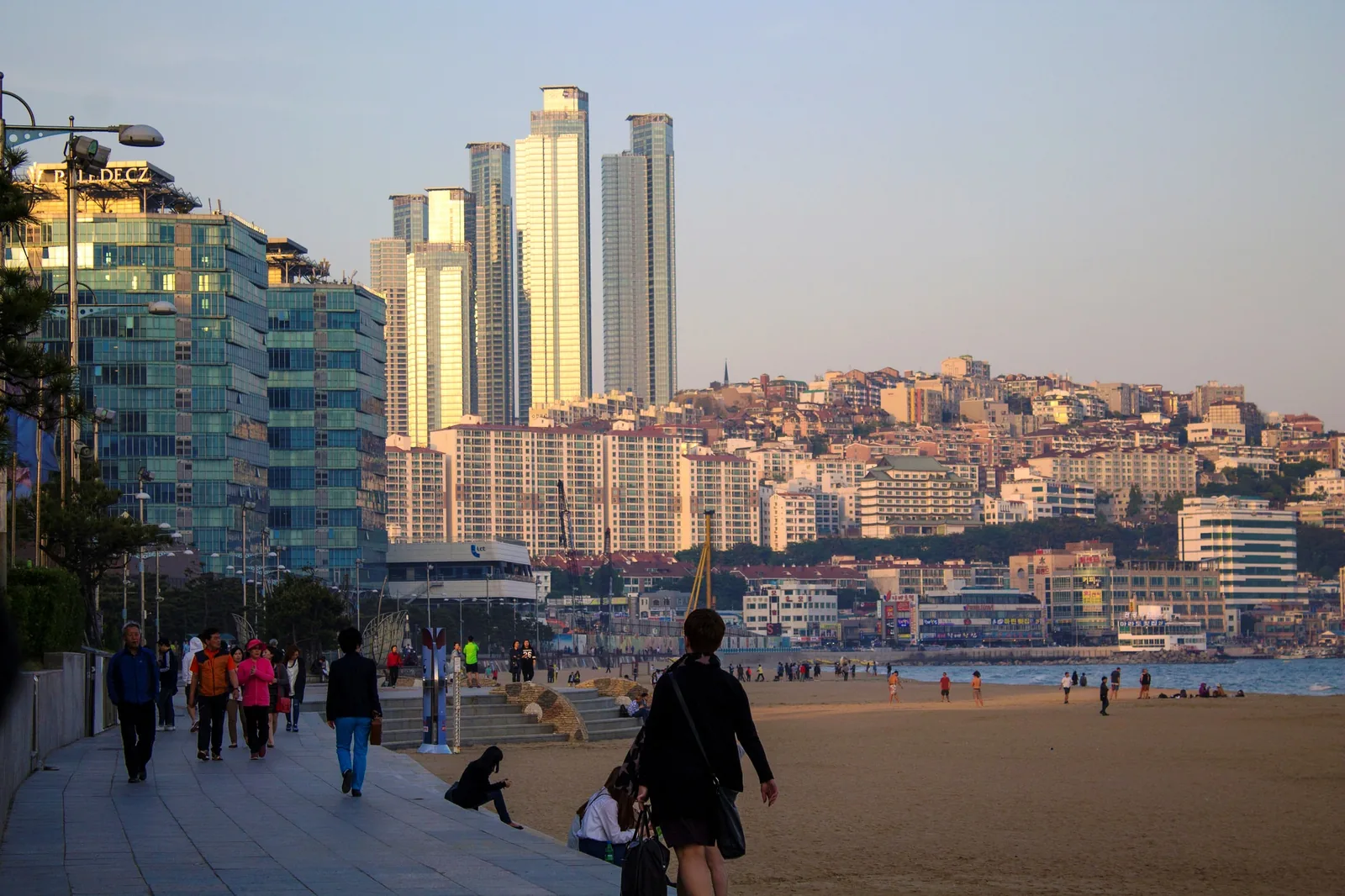
| 17:50 onward | Haeundae Beach | Mipo is at the east end of the beach |
Without a capsule ticket, walk the same way, see the Daritdol Skywalk, then take the Beach Train from Cheongsapo back to Mipo. On October afternoons there are about three trains an hour from Cheongsapo to Mipo, and the last leaves at 19:42.
Carry-on-size cases are allowed on both rides, but space is tight and bulky luggage may be refused. Mipo, Cheongsapo and Songjeong stations have lockers, which take only ₩1,000 notes.
Set one alarm for 07:00 on a Tuesday. If you get a ticket, ride the capsule from Cheongsapo; if not, take the ₩8,000 train from the same spot. Either way, you will already have seen the sea on the 2 km walk out.
Fares, timetables and availability as of 7 October 2026.
Sources & verification
A source-based guide. Check the linked operator information again before you travel.
- Haeundae Blue Line Park: Fares (English)Sources checked:
- Haeundae Blue Line Park: Fare restructuring from 1 May 2026 (notice, Korean)Sources checked:
- Haeundae Blue Line Park: Reservation guide and refundsSources checked:
- Haeundae Blue Line Park: Usage rules (Korean)Sources checked:
- Haeundae Blue Line Park: FAQ (English)Sources checked:
- Haeundae Blue Line Park: FAQ (Korean)Sources checked:
- Haeundae Blue Line Park: Sky Capsule operating hoursSources checked:
- Haeundae Blue Line Park: Sky Capsule entry windows by seasonSources checked:
- Haeundae Blue Line Park: Beach Train hours and stationsSources checked:
- Haeundae Blue Line Park: Beach Train timetables by stationSources checked:
- Haeundae Blue Line Park: DirectionsSources checked:
- Haeundae Blue Line Park: Daritdol and Haewol skywalk hours (notice, Korean)Sources checked:
- Haeundae Blue Line Park: NoticesSources checked:
- Blue Line Park online booking: Sky Capsule from Mipo (availability checked 7 October 2026)Sources checked:
- Blue Line Park online booking: Sky Capsule from Cheongsapo (availability checked 7 October 2026)Sources checked:
- Korea Astronomy and Space Science Institute: Sunrise and sunset times, BusanSources checked:
- Busan Fireworks Festival: 21st festival overviewSources checked:
- VISITKOREA: Haeundae Green RailwaySources checked:
- VISITKOREA: Dalmaji RoadSources checked:
- Visit Busan: Dalmajigil Road in the fallSources checked:
- r/KoreaTravelAdvice: Sky Capsule tickets, Busan (March–April 2026)Sources checked:
- r/koreatravel: Busan Sky Capsule sunset time (August 2026)Sources checked:
- r/koreatravel: Haeundae Blue Line Park, walking vs train (April 2025)Sources checked:
Help us keep this note useful
A quick response helps us decide what to clarify or recheck. No account or email is needed.