If you are planning a Chuseok holiday day trip with kids in the Seoul capital area, start by checking which places actually open over the holiday. What opens decides the shape of the day. Observatories stay open year-round even through the holidays, while other facility types mostly close on legal public holidays, so check closure days and session times on the booking screen first. Records that deal with crowds point the same way: arrive early and book ahead. The operating and fare figures in this post are publication-time figures checked as of September 2026, and only the arboretum items come from material checked on September 7, 2026.
Filter Holiday Openings Through the Booking Screen First
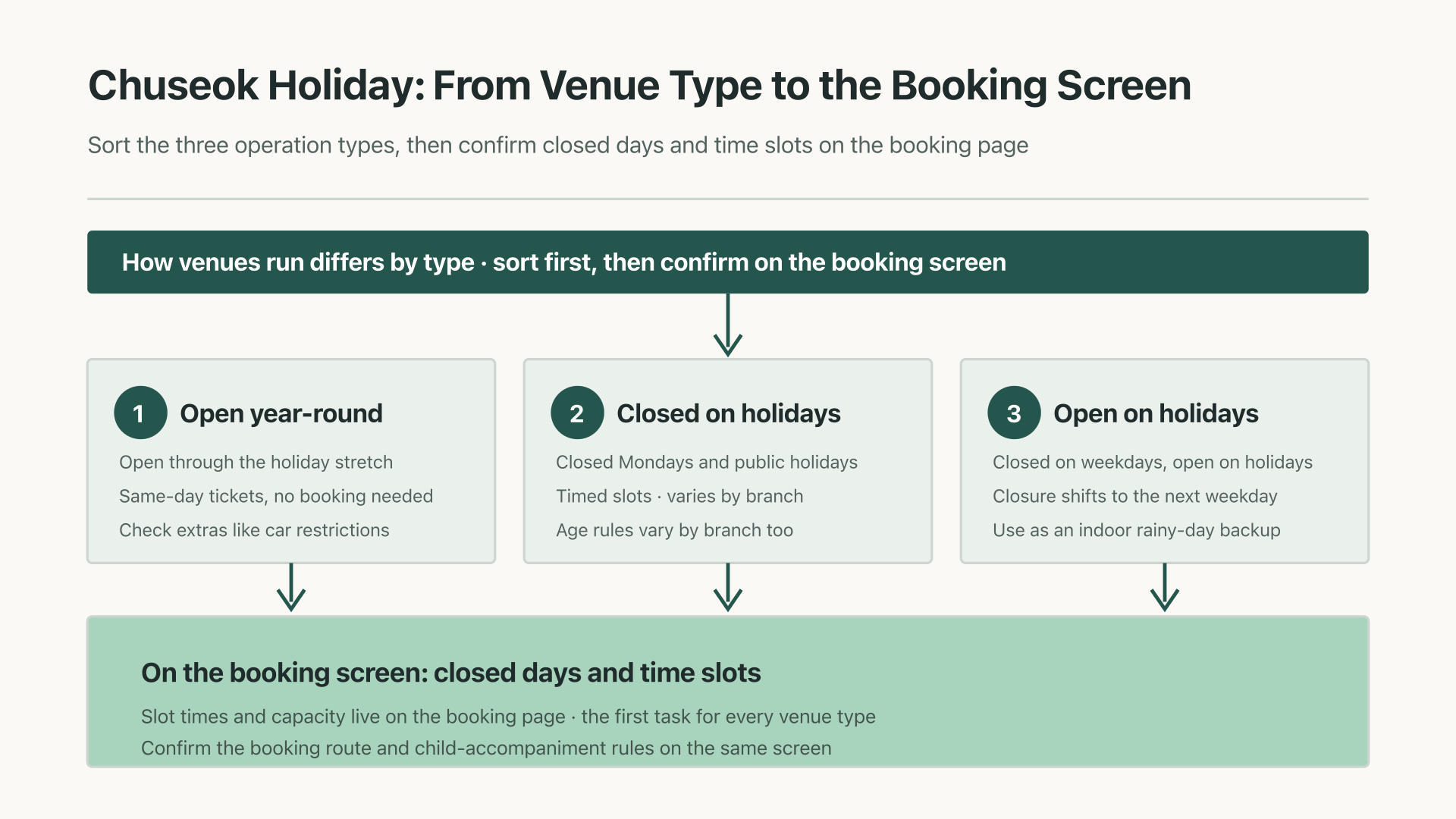
Holiday opening is stated officially in at least one case: N Seoul Tower says it opens on holidays too and runs 365 days a year, and the observatory works on a same-day ticket bought without a separate reservation. The same source carries one exception: if Namsan Park restricts vehicle access, operations can be suspended unavoidably. Over a holiday, check your way up the mountain too.
The opposite type is just as clear. Seoul-type kids cafes (서울형 키즈카페) post official guidance that they mostly close on Mondays and legal public holidays, with differences by branch. They run on a session system, so session times and capacity are confirmed on the reservation page. Booking means picking a session on the Uri-dongnae Kium portal (우리동네키움포털) or Seoul Public Service Reservation (서울시 공공서비스예약), and an accompanying adult guardian is required. The base age range is 0 to 6, preschool age; some branches take children up to elementary school. Add the roundup that many kids cafes and performances require reservations and the note that age limits differ by venue, so your child’s age comes first. What to look at on the booking screen then falls into place. These items come from material checked as of September 2026.
Some closing rules work in the holiday’s favor. Sejong Story and Chungmugong Story (세종이야기·충무공이야기) at Gwanghwamun close on Mondays, but when a Monday falls on a public holiday they open and take the next weekday off instead. The same source presents the National Palace Museum of Korea (국립고궁박물관) next to Gyeongbokgung as a free indoor alternative and names these two as the indoor backups for rainy days and cold days. That is the rain plan for a holiday outing.
For Gyeonggi Province, the Korea National Arboretum (국립수목원) figures come from material checked on September 7, 2026: nursing rooms sit at the main-gate ticket office and beside the Forest Museum, and lockers are usable 09:00–17:00.
A weekend program for children runs Saturdays and Sundays from 10:30 for 60 minutes, and on top of the program reservation, entry and parking reservations are separately required. No official announcement of autumn night openings or foliage special events turned up within this check range, so do not bundle them into the plan as fixed dates. At any facility, the first task is the same: closure days and sessions on the booking screen.
Filter Crowded Hours With the Usual Patterns First
Start from the outdoor park record. Seoul Forest is summarized as best in weekday afternoons and before 10:00 on weekends, with Seongsu and weekends called packed. With kids along, the walk to toilets, shade, and a convenience store decides the spot, as the same piece points out. This pattern is noted in material checked as of September 2026.
The paid theme park record is more specific. A Korean Folk Village (한국민속촌) trip report says rides have no wait on weekdays and about 30 minutes even on weekends, and tips that the Viking, popular with families with children, has a short line. Coming early on weekends gets you parked closer, the same record notes, and it lists compact-car parking at KRW 3,000. These items were also checked as of September 2026.
Market and alley districts carry harsher conditions. The Namdaemun Market record sees weekend peak hours piling street stalls on crowds: alleys very congested, uneven pavement that can make stroller movement uncomfortable. It recommends a quiet weekday morning visit or a baby carrier. A different roundup holds that for plain shopping and browsing, anywhere between 10:30 and 15:00 is fine, and that weekends bring more family visitors, so the alleys get busier. Both sources were checked as of September 2026.
Indoor facilities are about managing the wait. The COEX Aquarium roundup expects waits for popular programs on weekends. From reviews it pulls the trick for long-wait weekends: arrive 30 minutes before the mermaid show and book the boat ride first. The same source links it directly to the subway station, which is why it keeps landing on the candidate list for rainy days and for midsummer and midwinter. This item was also checked as of September 2026.
These hour records describe the usual weekday and weekend pattern. For a holiday outing, apply the same principle with one extra margin: earlier arrival and advance booking.
The table’s hours come from material checked as of September 2026.
| Place type | Pattern in the record | How to use it |
|---|---|---|
| Outdoor park (Seoul Forest) | Weekday afternoons and before 10:00 on weekends are the best times | Check the walk to toilets, shade, and a convenience store first |
| Paid theme park (Folk Village) | No wait on weekdays, around 30 minutes on weekends | Arrive early and park close |
| Market and alleys (Namdaemun) | Weekend peak congestion, strollers may struggle | Weekday morning visit or a baby carrier |
| Indoor facility (aquarium) | Waits for popular programs on weekends | Arrive 30 minutes before the show, then book the boat ride |
Lock the Day With One Transit Axis and Booking Order
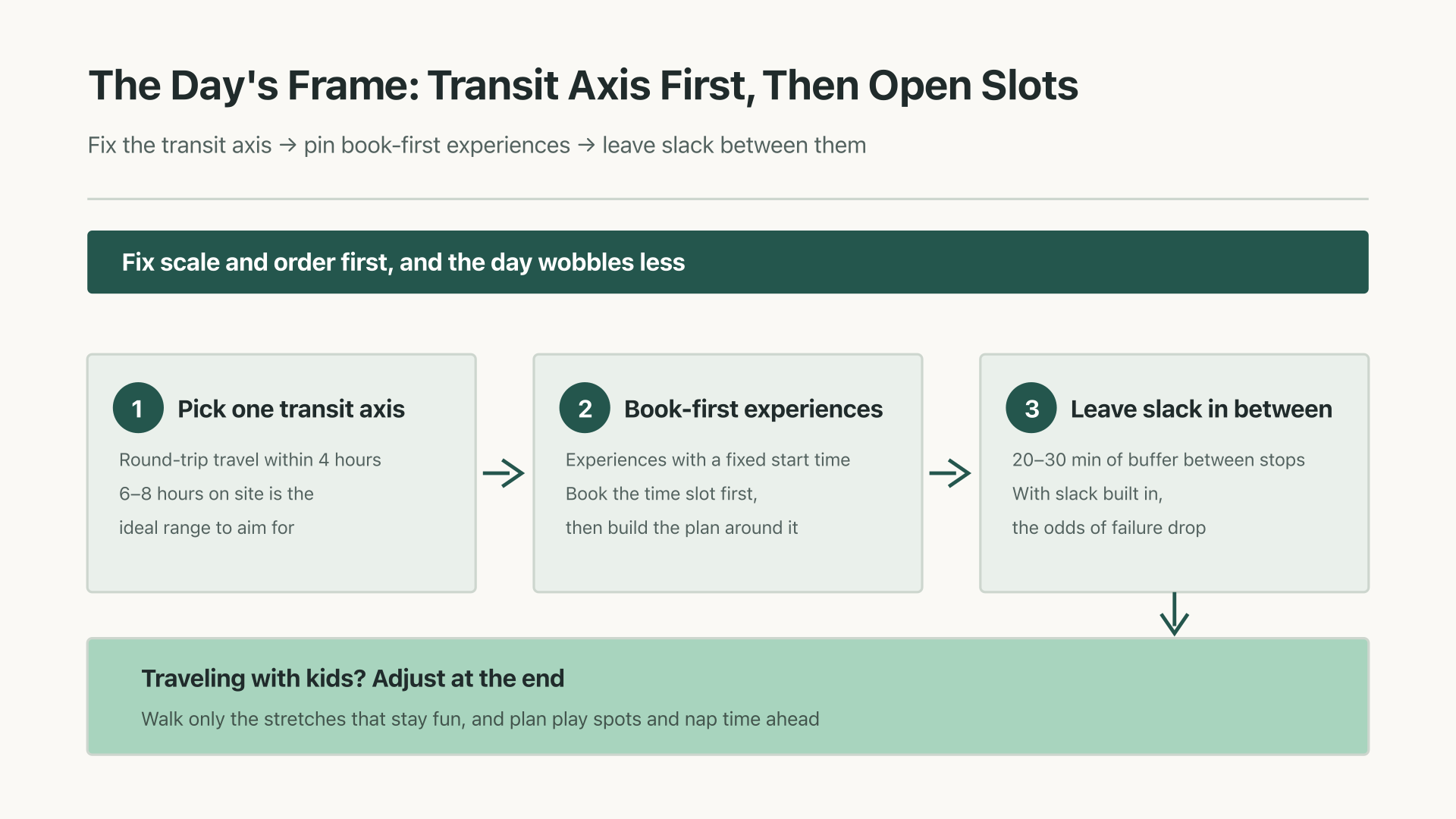
Decide the scale first and the day wobbles less. A general day-trip roundup calls round-trip travel within 4 hours and 6–8 hours on site the ideal range. Its Gapyeong example: ride the Gyeongchun Line down to Gapyeong Station, connect by shuttle bus, and bundle Nami Island and Petite France, so public transport alone covers the day. The hours and fares in this section come from material checked as of September 2026.
For order, pin booking-first experiences onto the timetable. Gapyeong Rail Bike (가평레일바이크) moves to fixed departure times, so book its time slot before other places and attach nearby stops around it. A half-day Korean Folk Village course goes folk village, one performance, lunch, then the play village, with shuttle buses leaving from Suwon Station and Gangnam Station. Both are the same structure: a booking-first experience pinned to a transit axis.
Guidance also exists for cutting the route to a child’s limits. For toddlers and lower elementary grades, the start of the forest path, the valley trail, and the suspension bridge are enough; aiming for the summit is advised against. Jaraseom (자라섬), parts of the Garden of Morning Calm (아침고요수목원), and Supullo Samhoe-ri (수풀로 삼회리) are comparatively easy with a stroller, but the Yeoninsan valley trail, Unaksan, and Myeongjisan are not stroller courses. After heavy rain, water levels in the mountains and valleys can rise, so take care; suspension bridges can limit entry for strong wind, heavy rain, or facility inspection.
A fall event can join the route too. The Jaraseom Autumn Flower Festival has this year’s dates posted, September 12 to October 5, and the same source names it the top recommendation for September.
These dates are a notice from material checked as of September 2026. Mark the calendar first, then watch the official channel for changes.
In the city, gaps act as the safety net. A day-course roundup linking Incheon’s original town center with Songdo holds that 20–30 minutes of blank time between stops lowers the odds of failure. For families, it proposes a layout centered on museums and Central Park with less market time, and names comfortable shoes because the Open Port alleys have slopes and stone paving. Its rain fallback: shift to indoor-centered stops and keep the park walk short.
A real family’s day record points the same way. A Seoul schedule by a three-generation family traveling with four kids made two planning axes, getting to each destination without transfers and choosing sights within a close range, and filled the day with a route that went by bus to the National Children’s Science Museum (국립어린이과학관) first, passed through Daehangno, and continued to Insadong. The same record calls it a satisfying day in which the kids got to move around plenty, and adds the judgment that traveling with children means thinking through play spaces and nap times in advance.
Here is how to decide
- Holiday openings split by facility type, so look at closure days and sessions on the reservation page first.
- Gauge crowds by the usual patterns, then give yourself one extra margin over the holiday: earlier arrival and advance booking.
- Pick one transit axis, pin booking-first experiences to the timetable, and leave blank gaps between stops.
Images are examples to aid understanding.
Last checked: 2026-09-13
Sources & verification
A source-based guide. Check the linked operator information again before you travel.
- N Seoul Tower, official FAQ on holiday operation and observatory ticketsSources checked:
- Supportimes, Namdaemun Market weekend crowds and stroller accessSources checked:
- BTSunrise blog, Korean Folk Village visit record with wait and parking notesSources checked:
- Yugacrew, Seongsu Seoul Forest kids outing recordSources checked:
- Yugacrew, COEX Aquarium with kids roundupSources checked:
- WHEREVER, domestic day trips in KoreaSources checked:
- Dongwoo blog, Gapyeong foliage visit and Rail Bike booking orderSources checked:
- Gamtan Travel, Korea National Arboretum reservation and facilitiesSources checked:
Illustrations are examples to aid understanding, not photographs taken on site. Actual photographs have separate source credits.
Continue planning
An Autumn Trip Near Seoul You Can Reach by Subway: A Complete Guide to the Bukhansan Dulle-gil — Recommended Sections, Difficulty, and Foliage Season
A subway-reachable autumn walk on the Bukhansan Dulle-gil: distance, difficulty and timing for sections 9, 10, 11 and the beginner fortress route.
Choosing an autumn foliage mountain: Namsan Sky Forest Trail vs. a Seoraksan day trip from Seoul
Namsan Sky Forest Trail or a Seoraksan day trip from Seoul: the choice splits by half a day versus the whole day, with hours, access, physical demand and foliage timing compared.
A Rainy Day in Seoul, Indoor Things to Do — From the National Museum of Korea to Deoksugung and Jeongdong Cafés
A rainy-day Seoul route done by subway alone: free permanent galleries at the National Museum, 1,000-won Deoksugung, Jeongdong cafés, plus closing days.
Help us keep this note useful
A quick response helps us decide what to clarify or recheck. No account or email is needed.