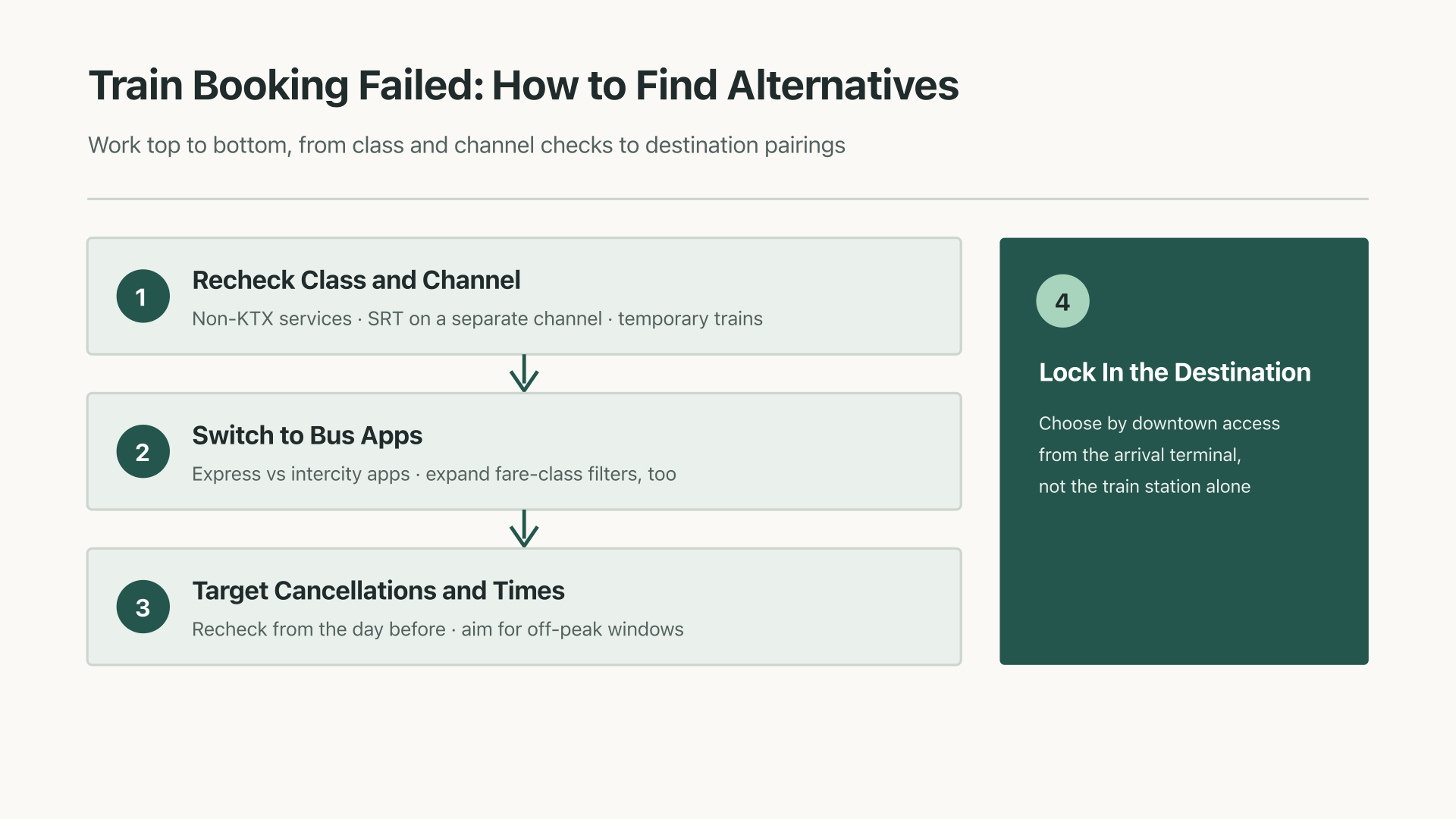
If KTX tickets for Chuseok are gone, widen the train class and the booking channel on the rail booking screen to re-check remaining departures first, then move over to the express and intercity bus booking apps and expand the view there down to fare classes as well. Regular Chuseok train booking runs September 7–11, 07:00–13:00, with station counters closed during the booking window — sales run only online through the Korail+ app and website, and leftover seats are sold at station counters after 15:00 on September 11 (confirmed as of August 2026). Choose the final destination by where its arrival terminal sits, not by the train station; the destination-by-destination order is laid out below.
When KTX shows nothing, widen the class and the channel first
If the booking screen showed KTX only, widening the class filter comes first. A Seoul–Gangneung timetable guide advises comparing the train classes — KTX, SRT, ITX, Saemaeul, Mugunghwa — together with departure times, and over the holiday stretch temporary trains are added to the schedule. The fine print still applies: some routes run a different booking calendar for the holiday, and without an advance booking seats can get hard to secure.
The channel splits as well. SRT departs from Suseo Station (수서역) and uses a booking channel separate from KTX, which adds one more screen to check. On ITX-Cheongchun (Yongsan–Chuncheon), non-reserved and standing tickets became available in Korail Talk from late February 2026, and the non-reserved self check-in service expanded in the same period; that is from a Korail press release and assumes the app is updated to a recent version.
Fares and seat capacity changed too. With the KTX–SRT integration of September 1, 2026, KTX fares fall by an average of 10% to former SRT levels, and the seat count is set to grow by at least 15,000 on weekdays and 17,000 on weekends (confirmed as of August 2026). Whether KTX-Eum trains on the Gangneung and Jungang lines fall inside the fare cut is something the same source leaves provisional.
Holiday timetables themselves can differ, so switch between classes in Korail Talk and re-check the remaining seats for your travel date.
For buses, two booking apps and the fare-class view do half the work
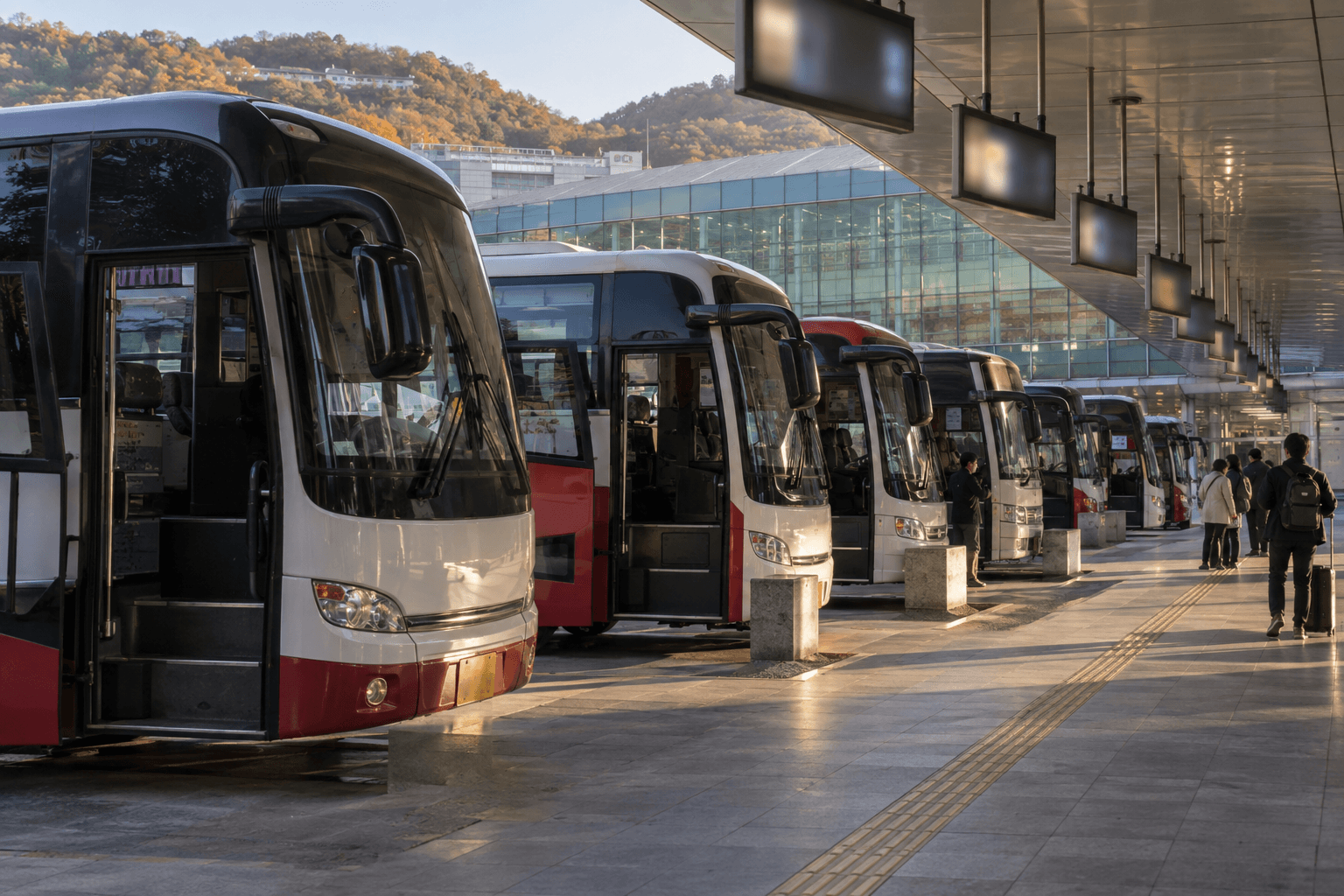
Which app you need depends on the departure terminal. Express buses are booked on Kobus (kobus.co.kr) or the express bus T-money app (고속버스 티머니), while intercity buses go through the intercity T-money bus app (티머니 시외버스) or Bustago (버스타고). In Gangnam, the Seoul Express Bus Terminal (서울고속버스터미널) is the express side and Dong Seoul Terminal (동서울종합터미널) is centered on intercity buses, though a first-hand account of leaving from Dong Seoul records intercity and express buses operating side by side there. Sokcho shows that the arrival end can split the same way: two bus terminals, express and intercity, about 3 km apart.
The fare-class view is easy to miss. Seats divide into standard 4-across, udeung 3-across, and premium recliners, and the fare that surfaces in an online search is often the standard grade, while a large share of actual dispatches are udeung or higher, so the amount paid runs above the displayed number — a pattern documented in a rider’s account.
Travel time varies by route, but for Sokcho the Gangnam express takes about 2 hours 10 minutes to 2 hours 30 minutes and the Dong Seoul intercity about 2 hours 20 minutes; in peak season, Friday-afternoon and Saturday-morning departures are often sold out on the day, and the advice to book ahead repeats across the guides.
Settle the departure terminal and the app first, then expand the fare-class view until the remaining seats are visible.
After the booking window closes, aim at cancellations and peak times
Missing the regular booking window does not end the hunt. Korail reservations can be cancelled free of charge until close to departure, so cancellation seats resurface near the departure time, and once regular booking finishes, leftover seats also go on sale at station counters (confirmed as of August 2026).
Demand clusters at predictable times. Trains are most crowded on Friday afternoon through evening and on Sunday afternoon, and the bus pattern overlaps: Friday-afternoon and Saturday-morning departures are commonly sold out on the day. During the holiday grand transportation period, ticketing for sightseeing train packages is blocked altogether, so a group package will not route around the shortage.
From the day before departure, alternate between Korail Talk and the bus apps to re-check cancellations.
The train-and-bus combination splits by destination
The travel times and frequencies in the table below reflect when each source pulled its data: the Gyeongju figures were confirmed in August 2026, and the Gangneung frequencies were queried in September 2026.
| Destination | What is left to book | Decision point |
|---|---|---|
| Gyeongju | KTX Gyeongju Station sits out in Geoncheon-eup (건천읍), 20–40 minutes by bus from downtown; the express terminal within walking distance of the city center is the alternative | Split the choice by where your lodging sits |
| Gangneung | 14 departures a day from Seoul, first at 05:06 and last at 22:14; SRT leaves from Suseo on a separate channel | Check two booking screens instead of one |
| Sokcho | No direct rail as of 2026; Gangnam express or Dong Seoul intercity | Counting the transfer time, the direct bus is faster and simpler |
| Jeonju and Yeosu | Yongsan departures are the rule, with only some trains running via Seoul Station; the express bus is the alternative | Read the departure-station label first |
Gyeongju also keeps a conventional-train fallback: in the same route comparison, ITX-Saemaeul and Mugunghwa trains take longer than the KTX but cost less, and their schedule is not dense. For farther cities such as Busan, Daegu, Daejeon, and Gwangju, a day-trip roundup credits the KTX with turning long-distance day trips into a realistic option, while Seoul–Sokcho has no train at all, which leaves the bus as the single axis.
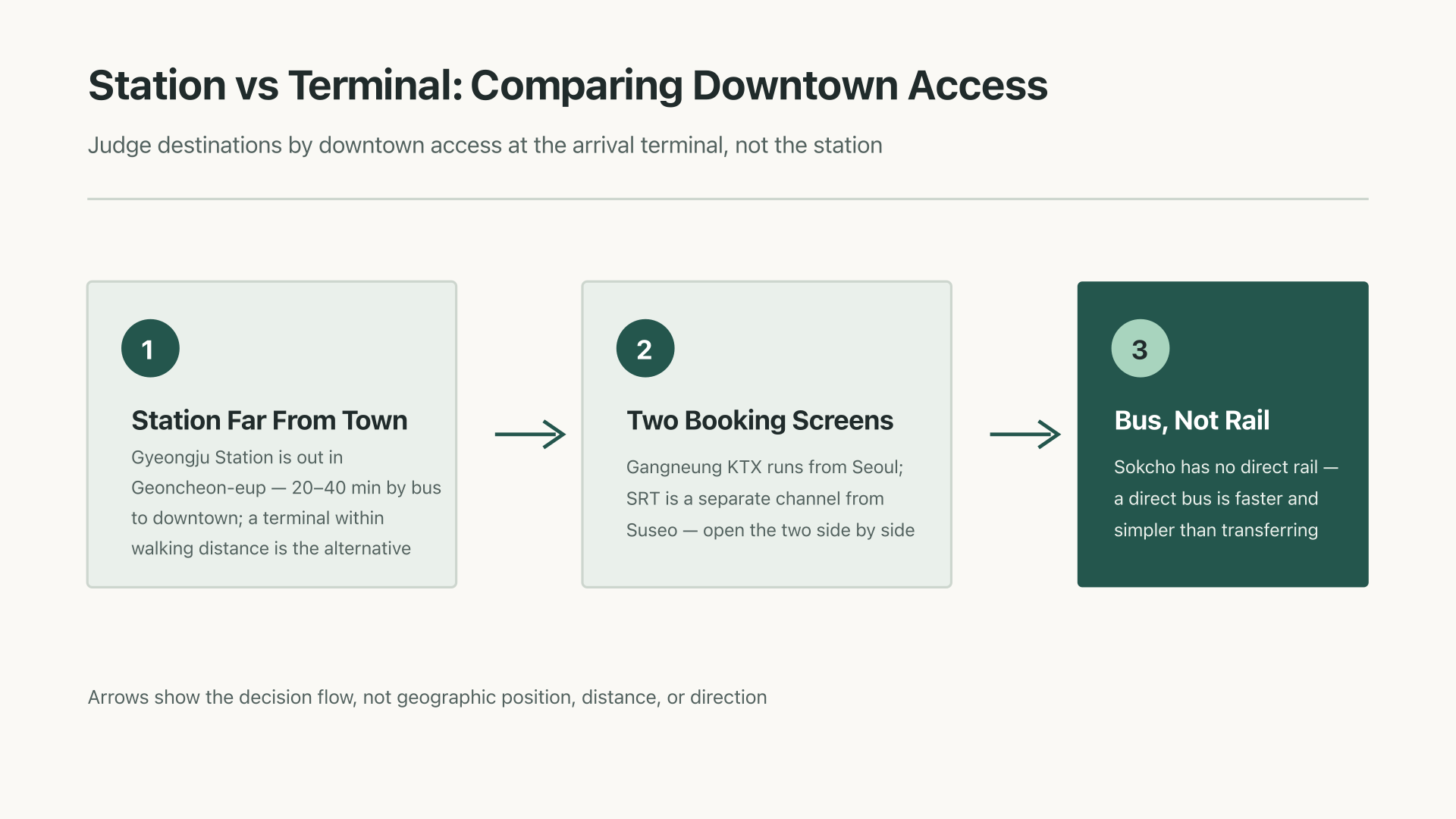
The narrowing order in one pass: change the class and the channel on the rail booking screen to re-check non-KTX departures and SRT; if that stalls, open Kobus or the T-money apps and expand the view down to bus fare classes; and fix the destination by where the arrival terminal meets the city, not by the train station. Cancellation seats keep reappearing as departure approaches, so coming back to the booking screens from the day before is the move that remains.
Sources
- LACHA Guide Team, regional-city train and bus access guide (published 2026-08-24; booking schedule and fares stated as of August 2026): https://lacha.co.kr/korea-guide/ko/korea-regional-cities-train-bus-access/
- Korail press release, non-reserved self check-in expanded to ITX-Cheongchun (published 2026-02-26): notice on info.korail.com
- Makka, Seoul–Gangneung train guide (queried 2026-09-07): https://makka.co.kr/train/seoul/gangneung
- totdragon blog, comparison of domestic destinations by public transport: https://rapael1004.com/entry/%EB%9A%9C%EB%B2%85%EC%9D%B4%EB%8F%84-%EC%99%84%EB%B2%BD%ED%95%98%EA%B2%8C-%EC%A6%90%EA%B8%B0%EB%8A%94-%EB%8C%80%EC%A4%91%EA%B5%90%ED%86%B5-%EA%B5%AD%EB%82%B4-%EC%97%AC%ED%96%89%EC%A7%80-%EC%B6%94%EC%B2%9C-BEST-4
- mustarddata, Jeonju–Seoul KTX guide: https://train.mustarddata.com/KTX/schedule/route/%EC%A0%84%EC%A3%BC-%EC%84%9C%EC%9A%B8/
- Sokcho Hangari Mulhoe, how to get from Seoul to Sokcho: https://mulhoe.co.kr/stories/seoul-to-sokcho/
- Angie Magazine, riding Sokcho intercity and express buses (in English): https://angiemagazine.com/sokcho-guesthouses-without-a-car/
- Manyeo Travel Agency, Gyeongju KTX travel package notice: https://mntour.tistory.com/5928
- WHEREVER, day trips from Seoul: https://wherever.kr/%EA%B5%AD%EB%82%B4-%EB%8B%B9%EC%9D%BC%EC%B9%98%EA%B8%B0-%EC%97%AC%ED%96%89/
- Issue Maker 69, transport options from Seoul to Gyeongju: https://issue69.tistory.com/entry/%EC%84%9C%EC%9A%B8%EC%97%90%EC%84%9C-%EA%B2%BD%EC%A3%BC%EA%B9%8C%EC%A7%80-%EA%B0%80%EB%8A%94-%EA%B5%90%ED%86%B5%ED%8E%B8
Images are examples to aid understanding.
Pick your next move
- Switch the train class and the channel on the booking screen and re-check non-KTX departures and SRT first.
- For buses, fix the departure terminal, then open Kobus or the T-money apps and expand the view down to the fare classes.
- Choose the destination by how the arrival terminal reaches downtown, not by the train station.
Last checked: 2026-09-13
Sources & verification
A source-based guide. Check the linked operator information again before you travel.
- LACHA Guide Team, regional-city train and bus access guideSources checked:
- Makka, Seoul–Gangneung train guideSources checked:
- mustarddata, Jeonju–Seoul KTX guideSources checked:
- Sokcho Hangari Mulhoe, how to get from Seoul to SokchoSources checked:
- Angie Magazine, riding Sokcho intercity and express busesSources checked:
- Manyeo Travel Agency, Gyeongju KTX travel package noticeSources checked:
- WHEREVER, day trips from SeoulSources checked:
- Issue Maker 69, transport options from Seoul to GyeongjuSources checked:
Illustrations are examples to aid understanding, not photographs taken on site. Actual photographs have separate source credits.
Continue planning
Chuseok holiday from the Seoul capital area: when to leave, when to return
When Chuseok train and bus tickets open and sell out around the Seoul capital area, which departure and return time slots leave more room, and where the day-trip line falls.
Seoul to Gangneung: KTX or car — when to take which
KTX or car to Gangneung? If the plan stays near the station, Gyeongpo and Anmok, take the KTX-Eum; for Jumunjin, Jeongdongjin or heavy luggage, drive.
Autumn in Seoul: From Gyeongbokgung's Fall Foliage to a Stroll in Bukchon Hanok Village
A one-day autumn walk in Seoul: Gyeongbokgung's late-October foliage, free palace entry in hanbok, then Bukchon Hanok Village, Samcheong-dong and Insadong.
Help us keep this note useful
A quick response helps us decide what to clarify or recheck. No account or email is needed.