
Put the room location before the roof style
For a winter Gyeongju visit without a car, choose a hanok room that makes dinner and the return after dark manageable, then plan one main night sight. A tiled roof and heated floor are appealing, but neither tells you whether the property is central, the room has a bed, or late check-in is possible. Skip an outlying hanok unless you have a workable evening transfer; choose a conventional hotel if floor sleeping or stepping outdoors between buildings would be uncomfortable.
| Your priority | Recommended choice | Question to resolve before booking |
|---|---|---|
| Walking to dinner and back | A room whose actual address fits the central sightseeing area | Is the final walk suitable after dark with bags or limited mobility? |
| Quiet surroundings and a car | An outlying hanok can be considered | Are parking, winter access and the evening return practical? |
| Familiar sleeping comfort | A room explicitly listing a bed | Does this exact room have a bed, rather than floor bedding? |
| Warmth and traditional room layout | A room with confirmed ondol heating | Can you control the temperature, and are bathroom facilities inside the room? |
| A short winter evening | One night sight plus dinner | Can you return without relying on the attraction’s closing time as a bus timetable? |
Hanok is a building type, not one room specification
Start with the room description, not the property’s main photograph. Bed type, bathroom, stairs, heating controls, luggage space and reception hours can differ within one property. If a listing says “ondol room,” establish what bedding is provided and whether getting up from floor level suits everyone in the party. Do not infer a western bed from the word “hotel.”
Ask the property to confirm your actual arrival time and a check-in route you can use in English or another shared language. There is no single hanok-wide check-in cutoff. An unattended reception, instructions sent through a booking app and a staffed hotel desk are different arrangements, especially after an evening train arrival.
Before paying, save three destinations on the map: the accommodation, the dinner area and the evening return pickup. If their positions require a taxi every time, include those transfers in the decision. A remote room may be a good choice for drivers; it is less useful for a visitor who mainly wants to walk between central sights.
For a conventional hotel alternative, compare Hotel Palace Gyeongju room types and dates. The reviewed property page identifies 11 Bonghwang-ro 51beon-gil and lists bed-based room types, which makes it a useful comparison if floor sleeping is unsuitable. This is a hotel alternative, not a hanok booking. The issued link contains example dates and one adult: reset the dates and party, then compare the actual room, taxes, total and cancellation conditions before booking.
What actual guests reveal about the trade-off
Gyeongju N Hanok Pension provides a concrete example of why a traditional building does not settle the location or bedding question. These are guests at that specific property, rather than a verdict on every Gyeongju hanok.
On its firsthand Trip.com review page, Chinese-language reviewer 愛玩咖 花姑娘, who stayed with friends in June 2025 and posted on 9 July, described a comfortable room but a remote location requiring taxis. A family reviewer displayed as Guest User, staying in March 2025, posted on 22 April that staff helped with a 19:00 check-in. Korean-language reviewer 디비 아트, staying in April 2025 and posting on 12 May, had expected a bed and found a different sleeping arrangement.
Taken together, the reviews show three separate trade-offs: a good room can still add transfers; one helpful evening arrival does not establish a general late-check-in policy; and room type matters as much as the property name. Use them to frame your booking questions, rather than copying a reviewer’s experience into your own reservation.
For transport from Seoul, the Gyeongju KTX guide helps decide whether one night is worth the station transfer. Add the actual room address before judging the final leg.
Compare winter evening cutoffs
The following operating details were checked against Gyeongju City’s central-sights guide and admission page on 1 October 2026. They are attraction times, not transport departure times.
| Sight | Listed access | Ticket or entry cutoff | Standard admission |
|---|---|---|---|
| Donggung Palace and Wolji Pond | 09:00–22:00 | 21:30 | Adult KRW 3,000; youth KRW 2,000; child KRW 1,000 |
| Woljeonggyo Bridge | 09:00–22:00 | No separate cutoff in the cited central-sights listing | Free |
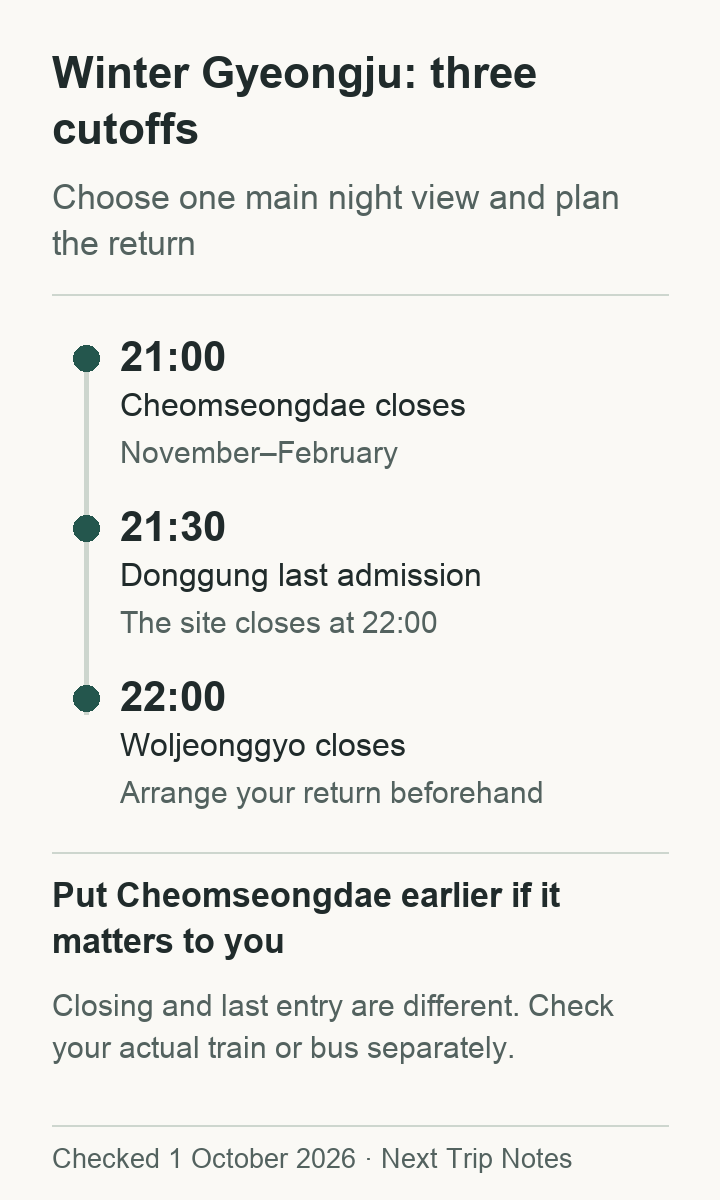
| Cheomseongdae | 09:00–22:00 normally; until 21:00 in November–February | Plan the winter visit before 21:00 | Free |
From the listed fees, two standard-fare adults pay KRW 6,000 at Donggung and Wolji; two adults and two children pay KRW 8,000, assuming those ticket categories apply. Adding the bridge or Cheomseongdae adds no attraction admission in this comparison. Meals, taxis and accommodation are separate.
The other useful calculation is time: Cheomseongdae’s listed winter access ends 60 minutes earlier than its general closing time, and 30 minutes before Donggung and Wolji’s ticketing cutoff. If you want both, put Cheomseongdae earlier instead of leaving it for the very end. Neither cutoff is a target arrival time.
Use one paid sight as the main evening
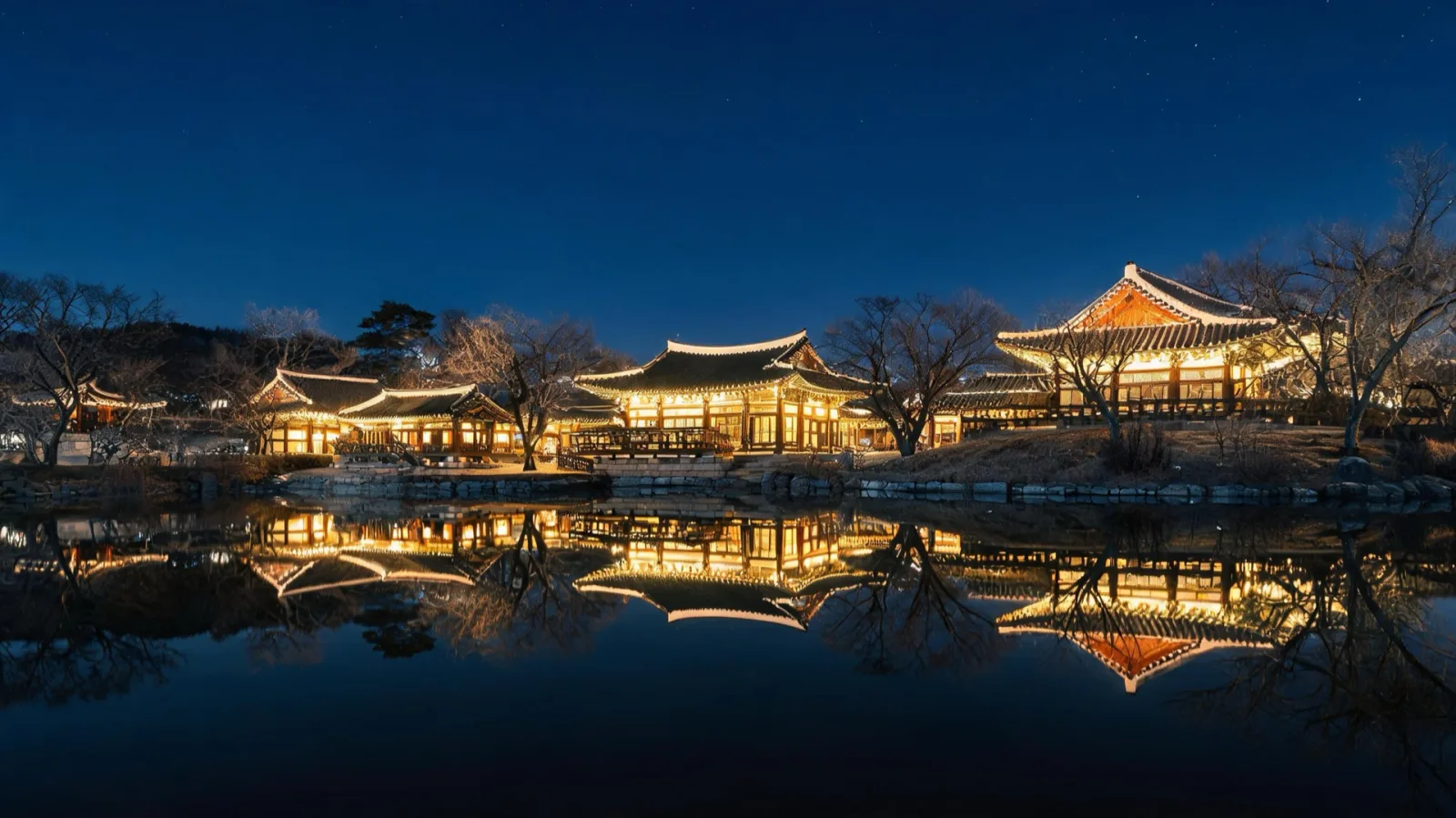
Make Donggung and Wolji the main stop when the pond-side pavilions and reflections are the reason for going out. Arrive with time to enter and walk before the cutoff, then return to dinner or the room. Do not wait until a fixed 18:00 lighting promise: sunset and the lighting programme are separate from the opening hours.
For a shorter free outing, choose Woljeonggyo. Add a second stop only if the return route and everyone’s energy allow it. The Seoul-to-Gyeongju KTX guide compares a late return with staying overnight; it is a better next step than assuming all three sights fit a short walk.
Japanese solo traveler zaru, on a 19 May 2025 daytime visit after a night tour the previous evening, found Woljeonggyo less striking in daylight than under illumination. That comparison supports saving the bridge for after dark when its night appearance matters to you. It does not establish winter crowd levels or clear weather.
Build warm breaks into the day
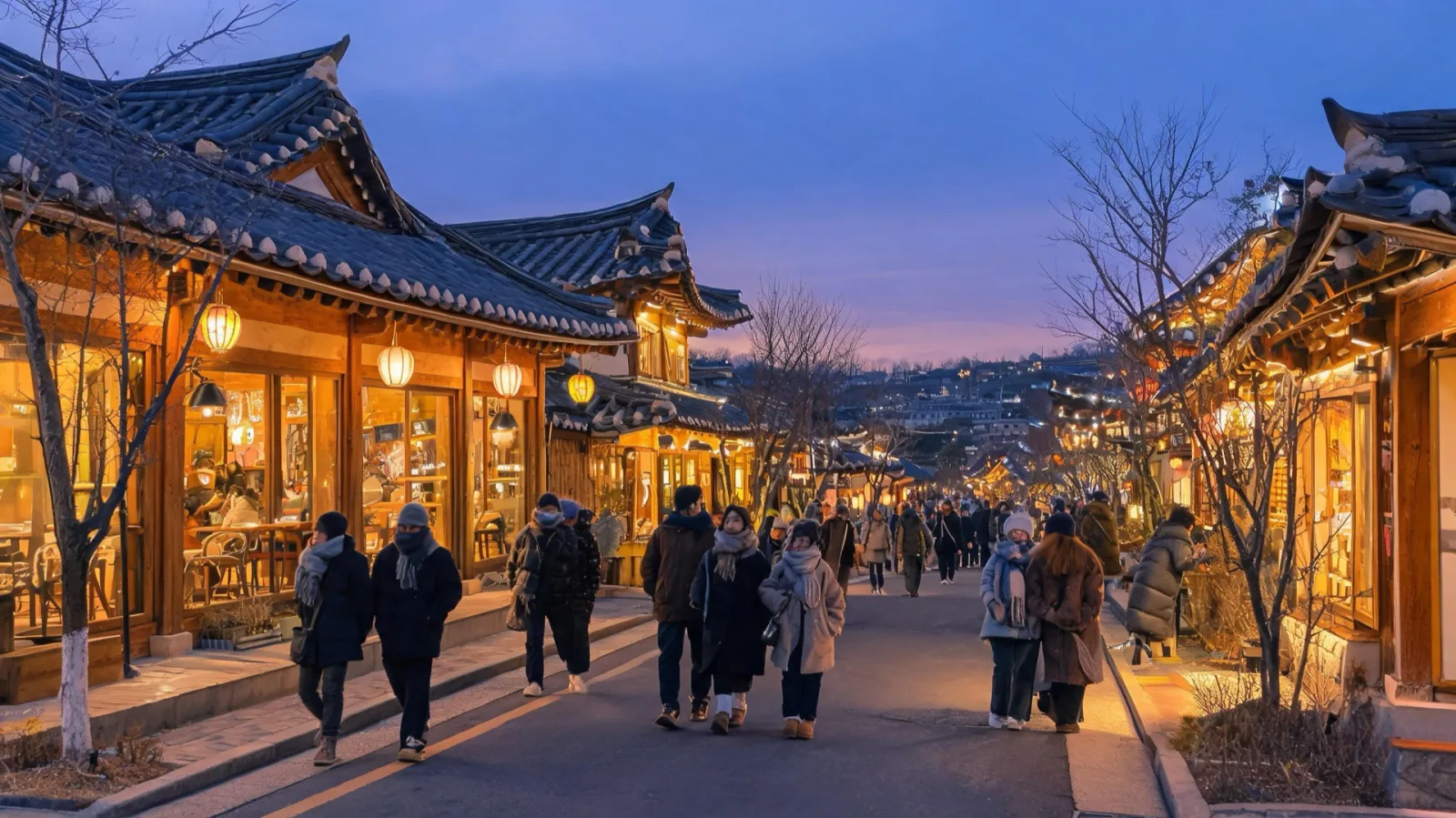
A workable winter plan breaks up outdoor time with a meal or an indoor stop. Browse the central area in daylight, have an early dinner or warm drink, then go out for the single sight you most want to see. A café before the evening visit is a rest opportunity; it is not a guarantee that nearby cafés will still be serving after the last attraction entry.
Gyeongju National Museum is a useful indoor alternative. The Korea Tourism Organization lists free admission except for paid special exhibitions and identifies separate holiday and closure rules. Keep it as a daytime anchor and use its current calendar when your travel date is a Korean public holiday, rather than treating it as an always-open evening refuge.
Dress for being outdoors, rather than only the journey between warm rooms: a wind-resistant outer layer, gloves and footwear with grip make the evening easier to shorten or extend. A cold-weather route should not depend on crossing slippery stepping stones or standing still for a perfect reflection. If rain, ice or strong wind makes the optional walk unpleasant, go back after the main sight.
A sample one-night plan with a clear stopping point
Use this as an editorial sequence, not a timed transport itinerary:
- Arrive, leave bags using an arrangement confirmed with the accommodation, and visit the museum or central sights in daylight.
- Eat before heading out again. Resolve the route back while you still have time to change the plan.
- If Cheomseongdae is important, put it before its winter 21:00 closure; make Donggung and Wolji the main ticketed visit.
- Add Woljeonggyo only if the return journey and the group still allow it. Otherwise return to the room.
- Leave remote temples or the coast for a separate daytime route, using the Bulguksa and Seokguram guide when relevant.
What can change before your trip
Confirm the exact room’s bedding, heating, bathroom, reception or self-check-in instructions and final arrival time. Check attraction notices, the museum calendar and weather-related access before fixing the evening. If a final train or bus controls your return, verify that service separately; a 22:00 attraction closing time provides no transport guarantee.
Choose the room for the journey you actually want to make. A central hanok with the right bedding and a short night outing is often a better winter plan than a photogenic outlying room followed by several unplanned transfers.
Last checked: 2026-10-20.
Sources & verification
A source-based guide. Check the linked operator information again before you travel.
- Gyeongju City, central sights and winter Cheomseongdae hoursSources checked:
- Gyeongju City, admission feesSources checked:
- Korea Tourism Organization, Gyeongju National MuseumSources checked:
- Trip.com, named firsthand guests at Gyeongju N Hanok PensionSources checked:
- zaru, daytime and night-visit comparison, 19 May 2025Sources checked:
- Klook, Hotel Palace Gyeongju exact property and room comparisonSources checked:
Images are examples to aid understanding.
Help us keep this note useful
A quick response helps us decide what to clarify or recheck. No account or email is needed.