Yufuin’s lodging prices and booking competition are burden enough on their own. For a 1-night, 2-day plan, Hita Onsen is the alternative that keeps access simple: a direct highway bus from Fukuoka Airport takes about 1 hour and 23 minutes, and direct buses also leave from the Hakata and Tenjin bus terminals. Build the trip around a night at a riverside ryokan and a daytime Mameda-machi walk, and the day holds together without repeated transfers. Lowest rates across Hita lodgings also span a wide band, from the KRW 150,000s to the KRW 690,000s (rates as of September 2026). If the trip would end at a day-use bath, though, skip the night. The value of the night comes from the experiences that open in the evening and the morning.
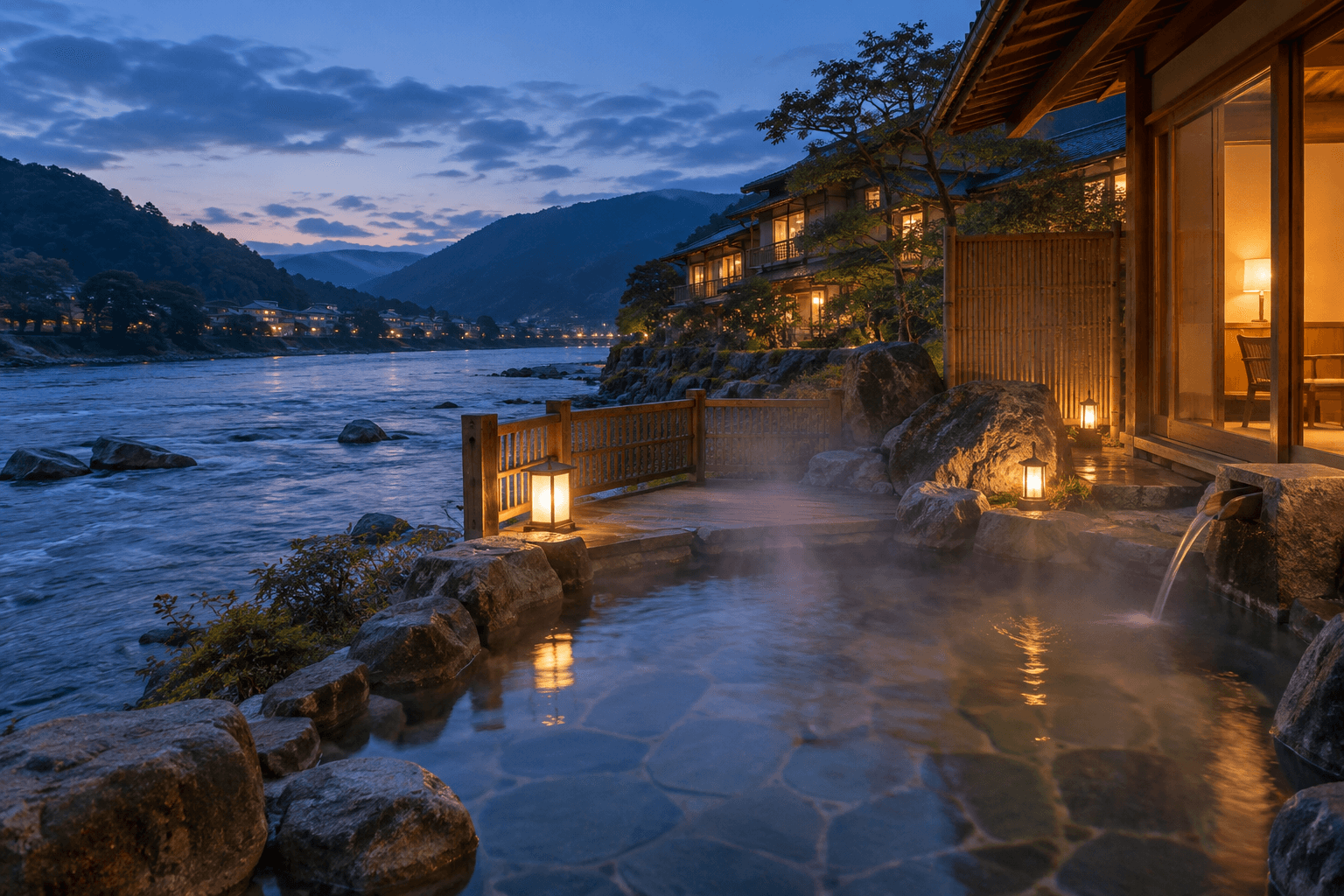
What rooms and baths a night in Hita gets you
On booking sites, Hita’s ryokan spread across grades and price bands. The 5-star Okuhita Onsen Umehibiki lists gardens, a terrace, and a bar, plus free private parking and a shuttle service, with lowest rates from the KRW 690,000s for 1 night for 2 adults. The 4-star Sanso Tensui in Amagase Onsen adds free Wi-Fi and free private parking from the KRW 640,000s, the 3-star Ryokan Tenryu starts from the KRW 190,000s, and in-town lodgings also show rates in the KRW 150,000s (as of September 2026).
Bath conditions are where the properties split hardest. Okuhita Onsen Umehibiki equips its two large public baths overlooking Hibiki Valley with reclining baths, a bedrock bath, and low-temperature saunas, and tattoos are allowed only in the private and family baths, and only for staying guests. The riverside Hananoki RIVER TERRACE is introduced as offering 12 types of baths, with the open-air ones drawing 100% from the source, and it sits 8 minutes by taxi from JR Hita Station. KIZAN Club opens its two private baths by hourly reservation only, for fully private use, with a bathing tax of JPY 150 for adults and JPY 150 for children (as of September 2026).
The last leg from the station to the property is also worth checking before you book. Hananoki RIVER TERRACE runs a JR Hita Station pickup for guests with advance reservation, but the guidance lists only three departures, at 14:40, 15:30, and 16:30, and notes that capacity is limited (as of September 2026). So on the booking screen, match your arrival train time to the pickup times first.
Which way in: from Hakata, Yufuin, or Beppu
Which mode wins depends on where you start (table figures as of September 2026).
| Origin | Mode | Time |
|---|---|---|
| Fukuoka Airport | Direct highway bus | About 1 hr 23 min |
| Hakata | Shinkansen + JR Kyudai Main Line | About 18 min to Kurume, then about 1 hr 20 min on the Kyudai Main Line |
| Beppu | Limited Express Yufu or highway bus | About 75 min (JPY 2,480 one-way) or about 80 min (JPY 1,600) |
| Yufuin | Kyudai Main Line or car | Train 57 min to 1 hr 17 min, car about 46 min (49 km) |
For buses, direct service leaves from both the Hakata Station Bus Terminal and the Tenjin Bus Terminal. One travel log, though, records that few return buses from Hita pass through Tenjin; unlike the outbound ride, lock in a return departure first. The same log notes that the Hita-go (ひた号) is a reservation-free route.
By train, the Limited Express Yufuin no Mori is one option, introduced as a train whose luxurious wooden interior glides through the forest, with the scenery en route to Hita as the selling point. At Hita Station, the automatic ticket machines operate 5:15–23:20 and coin lockers are available, so you can drop your bags and start your first stop (as of September 2026).
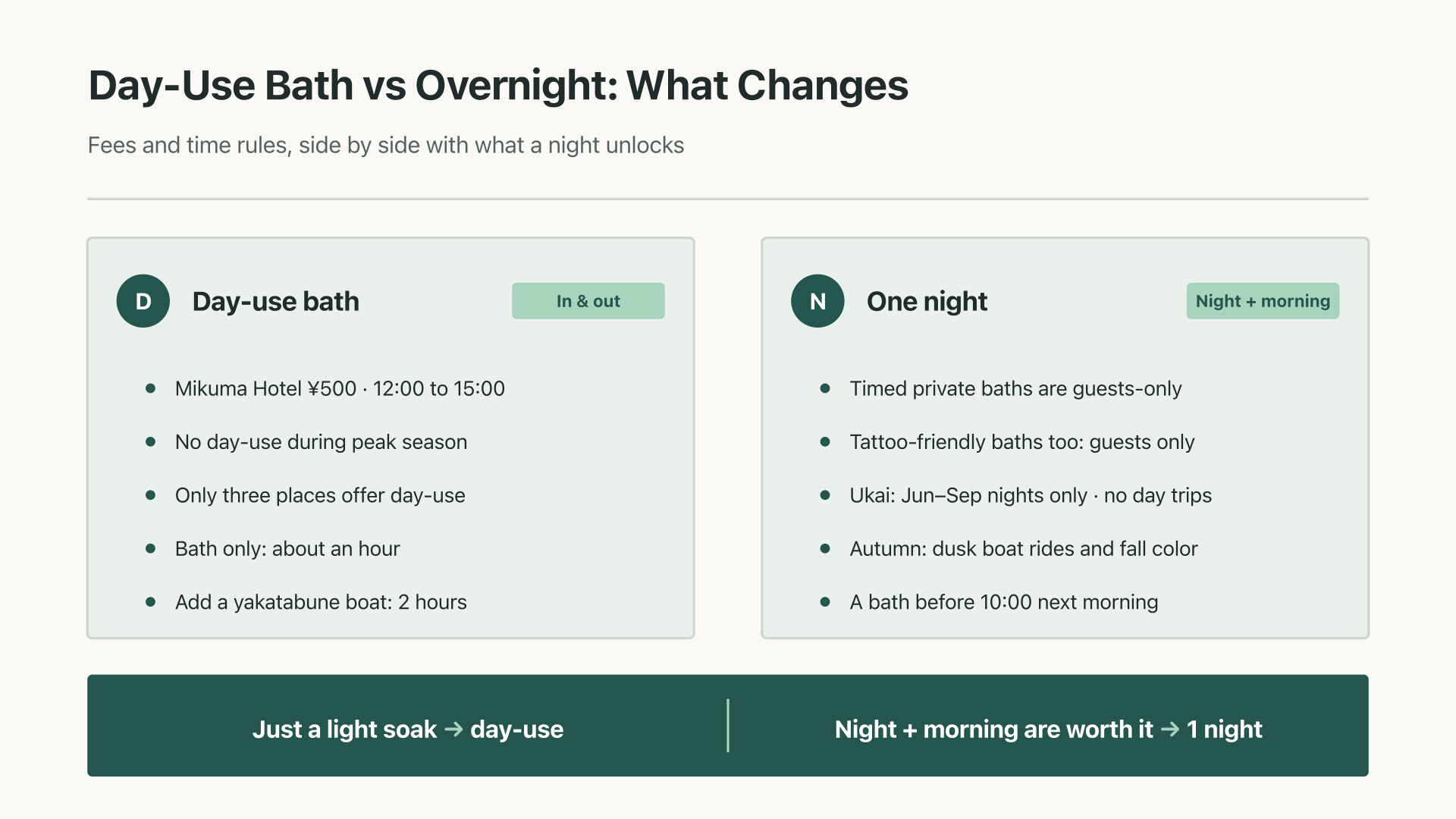
Day-use bath or a night: what changes
By cost alone, the day-use bath is the lightest choice. A roundup cross-checked against the official Hita Onsen Ryokan Association site counts three establishments that take day-use bathers. Among them, Mikuma Hotel’s day-use bath is listed at JPY 500, open 12:00–15:00, and explicitly not available in busy periods (as of September 2026). One guide puts a soak alone at about 1 hour, about 2 hours with a yakatabune, and half a day to a full day once a Mameda-machi stroll is added.
What the night adds is the evening, the morning, and staying-guest-only conditions (operating-season conditions as of September 2026). Cormorant fishing (ukai) on the Mikuma River is introduced as a traditional fishing method going back about 400 years. One record says it runs at night only from June through September and that the last train leaves before the boats go out, so a day trip misses it entirely; the same record proposes staying the night in Hita and returning to Beppu the next morning. Once the ukai season ends, autumn assigns the dusk yakatabune and the foliage around Yomei Dam to those evening and morning hours. The hourly-reservation private baths are a staying-guest arrangement, and the tattoo-permitting private and family baths are also limited to staying guests, so using those conditions presupposes the night.
The 1-night, 2-day flow: where to put Mameda-machi
The basic shape is simple: keep daytime Mameda-machi and the river at night inside one area. On public transport, one guide advises putting Hita first on Day 1 while fixing the exit time from Hita in advance; the same record says to forward big suitcases or carry a single overnight bag. If Yufuin follows Hita, one more condition applies: Yufuin ryokan luggage-delivery desks close at 15:00 (as of September 2026), so settle your bags before arrival.
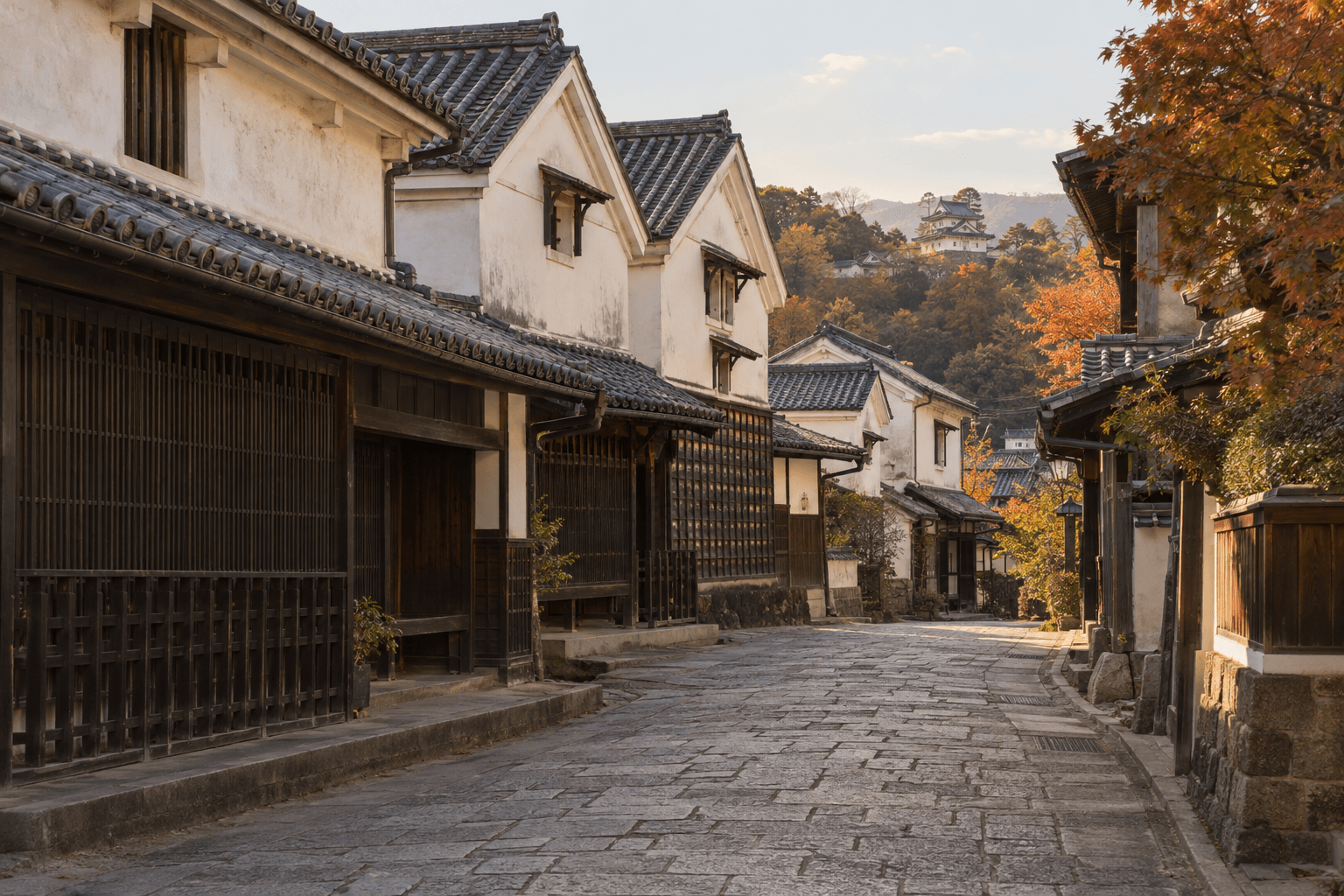
Mameda-machi is 15 minutes on foot from JR Hita Station, and there is parking (as of September 2026). Modeled on Kyoto in the Edo period, nicknamed “Little Kyoto”, the district keeps streets of preserved period buildings, lined with the Hirose Museum (廣瀬資料館), the Kusano House (草野本家), the Nihongan Medicine Museum (日本丸館), the Tenryō Hita Museum (天領日田資料館), and the Kuncho Shuzō Sake Brewery (薫長酒蔵資料館), which runs both a museum and a shop. For getting around town, one guide calls walking the best fit and bicycle rental a popular option, with no single day pass in wide use.
Run as a single day, the flow looks like this (time conditions as of September 2026). Walk Mameda-machi in the daytime, take an open-air bath after check-in, watch the river from a yakatabune at dusk, and use a bath slot before 10:00 the next morning. Factor in the guide’s half-day-to-full-day stroll estimate, and choosing between compressing Mameda-machi and stretching the night gets easier. For the return, remember that few highway bus departures pass through Tenjin, and fix your departure first.
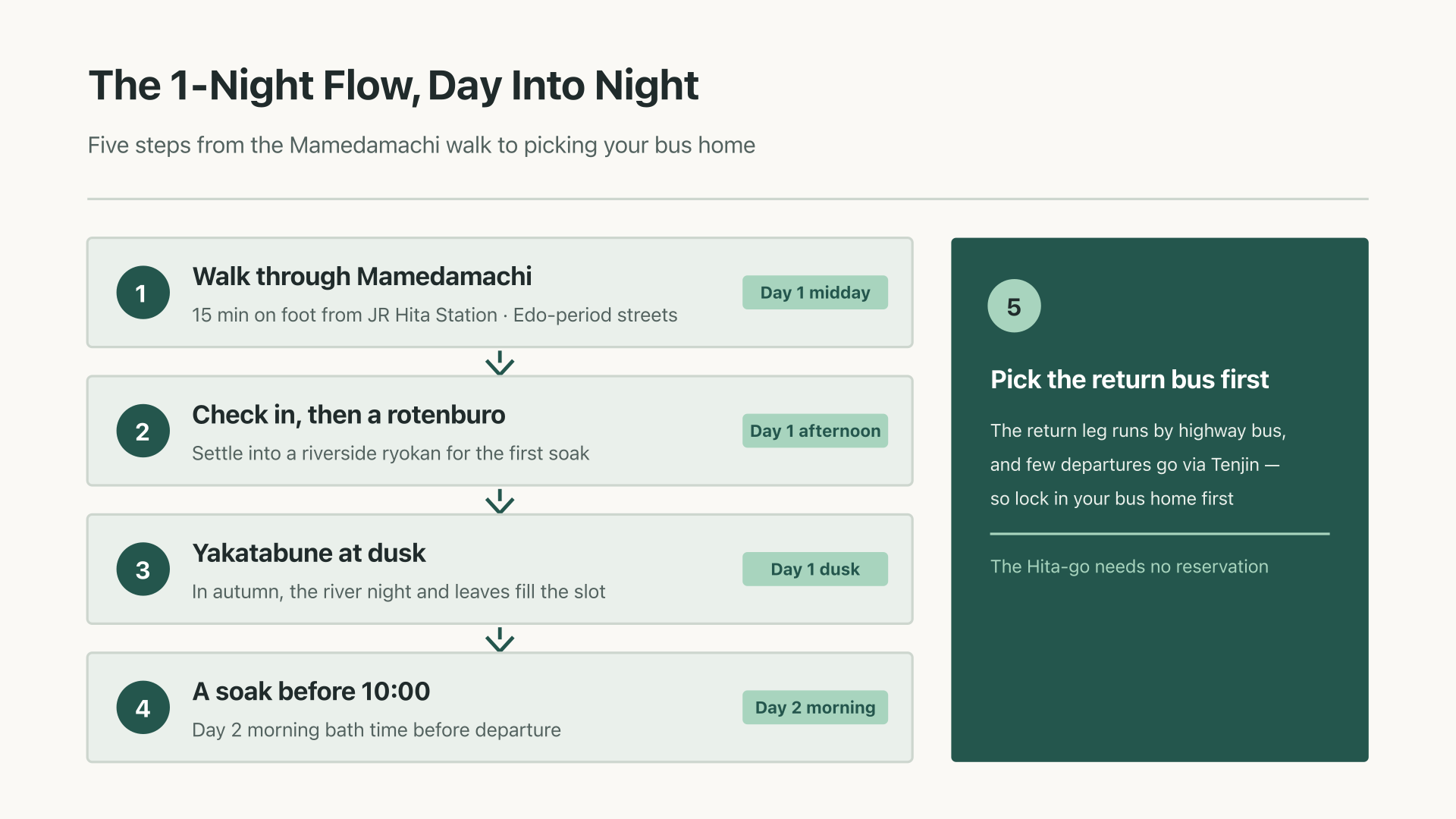
When access and value for money lead the list, take the highway bus in from Fukuoka and settle the trip with 1 night at a riverside ryokan. If summer ukai is the goal, only a 1-night stay between June and September makes it work. For an autumn 1-night, 2-day trip, the realistic shape compresses daytime Mameda-machi, an evening yakatabune, and a morning bath.
Images are examples to aid understanding.
Last checked: 2026-09-13
Sources & verification
A source-based guide. Check the linked operator information again before you travel.
- Oita Tourism, Hita onsen storySources checked:
- Oita Prefectural Tourism Association, Hita attractionsSources checked:
- JR Kyushu, Hita Station guideSources checked:
- Hananoki RIVER TERRACE, access and shuttle guidanceSources checked:
- KIZAN Club, onsen and private bathsSources checked:
- Booking.com, Hita city lodgingSources checked:
- Mieum Route, Fukuoka 5-day trip logSources checked:
- MATCHA, Hita area guideSources checked:
Illustrations are examples to aid understanding, not photographs taken on site. Actual photographs have separate source credits.
Continue planning
Seoul to Busan and Gyeongju: KTX, Express Bus, or Car
How Seoul–Busan and Gyeongju move by KTX, express bus, or car after the September 2026 Korail–SR merger, when Chuseok train tickets open by route, and how to leave Gyeongju Station.
Rainy Autumn Day Outings in the Seoul Capital Area: Indoor Anchors, Routes, and a Day Plan
When rain hits the Seoul capital area, bundle the day around COEX, Seongsu, or the Myeongdong–Jongno anchors, keep moves underground, pre-decide the cut order, and close at a jjimjilbang.
Garden of Morning Calm in autumn: same-day tickets, the Cheongpyeong shuttle, and pairing it with Nami Island
Same-day tickets with no reservation, the Cheongpyeong shuttle for car-free access, and pairing with Nami Island as a two-stop day; set the foliage window at October–November.
Help us keep this note useful
A quick response helps us decide what to clarify or recheck. No account or email is needed.