
Picture someone on the square in front of Hwaseong Haenggung, looking around for where the Hwaseong Trolley leaves. The plan makes sense: ride the trolley round the fortress from the palace, then walk only the stretches worth walking. Anyone who read a guide from a few years ago would expect exactly that. But the route that left from the palace was abolished on 11 March 2024. The trolley now starts only at Yeonmudae, on the opposite, eastern side of the wall, and ends there too. Yet the Suwon Cultural Foundation’s own directions page still lists “Hwaseong Trolley (departs Hwaseong Haenggung)” among the palace’s sights.
The wall runs 5,744 metres all the way round. The eastern side is flat; the western side climbs over Paldalsan. How you string together the palace, the martial arts show, the wall walk, the archery and the trolley changes the shape of the whole day.
Here is the order I suggest. Start at the palace in time for the 11:00 Muye 24gi show, have lunch, then climb Paldalsan, the hill right behind the palace, before anything else. From there, walk clockwise along the downhill and flat stretches and finish the daytime part at Yeonmudae. You get the hard climb out of the way while your legs are fresh, and you finish at Yeonmudae, where the archery range, the trolley stop and one of the two stamp-tour souvenir counters sit together.
Avoid Mondays
Pick the day first. The fortress wall is open every day, free, and you can walk it after dark too. Hwaseong Haenggung is open daily from 09:00 to 18:00. It is the extras that depend on the day.
| Day | Muye 24gi show (in front of Sinpungnu) | Hwaseong Trolley | Palace night opening |
|---|---|---|---|
| Monday | None | Does not run | None (except public holidays) |
| Tuesday–Thursday | 11:00 | 09:40–17:00 | None (except public holidays) |
| Friday | 11:00 | 09:40–17:00 | 18:00–21:30 |
| Saturday, Sunday | 11:00, 14:00 | 09:40–17:00 | 18:00–21:30 |
The night opening runs on Fridays to Sundays and public holidays until 1 November 2026. On Mondays both the show and the trolley take the day off. You can still walk the wall and see the palace, but if you have any choice of day, there is no reason to go on a Monday.
Sundays add one more thing. Until 25 October 2026, the Jangyongyeong guard ceremony takes place every Sunday at 16:00 at the same gate, Sinpungnu. On this plan, though, you will most likely be on the eastern side of the wall by then. If you only catch one performance, the 11:00 martial arts show makes the better start to the day.
The 2026 Suwon Hwaseong Cultural Festival runs from 4 to 11 October across the fortress area. Expect the palace area to be busier than usual that week.
From Seoul, take the Mugunghwa; from Gangnam, bus 3000
Subway Line 1 from Seoul Station to Suwon costs ₩2,250 with a transport card. That is what the distance-based fare table gives for the 41.5 km. In a Suwon day-trip post on Reddit in May 2026, one traveler said they took Line 1 from City Hall. They remembered it as around ₩3,000, chose it over the KTX for the price, and found it took a bit longer.
A Mugunghwa train over the same stretch, though, costs ₩2,600–2,700 for a seat. For a few hundred won more than the subway, you are at Suwon Station in 30 to 38 minutes. The ITX costs ₩4,800 and the KTX ₩7,500, yet on the 7 October timetable the KTX takes 32 to 36 minutes, hardly different from the Mugunghwa. There is no point buying a KTX ticket to save time.
| Seoul to Suwon | Adult fare | Journey time | Best for |
|---|---|---|---|
| Mugunghwa (Seoul or Yongsan Station) | ₩2,600–2,700 | 30–38 min | Most travelers |
| ITX (Seoul or Yongsan Station) | ₩4,800 | 29–38 min | When no Mugunghwa fits |
| Subway Line 1 | ₩2,250 (transport card) | Longer than the train | Not wanting to plan around a train time |
| Red bus 3000 (Gangnam Station) | From ₩3,200 base fare (transport card) | Depends on traffic | Staying in Gangnam |
Based on the 7 October 2026 timetable.
To make the 11:00 show, aim for a train that reaches Suwon around 10:00. On the 7 October timetable, the 09:38 Mugunghwa from Yongsan arrives at 10:08 and the 09:47 ITX-Maeum at 10:17. From Seoul Station, the train after the 08:49 ITX-Maeum is the 10:12 KTX, a gap of over an hour. Even if Seoul Station is closer to you, look at Yongsan departures as well. A Reddit tip from March 2026 suggests booking ahead for weekend trains, since trains towards Suwon can fill up.
At Suwon Station, change to a city bus. From exit 4, outside the Novotel, take bus 11 or 13; from exit 7, outside AK Plaza, take bus 60 or 7-2. Get off at the Hwaseong Haenggung stop and walk about 5 minutes. The fare is ₩1,650 with a transport card since the increase on 25 October 2025. The Suwon tourist information centre near exit 4 is open 09:00–18:00 and offers interpreting in English, Chinese and Japanese.
If you are staying in Gangnam, you can skip Suwon Station altogether. Red bus 3000, a Gyeonggi express-seat bus from Gangnam Station, stops at Paldalmun, about a 5-minute walk from the palace. From Jamsil, bus 1007 goes to the Hwaseong Haenggung/Yeomingak stop. These buses use the roads, though, so the journey time depends on the traffic that day. If you are set on the 11:00 show, the train is easier to plan around.
11:00, in front of Sinpungnu
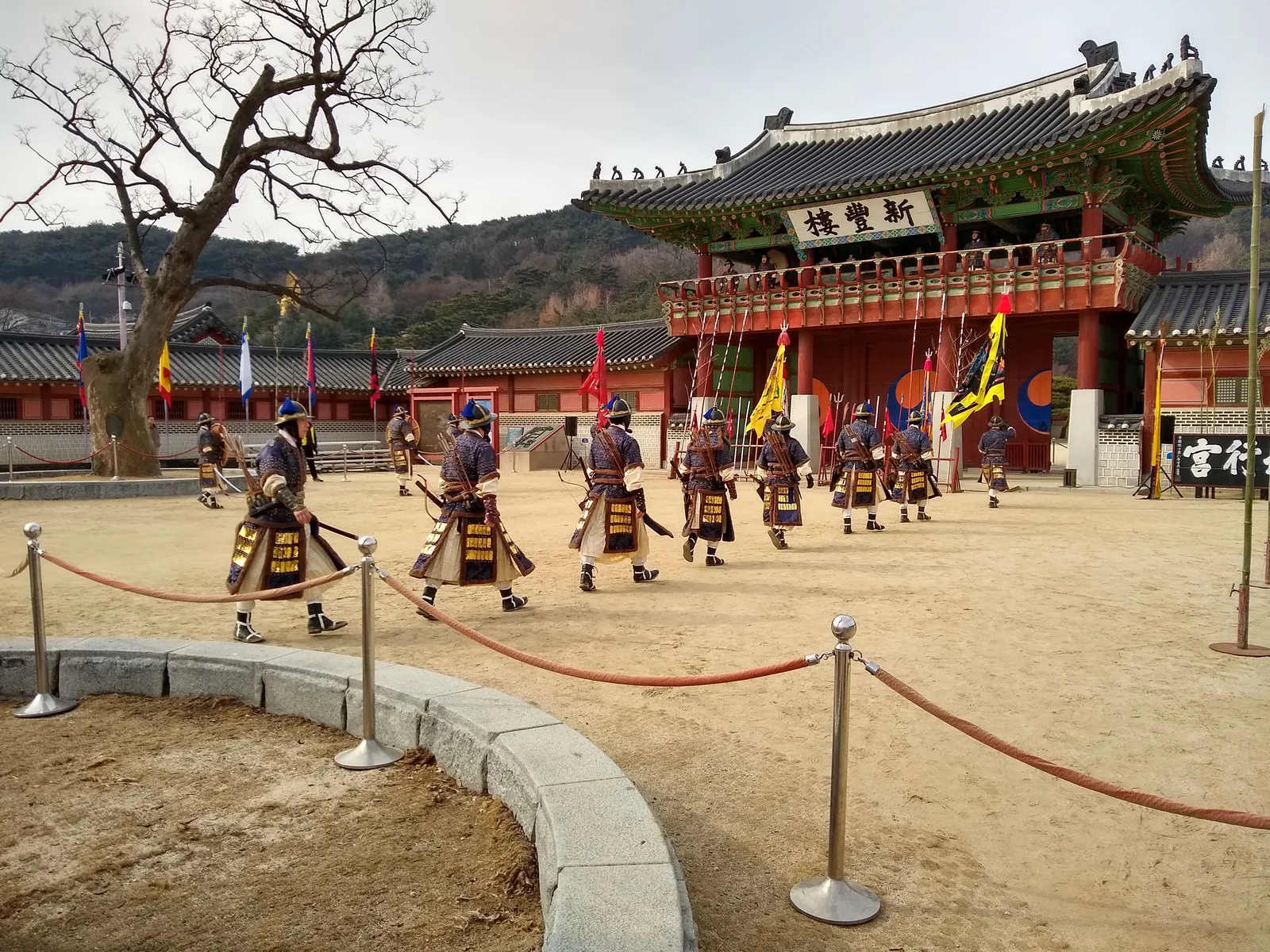
The Muye 24gi demonstration runs Tuesday to Sunday from 11:00 to 11:30 in front of Sinpungnu, the palace’s main gate. It re-enacts the martial arts trained by the Jangyongyeong, King Jeongjo’s elite guard, and watching it costs nothing; palace admission is separate. There is a regular break in the hottest part of summer, and shows can be cancelled for weather or air quality.
.jpg)
After the show, go inside the palace. Admission is ₩2,000 for adults, ₩1,500 for teenagers and ₩1,000 for children, with last entry at 17:00. Wearing hanbok, modern hanbok included, gets you in free. Entry is also free on the last Wednesday of each month, Culture Day, though that does not cover the night opening. The palace lends out wheelchairs and strollers free of charge. A ₩4,000 combined ticket adds the Suwon Hwaseong Museum and the Suwon Museum. If you also mean to walk the wall that day, two museums on top is a squeeze.
Seeing the palace in the morning means the 17:00 last entry no longer matters in the afternoon. You do not have to get back to the palace before it closes, so you are free to end your wall walk wherever you like.
Lunch near the palace: for galbi, go for the lunch sets
The foundation lists Suwon wang-galbi, the fried chicken street, gopchang town and Haengnidan-gil as the places to eat. According to a Korea Tourism Organization article, Suwon’s wang-galbi began at Hwachunok, a hangover-soup house that opened in 1945, which started selling marinated beef short ribs in 1956.
If galbi is the plan, lunch is the time for it. Hwacheong Galbi, one of the restaurants in the same article, is behind the Paldal-gu Office and serves its galbi set meals at lunch only. It is close to the palace and Haengnidan-gil. Yeonpo Galbi sits in front of Hwahongmun, so you pass it halfway along the afternoon wall walk; its galbitang is sold at weekday lunch only, in limited quantities. The set meals listed in the article start in the ₩30,000s. The article carries no date, so treat those prices as a guide. It lists English and Japanese menus as well as Korean at Yeonpo Galbi, and Korean only at Hwacheong Galbi.
Eat a proper lunch and bring water before the climb. You will be walking all afternoon.
Take the climb first
The western side of the wall goes up over Paldalsan. From behind the palace to Seojangdae, the command post on the summit, it is uphill all the way. The foundation’s three-hour course also starts by climbing from Hwaseong Haenggung to Seojangdae, then goes on to Hwaseomun, Janganmun, Banghwasuryujeong, Changnyongmun, Bongdon and Namsumun. This plan follows the same direction. Once past Seojangdae you come down off the hill, and then the eastern side is flat.
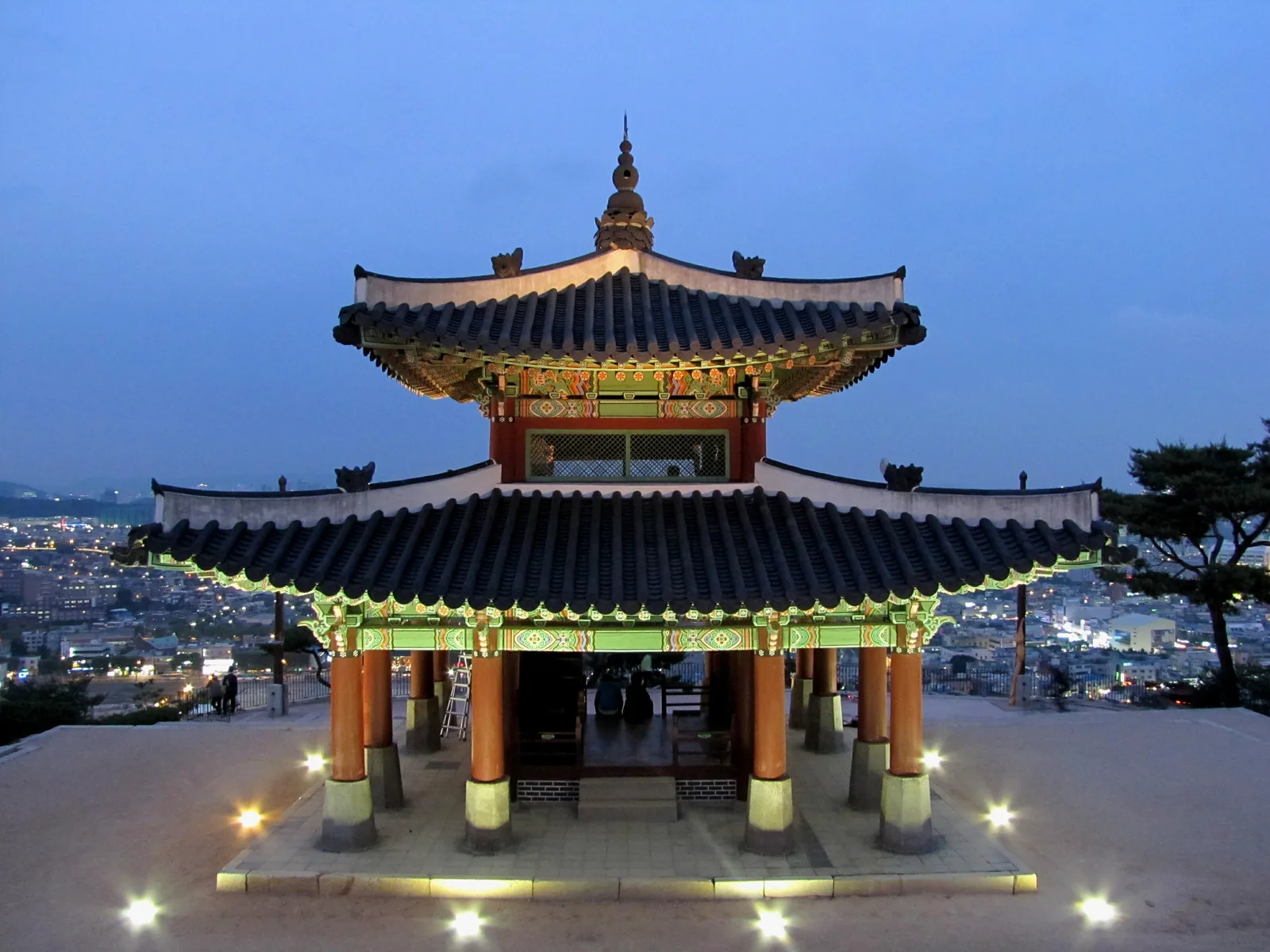

Go the other way round and you climb the Paldalsan stairs late in the afternoon, when you are most tired. A solo traveler who posted about Seoul, Busan and Suwon on Reddit in April 2026 described Suwon as a day full of stairs and walking, about 25,000 steps on a day that also took in the Starfield mall. When another user said they were going with their parents, the poster replied that the stairs would be tough going.
The foundation’s course times give a rough idea. It puts Janganmun to Hwaseomun, Seojangdae and the palace at two hours, and Yeonmudae past Banghwasuryujeong to Janganmun at one. This plan joins those two in reverse, so by the foundation’s reckoning it is three hours. Allow more for photos and rests. Start up behind the palace around 13:00 and you reach Yeonmudae somewhere between mid and late afternoon. The foundation itself notes that course times vary with conditions.
_(41090332882).jpg)
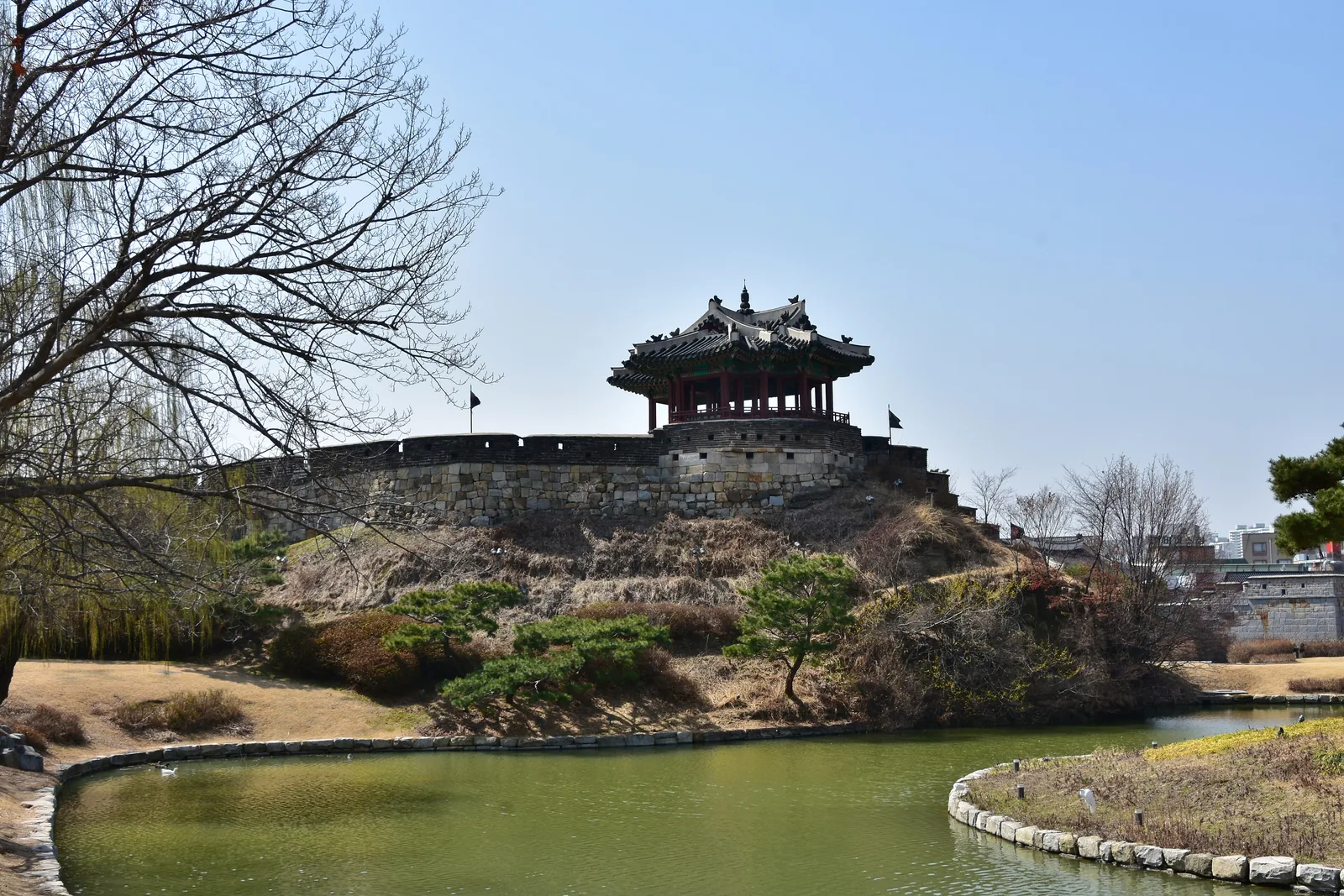
After Janganmun come Hwahongmun and Banghwasuryujeong, and it is flat all the way to Yeonmudae. The remaining stretch, Changnyongmun, Bongdon and Namsumun, is there to add if you still have energy.
If you are doing the stamp tour, check the closing times first. Collect stamps at 7 or more of the 10 spots along the wall and you get a souvenir at the Hwaseomun or Yeonmudae tourist information centre. Both are open 10:00–17:00 on weekdays and 10:00–18:00 at weekends and on public holidays, closed 12:00–13:00. You have to ask for the souvenir at least 20 minutes before closing. A blog post from May 2026 described arriving in Suwon around lunchtime, more of a half-day trip, and running out of time to finish the stamp tour before the information centre closed. On this route you pass six stamp spots: Hwaseong Haenggung, Seojangdae, Hwaseomun, Janganmun, Hwahongmun and Changnyongmun (next to the Yeonmudae ticket office). For the seventh, add one of Paldalmun, Namsumun, the Suwon Hwaseong Museum or the Suwon Traditional Culture Center. Finishing at Yeonmudae, where you collect the souvenir, works in your favour.
The trolley leaves from Yeonmudae
The Hwaseong Trolley now starts at Yeonmudae and runs via Hwahongmun, Janganmun, Hwaseomun and Maehyanggyo back to Yeonmudae. It makes 20 trips a day, every 20 minutes from 09:40 to 17:00, with a gap from 11:40 to 13:00. Fares are ₩6,000 for adults, ₩3,500 for teenagers and soldiers and ₩2,000 for children. It does not run on Mondays or when it rains or snows.
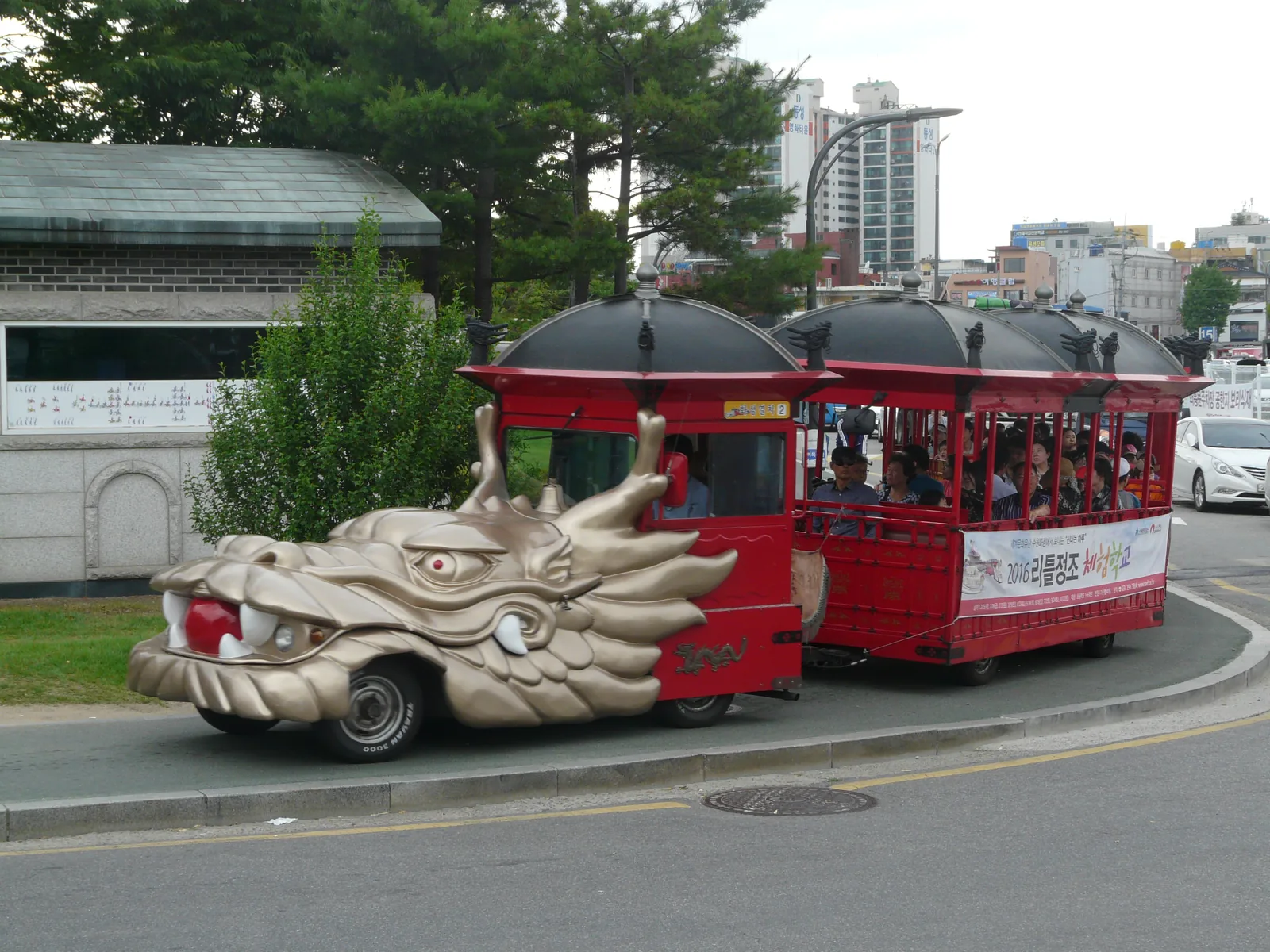

Buy tickets at the Yeonmudae ticket office and board right outside. There is an online booking site, but it takes Korean payment methods such as domestic credit and debit cards and bank transfer. If you only have a card issued abroad, the ticket office is the sure option. Each run takes up to 36 passengers. You can get off at Hwahongmun, Hwaseomun or Maehyanggyo, but you cannot get back on. Commentary is in Korean, and the audio system at each seat has English, Chinese and Japanese. Earphones are not provided, so bring your own.
If you have walked the whole wall, the trolley just takes you past gates you have already seen. It is a different story if someone in your group finds walking hard. Skip the Paldalsan stairs, go straight to Yeonmudae, see the northern and western gates from the trolley, then walk only the flat stretch from Yeonmudae to Banghwasuryujeong. Light manual wheelchairs can go on board, but powered and large wheelchairs cannot, and you need to call the tourism operations team first (+82 31-290-3634).
Try the archery at Yeonmudae
Traditional archery at Yeonmudae runs every 30 minutes from 09:30, with a break for lunch from 12:00 to 13:00. The last session is at 17:30 from March to October and 17:00 from November to February. You shoot 10 arrows. The foundation’s two information pages give different prices, ₩2,000 and ₩3,000 (checked 7 October 2026). Either way it is pocket change. Children can take part from age 7, and sessions stop if it rains or snows.
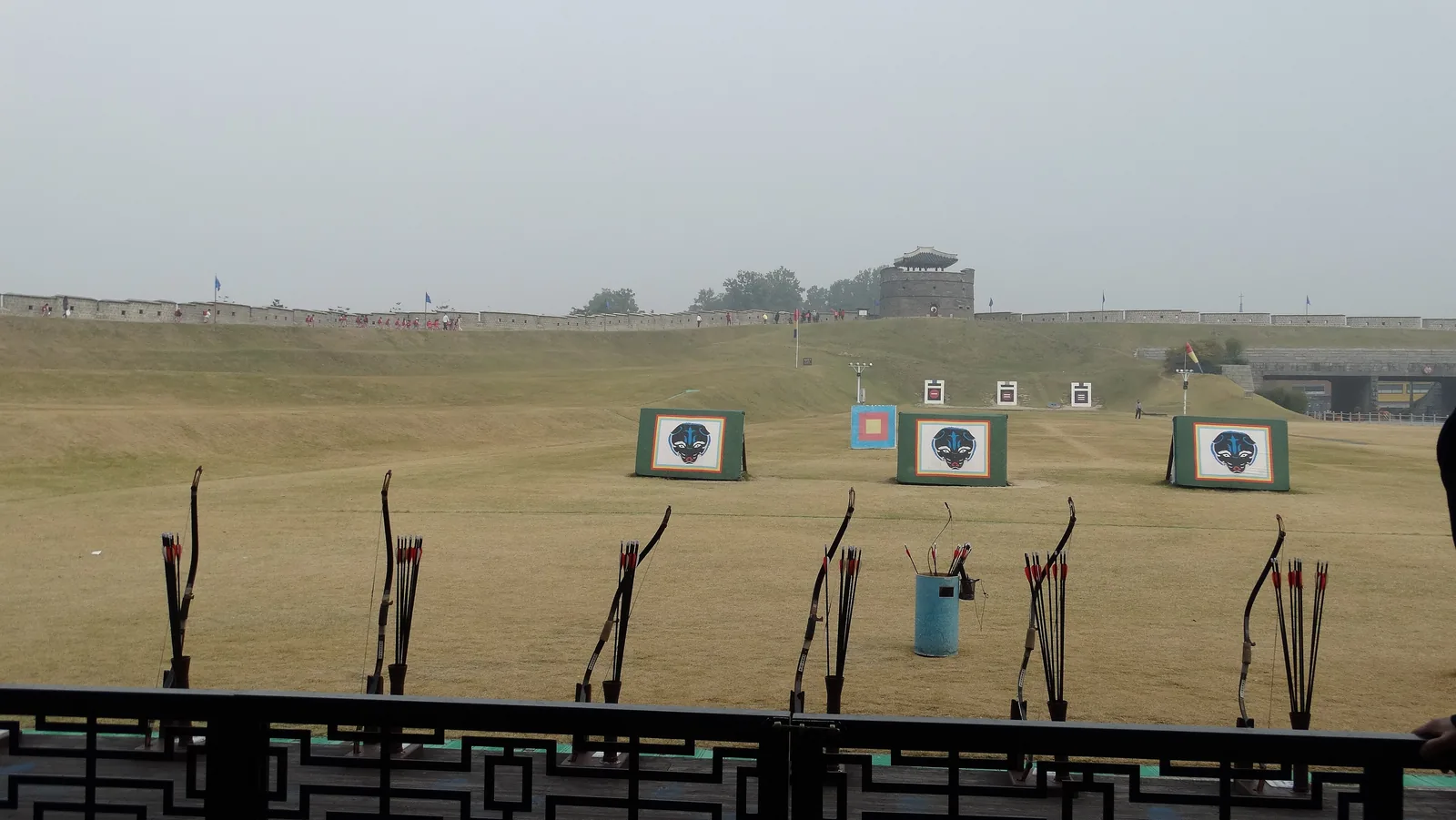

There is nothing to book. In February 2026, a Reddit reply said you can just walk in, and that in peak season there may be a queue but it moves fast. Each session takes up to 25 people.
Friday to Sunday, stay for the evening
On Fridays, Saturdays, Sundays and public holidays, the palace night opening runs from 18:00 to 21:30. Last entry is 21:00, and admission is the same as by day, ₩2,000 for adults. The programme includes a special evening Muye 24gi performance. From 16 October to 1 November 2026, there is also a taekwondo performance at Yuyeotaek from 18:00 to 19:20 on Fridays to Sundays. The wall itself stays open after dark, so you can also end the way the foundation’s one-day course does, with the night view at Banghwasuryujeong.
Spend the late afternoon at Yeonmudae, come back down to Haengnidan-gil for dinner, then return to the palace for the night opening, and the day comes full circle. You pay ₩2,000 again to see the palace you saw that morning, this time by lantern light.
Two ways to spend the day
Tuesday to Friday. Take the 09:38 Mugunghwa from Yongsan, arriving at Suwon at 10:08. Ride the bus to the palace, watch Muye 24gi at 11:00 and look round the palace. Have the galbi set lunch at Hwacheong Galbi and start up Paldalsan around 13:00. Walk past Seojangdae, Hwaseomun, Janganmun and Banghwasuryujeong to Yeonmudae and shoot your arrows. On weekdays the stamp souvenir has to be requested by 16:40, so pace your rests to get to Yeonmudae before then. On a Friday, have dinner and stay for the night opening.
Saturday and Sunday. Walk in the same order. If you set off late, you can catch the 14:00 Muye 24gi show and then head up to the wall. That puts your arrival at Yeonmudae close to the last archery session, though. At weekends the stamp souvenir counter is open until 18:00, so ask by 17:40. End the day at the palace night opening.
On this plan, the hardest moment for your legs is Paldalsan, straight after lunch. Once that climb is behind you, the rest of the afternoon is the walk down off the hill and along the flat wall, and all you need to save is enough strength to draw a bow.
Sources & verification
A source-based guide. Check the linked operator information again before you travel.
- Suwon Hwaseong tourism: visiting hours, admission, night opening, trolley and archery faresSources checked:
- Suwon Hwaseong tourism: Hwaseong Trolley route change from 11 March 2024 (notice)Sources checked:
- Suwon Hwaseong tourism: Hwaseong Trolley route, timetable and conditionsSources checked:
- Maketicket: Hwaseong Trolley online booking and payment methodsSources checked:
- Suwon Hwaseong tourism: traditional archery at YeonmudaeSources checked:
- Suwon Hwaseong tourism: Muye 24gi martial arts demonstrationSources checked:
- Suwon Hwaseong tourism: Jangyongyeong guard ceremony (2026 season)Sources checked:
- Suwon Cultural Foundation: recommended courses and course timesSources checked:
- Suwon Hwaseong tourism: how to get to the palace and the main gatesSources checked:
- Suwon Hwaseong tourism: wall stamp tour and souvenir countersSources checked:
- Suwon Cultural Foundation: Hwaseong Haenggung night opening 2026Sources checked:
- Suwon Hwaseong tourism: 63rd Suwon Hwaseong Cultural FestivalSources checked:
- Suwon Hwaseong tourism: about the fortress (length, terrain, UNESCO listing)Sources checked:
- Train timetable mirror: Seoul Station to Suwon, 7 October 2026Sources checked:
- Train timetable mirror: Yongsan to Suwon, 7 October 2026Sources checked:
- Seoul Metro: subway fares by distanceSources checked:
- Wikipedia (Korean): Suwon Station, 41.5 km from Seoul StationSources checked:
- YTN: Gyeonggi bus fares from 25 October 2025Sources checked:
- Bus 3000 (Gangnam–Suwon) stop listSources checked:
- VISITKOREA (Korean): Suwon wang-galbi and four restaurants (undated article)Sources checked:
- r/koreatravel: solo trip to Seoul, Busan and Suwon (April 2026)Sources checked:
- r/koreatravel: Suwon day trip from Seoul (May 2026)Sources checked:
- r/koreatravel: train booking tip for weekend Suwon trips (March 2026)Sources checked:
- r/KoreaTravelAdvice: Suwon archery (February 2026)Sources checked:
- Sunny Days with Juliette: a day trip to Suwon (May 2026)Sources checked:
Help us keep this note useful
A quick response helps us decide what to clarify or recheck. No account or email is needed.