Of Saga’s two representative onsen towns, anchor the day trip on Ureshino when the plan is to walk an onsen town and sink into the feel of its water, and on Takeo when the gate and a sightseeing route are the draw. The two towns sit about an hour from Hakata by train and roughly 5 minutes from each other, one shinkansen stop apart, so the realistic shape is one town at the center with the other added when time allows. The travel times below follow official guidance checked in September 2026; check fares and operating information against each facility’s own notices at the time of publication.
From Hakata: the limited-express transfer route and the direct highway bus
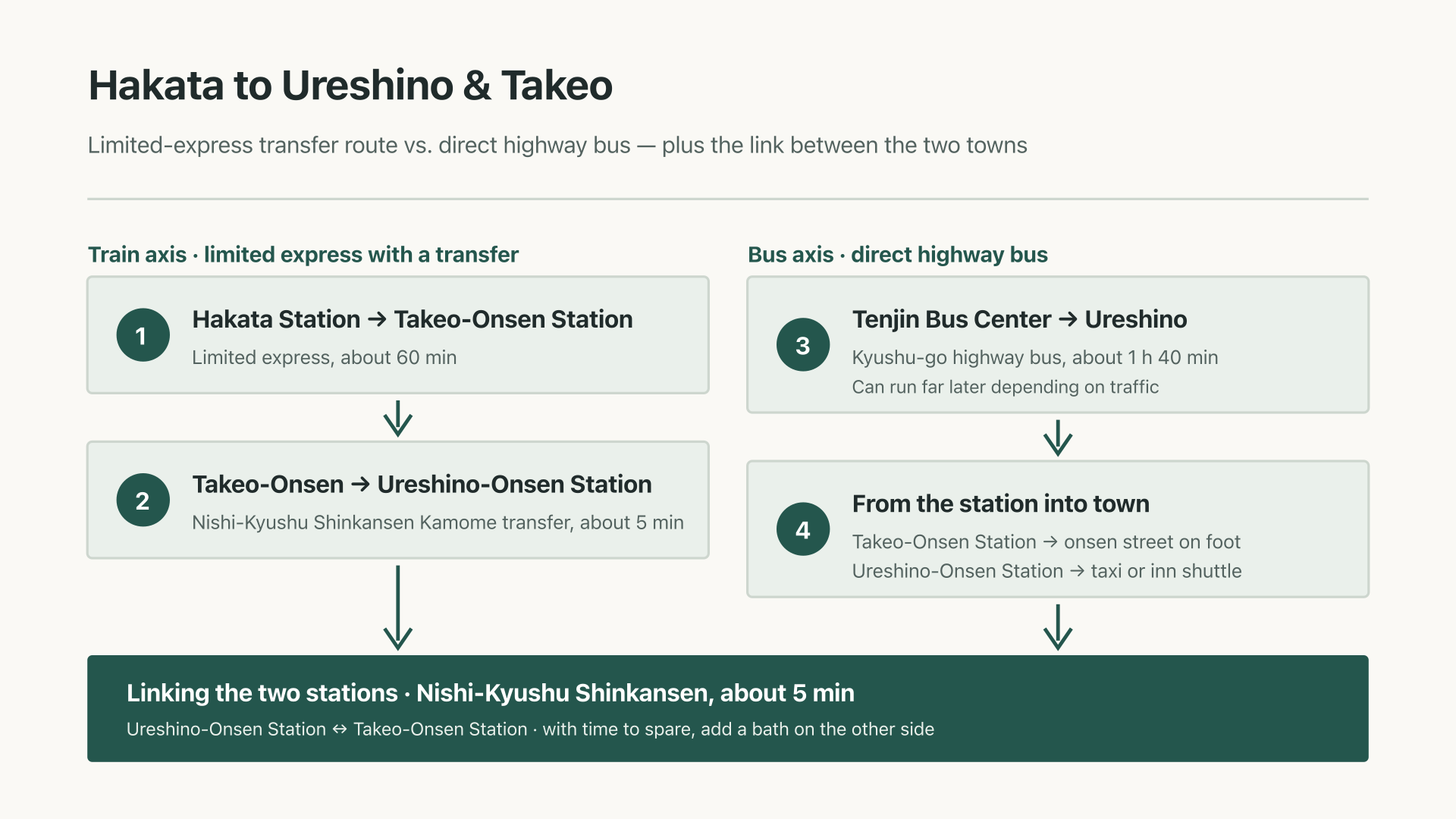
By rail, ride the limited express about 60 minutes from Hakata Station, get off at Takeo-Onsen Station (武雄温泉駅), and transfer to the Nishi-Kyushu Shinkansen Kamome (かもめ) for the roughly 5 minutes to Ureshino-Onsen Station (嬉野温泉駅). By bus, take the Kyushu Expressway Bus “Kyushu-go” (九州急行バス「九州号」) from Fukuoka Tenjin Bus Center (福岡天神バスセンター), ride about 1 hour 40 minutes, and get off at the Ureshino IC stop or Ureshino Bus Center. The same notice cautions that the highway bus can run substantially late depending on road conditions.
A ride log adds the feel of the actual movement. One from December 2023 records 5 minutes aboard the Kamome from Ureshino-Onsen Station to Takeo-Onsen Station, with only about 3 minutes of that actually seated. The same log also records a 3-minute wait at Takeo-Onsen Station to connect onto the Relay Kamome (リレーかもめ).
The figures for this segment follow the December 2023 ride log as checked in September 2026, so they may differ from current timetables. Before departure, match the limited-express and shinkansen connection times at Hakata Station on the booking screen.
Station-to-town connections differ between the two towns. Official tourism guidance describes the onsen district as walkable from Takeo-Onsen Station, while from Ureshino-Onsen Station the guidance points to taxis or an accommodation shuttle. The Ureshino ryokan Ureshino Motoyu (うれしの元湯) carries official guidance that its free shuttle to the station runs on a reservation basis, in principle booked by the day before; the same ryokan also writes that it sits a 1-minute walk from Ureshino Bus Center when arriving by highway bus. Settle the shuttle question on the accommodation booking screen in advance and the day’s routing stays stable.
Ureshino: the feel of the water and walking the town
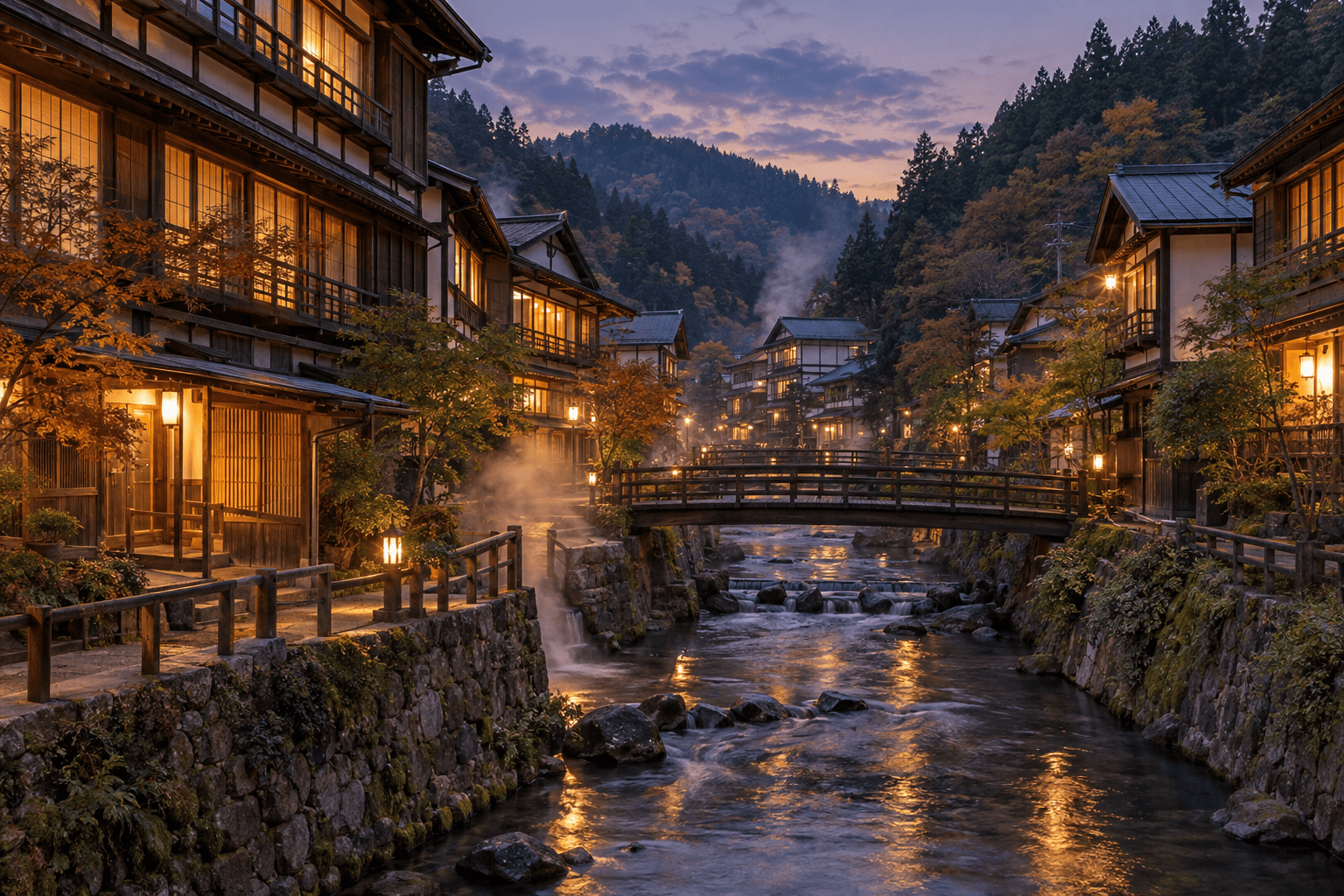
The water of Ureshino Onsen is introduced as a sodium bicarbonate-chloride spring whose texture clings gently to the skin, and the town is counted among Japan’s three great beauty-water springs, bihada no yu (美肌の湯). Ryokan cluster along the Shiotagawa River, and a comparison guide notes that inns and footbaths scattered through the streets let the onsen-town atmosphere come through strongly. Another summary adds that the town keeps a quiet, retro character.
One summary has day-trip bathing centered on the town’s public bathhouses, with the riverside footbaths usually free. A separate one says combining the public baths, the free footbaths, and a tea tasting completes a day plan without strain, and day-use bathing at a ryokan is another possible add-on. The representative dish is onsen yudofu, tofu simmered soft in the alkaline spring water. Ureshino green tea is counted as the origin of Japanese green tea, and at Chaoshiru, the tea exchange center set among the fields, a tasting teaches you to brew tama-ryokucha, the pearl-like curled green tea, with low water temperature and a short steep.
If the day runs short and you attach a night, one figure is worth knowing. Ureshino’s bathing tax rose to about ¥250 per adult in late 2025 and appears on ryokan bills, one notice states; the figure rests on sources checked in September 2026. Checking the bathing-tax line on the bill alongside the rest keeps the total arithmetic clean.
Takeo: the gate and the sights pull the day
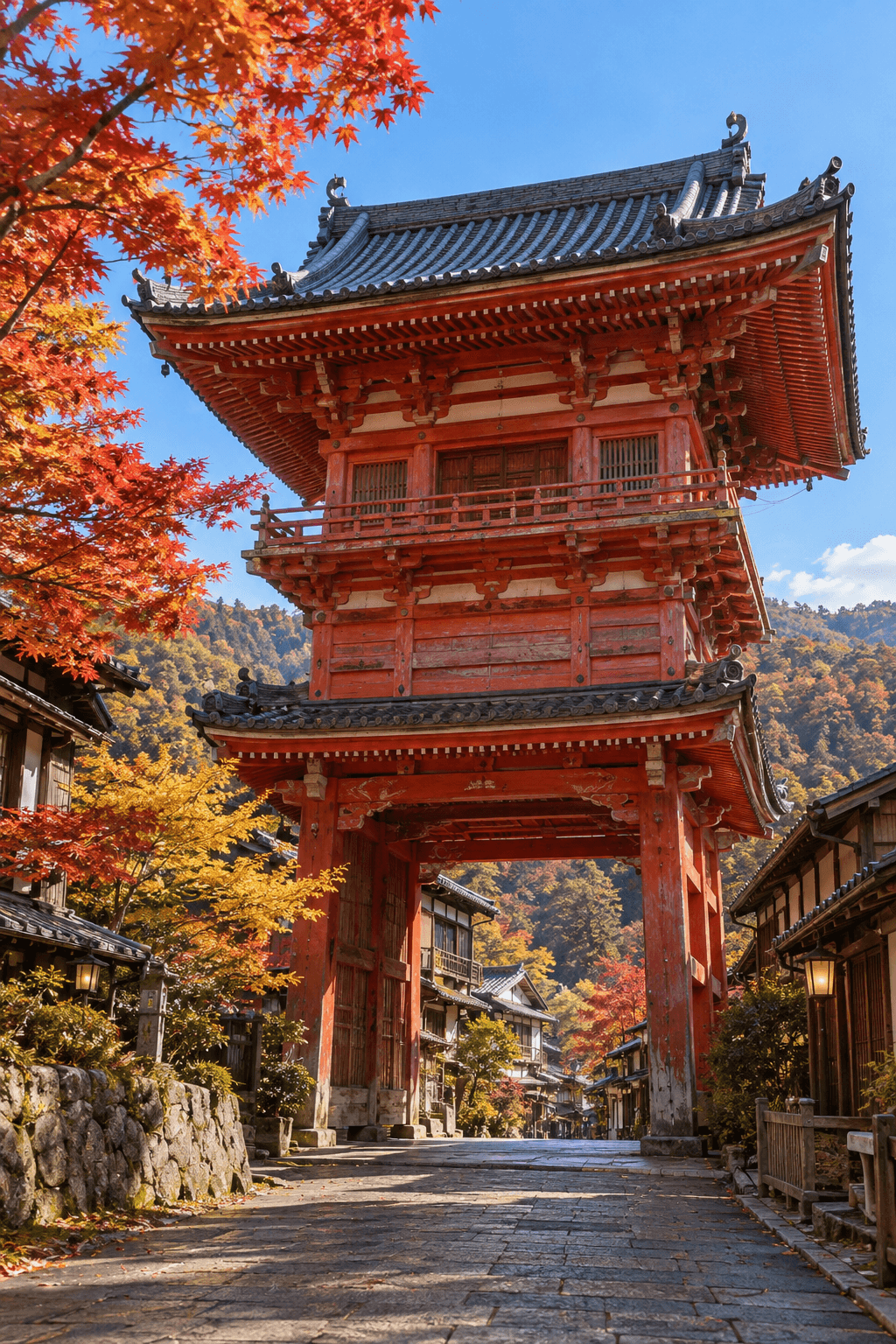
Takeo Onsen carries 1,300 years of history, and the huge vermilion romon gate at the town entrance was designated an Important Cultural Property in 1915. It is the work of the Saga-born architect Tatsuno Kingo, who also designed Tokyo Station and the Bank of Japan; the same official tourism guidance calls it the oldest building still operating as an onsen. Anecdotes passed down say Miyamoto Musashi and Philipp Franz von Siebold bathed here.
The water is alkaline spring water known for leaving skin silk-soft, and it goes by bihada no yu, the onsen that makes you beautiful. Just behind the gate, the Motoyu and Horaiyu public bathhouses form the center of the town, and the complex has public baths, private baths, and family baths in one place. The Tonosama-yu and Karou-yu baths, once reserved for the Nabeshima domain lords, can now be used as private baths, and adding day-use bathing at a ryokan lets you compare the character of several baths within a single day. Hours and fees differ by facility, so read the notices of the gate-area facilities first.
Outside the baths, the representative sights are Takeo Shrine with the great camphor tree on the forest path behind it, the Mifuneyama Rakuen garden, and the Takeo City Library. One comparison says the wealth of sights beyond the baths makes the town popular with travelers who want sightseeing as well, while another guide notes that the gate, library, garden, and shrine are scattered, so adding a taxi or a car makes the day easier. Walking from the gate to the old bath building Shinkan and finishing at a public bath makes a car-free day work too.
How to bundle them into a single day and how to choose
| Axis | Ureshino | Takeo |
|---|---|---|
| Town structure | An onsen town with ryokan and footbaths scattered along the streets | Sights spread around a gate-centered core |
| Water | Sodium bicarbonate-chloride, a beauty-water onsen | Alkaline bihada no yu |
| Day-use bathing | Town public baths and free footbaths | Motoyu and Horaiyu, plus private baths |
| What to add | Green tea tasting and onsen yudofu | Shrine, garden, and city library |
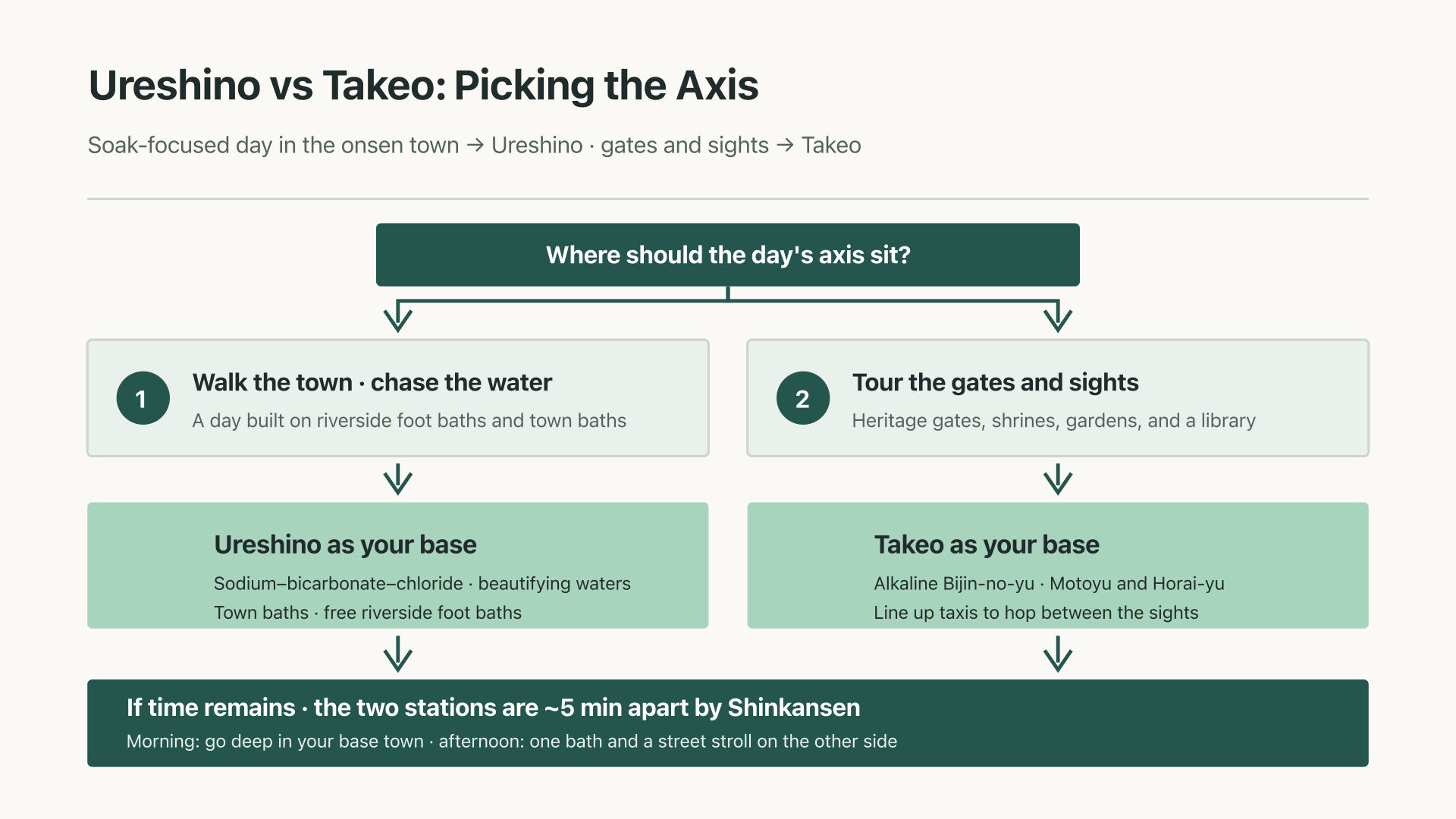
There are also records of covering both towns together. A comparison guide put out by a Takeo accommodation writes that covering both onsen towns on a one-night, two-day trip is a common pattern, and a travel guide summary judges that a day linking the two towns by train, with the occasional taxi, is quite feasible. What makes the pairing work is the roughly 5 minutes between the two stations on the Nishi-Kyushu Shinkansen. For a single day, the realistic split is to go deep on whichever town becomes the anchor in the morning, move to the other side in the afternoon, and add just one more public bath or one stretch of street walking.
For a first visit the summary is blunter. The same comparison guide recommends Takeo for those who want to enjoy sightseeing and walking around town, and Ureshino for those who want to immerse themselves fully in the atmosphere of an onsen town. One caveat to keep in view: the guide is an AI English translation of a post issued by a Takeo accommodation, so weigh the skeleton (the character of the water, the routing) against how far it overlaps the official guidance.
The day course in summary
- Walk the onsen town itself and sink into the feel of the water: anchor on Ureshino.
- Want the gate and a sightseeing route: anchor on Takeo and line up the taxi connection from the station.
- The two stations sit about 5 minutes apart by shinkansen; on a day with slack, add the other town’s public bath.
Images are examples to aid understanding.
Last checked: 2026-09-13
Sources & verification
A source-based guide. Check the linked operator information again before you travel.
- Ureshino Motoyu, access and free shuttle guidanceSources checked:
- Japan National Tourism Organization, Takeo OnsenSources checked:
- Bike Tourist, Kamome ride log between Ureshino-Onsen and Takeo-OnsenSources checked:
- Travelzpro, Ureshino and Takeo onsen guideSources checked:
- Onsen Japan, Ureshino Onsen water and town characterSources checked:
- Holiday Landmark, Ureshino Onsen guideSources checked:
- Holiday Landmark, Takeo Onsen guideSources checked:
- Nanairo Hotel note, Ureshino and Takeo comparison FAQSources checked:
Illustrations are examples to aid understanding, not photographs taken on site. Actual photographs have separate source credits.
Help us keep this note useful
A quick response helps us decide what to clarify or recheck. No account or email is needed.