
Picture yourself at Beppu Station one morning, standing at the tourist information counter by the east exit. Two tickets there are worth weighing for the hells: the ¥2,400 combined ticket that gets you into all seven, and the ¥1,100 day pass for Kamenoi’s buses. Both are sold as bundles that save you money, and in a town you have never been to it is tempting to buy both.
The two do not work out the same way. On the usual route, seeing all seven, the combined ticket with the website coupon comes to ¥1,300 less than seven single tickets, while the day pass costs ¥30 more than paying each bus fare. Our recommendation: If you will go into five hells or more, show the official website coupon and buy the combined ticket for ¥2,200 in cash. Skip the day pass and pay each ride with an IC card or a contactless card.
The order of the day matters even more than the tickets, though. The six-minute bus between the two areas runs only every half hour in the morning, and nobody can tell you when the geyser at Tatsumaki Jigoku will go off. Below, the ticket arithmetic comes first, then a half-day route built from the timetables.
Start by counting how many hells you will go into
All seven hells charge the same. Since 1 February 2025, one hell costs ¥500 for an adult and the combined ticket costs ¥2,400. Show the coupon from the official website and the combined ticket drops by ¥200, to ¥2,200.
| Ticket | Adults (high-school age and over) | Elementary and junior-high students |
|---|---|---|
| One hell | ¥500 | ¥250 |
| Combined ticket, all seven | ¥2,400 | ¥1,200 |
| Combined ticket with the website coupon, cash only | ¥2,200 | ¥1,100 |
The break-even point is five hells. Five single tickets cost ¥2,500, more than the ¥2,200 coupon ticket. At four, the ¥2,000 in singles is cheaper. Even at the full ¥2,400, the combined ticket wins from five. The children’s prices tip at the same point.
So rather than asking “should I see all seven?”, ask which ones you would drop. Oniyama Jigoku goes by the nickname “crocodile hell” and keeps about 70 crocodiles, warmed by the hot spring. Shiraike Jigoku has a tropical fish house with about 20 species, including arapaima and piranhas. Both have a pond, but the animals are much of the show. If you came for the steaming pools and the day is tight, those are the two we would cut first.
Cutting them changes nothing in the arithmetic. That leaves exactly five, and the ¥2,200 coupon ticket still beats ¥2,500 in singles. Switch to singles only when you drop one more and are down to four.
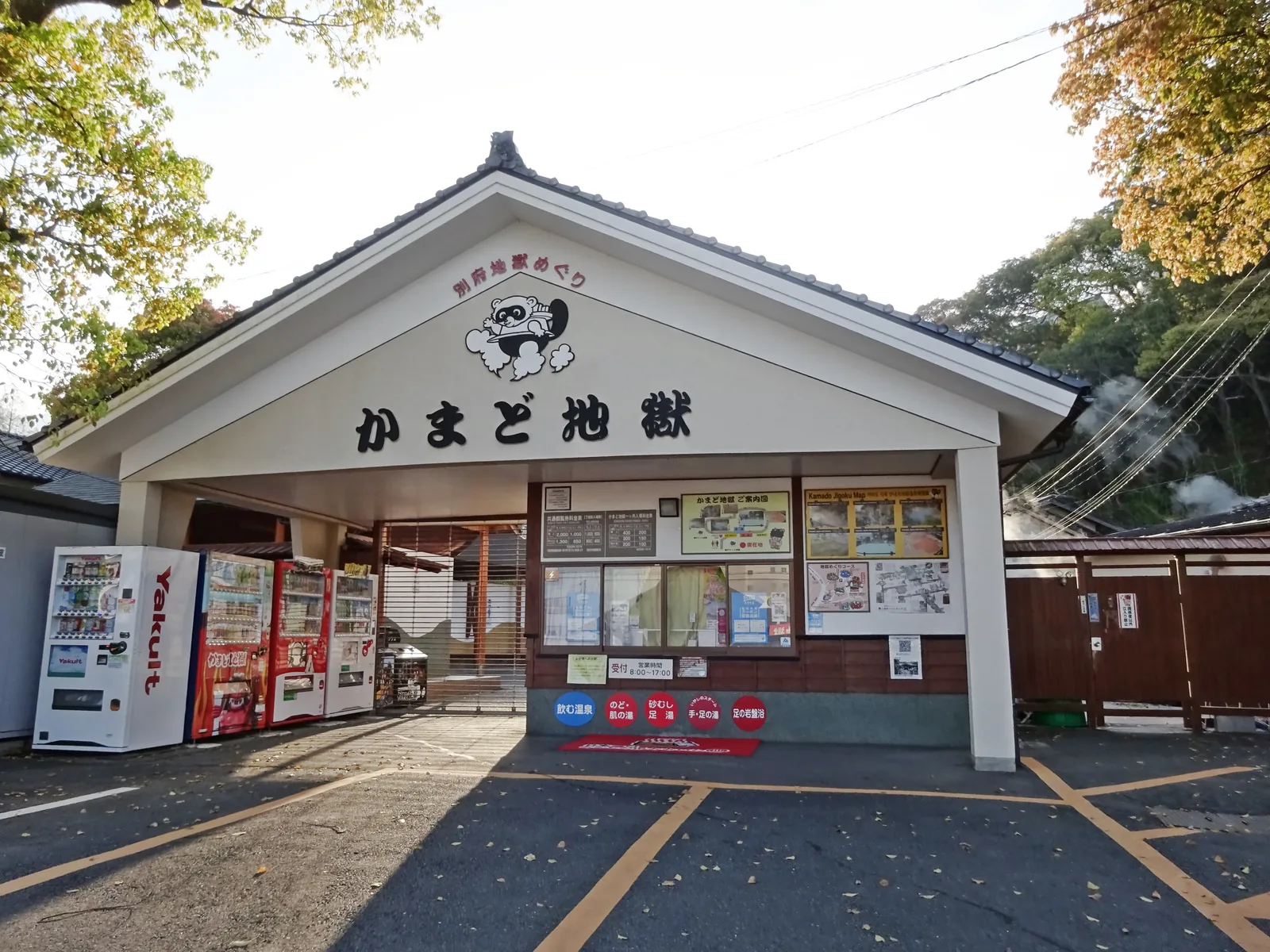

How the combined ticket works:
- Buy it at the ticket window of the first hell you reach. Every hell sells it.
- It is valid on the day you buy it and the next day, and gets you into each hell once. If you run out of energy after Kamado, Chinoike and Tatsumaki can wait until tomorrow.
- The coupon is on the Beppu Jigoku Association’s discount page. Print it or show it on your phone; one coupon covers up to five people. It cannot be combined with other discounts, and the discounted ticket is cash only. It is valid until 31 March 2027.
The Wander Compass Beppu tourist information center at the station’s east exit also sells the combined ticket. Beppu’s tourism website lists it at ¥2,400. Taiwanese travelers who posted in February 2025 left their bags at the tourist information center next to Beppu Station and bought the ticket at the same counter for ¥2,200 each. They were given a voucher and told to collect the ticket at the first hell. Ask the price at the counter. If it is ¥2,400, buy at the first hell with the coupon instead.
If you have no yen in cash, Klook sells a date-fixed admission voucher. As of 7 October 2026 it covers admission only, and you print the voucher before you go. It is valid only on the date you choose and cannot be cancelled. Check Klook’s seven-hell voucher for your date. Compare its price with ¥2,200 at your card’s exchange rate, and book it only when your date is certain.
Two other products get mixed up with this one. A paper Kamenoi bus day pass also takes ¥200 off the combined ticket, but not on top of the coupon, and digital passes do not qualify. That is the same ¥200 the coupon gives. The BEPPU ROUND TOUR PASSPORT (¥3,800 for one adult day) bundles the hells with other attractions such as the Hell Onsen Museum (¥1,500 at the standard price). It pays only if you visit more than ¥1,600 worth of those other places on the same day, which is the gap between it and the ¥2,200 coupon ticket. To use it for the hells, start at Umi Jigoku or Chinoike Jigoku.
Prices changed on 1 February 2025. Admission prices in posts written before then are out of date.
Three bus rides, and the day pass loses by ¥30
Every bus on this route is a Kamenoi bus. Oita Kotsu buses also run in Beppu, but Kamenoi’s My Beppu Free day pass is not valid on them. Adult fares for the three usual legs:
| Leg | Routes | Adult fare | Ride |
|---|---|---|---|
| Beppu Station West Exit, stand 3 → Umi Jigoku-mae | 1, 2, 5, 7, 41 | ¥390 | 19–25 min |
| Kannawa, stand 2 → Chinoike Jigoku-mae | 16, 16A, 29 | ¥220 | 6 min |
| Chinoike Jigoku-mae → Beppu Station-mae (east side) | 16, 16A | ¥460 | about 35 min |
Three rides come to ¥1,070. The Mini day pass costs ¥1,100, so on this route alone it loses by ¥30. The Taiwanese travelers heard the same sum from the staff at the station’s information center: the three legs add up to ¥1,070, ¥30 less than the day pass, and with an IC card you can simply tap.
The pass wins from the fourth ride. If you are heading up toward Myoban after the hells, or going back to Kannawa for dinner, it is worth buying. A two-day pass costs ¥1,700. Leaving Chinoike for Kamegawa Station costs ¥170, and going from Chinoike back to Kannawa costs ¥220. Add those up once your route is settled.
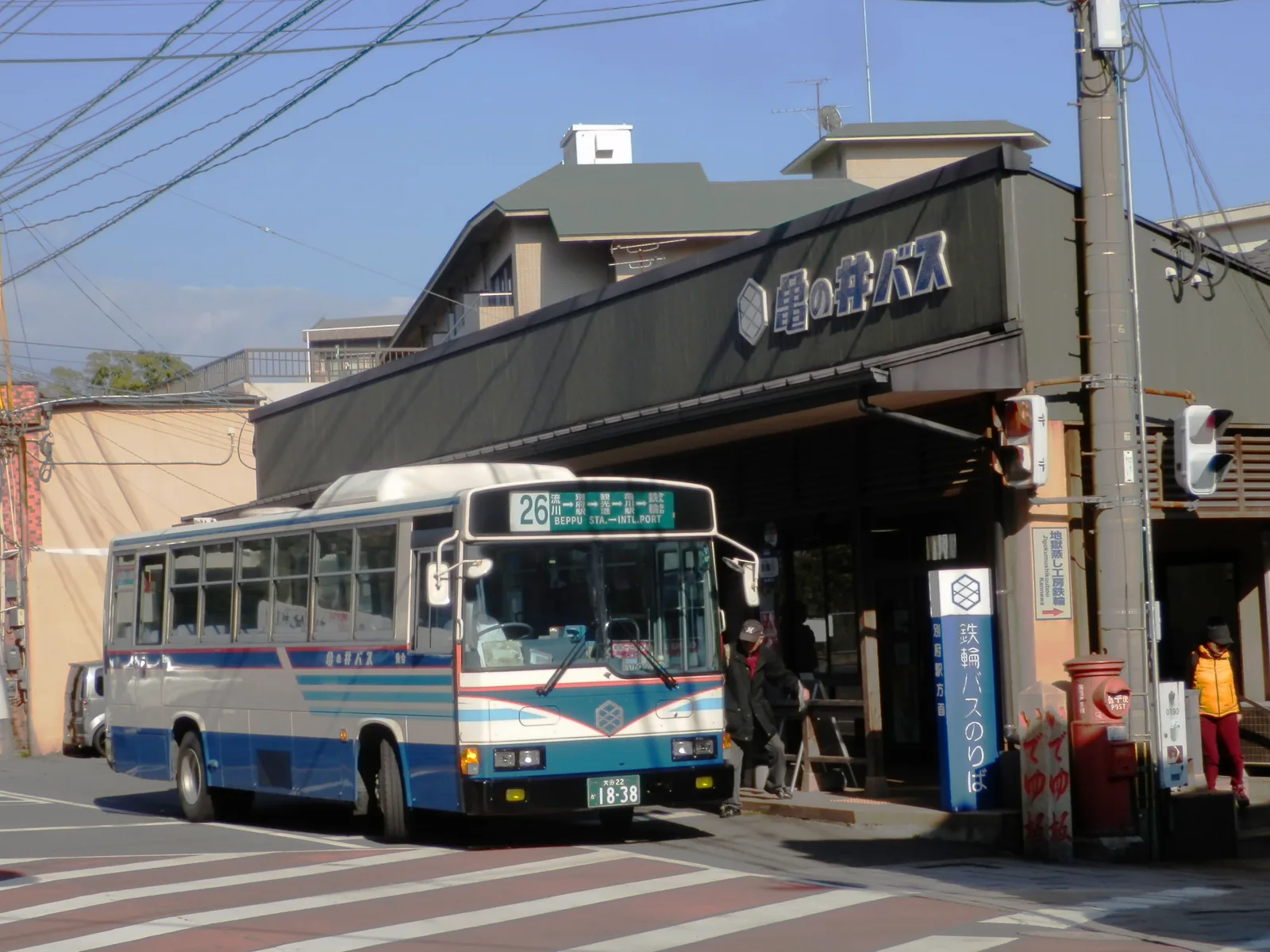

A few things about riding:
- Paying. If you pay cash, carry coins and small notes. There is no change on board, and the driver cannot break ¥2,000, ¥5,000 or ¥10,000 notes. Nimoca and the other transit IC cards that are interchangeable across Japan are accepted. Since 21 March 2026, every Kamenoi local bus also takes contactless Visa, Mastercard, JCB, American Express, Diners Club, Discover and UnionPay. Tap the same card once as you board and again as you get off.
- Buying the pass. Paper passes are sold at Wander Compass by Beppu Station, the Kitahama bus center and the Kannawa waiting room. Since November 2025, Kamenoi also sells digital passes on its website.
- Children. On the bus, junior-high students pay the adult fare and elementary students and younger pay half, except that one preschool child per paying passenger rides free. At the hells, junior-high students still pay the child price, so the two rules differ.
- Where to get off. From the Umi Jigoku-mae stop it is a minute’s walk to Umi Jigoku. Start there and walk the five hells. Until 31 March 2027, the Umi Jigoku-mae stop toward Kannawa is in a temporary spot.
- Full buses. Kamenoi asks riders to take the next bus when one is full. The Taiwanese travelers found the bus to the station after Tatsumaki crowded, with people getting on and off all the way, and arrived later than they expected. If you are at the back of the queue with no seat, they wrote, the standing is hard going.
If you will ride four times or more and are flying into Fukuoka Airport, Klook sells the Mini day pass for collection as a physical pass at the airport’s H.I.S. counter. As of 7 October 2026 you can cancel free of charge until you collect it, and the pass then lets you choose your day within a month. Reserve the Mini pass for airport pickup on Klook. It only makes sense if you pass that counter anyway. If you arrive in Beppu by train, buy the pass there or on Kamenoi’s website. Compare the price with ¥1,100 at your card’s rate.
A half day from the timetables: the six minutes in the middle
We built a weekday from the timetables dated 14 March 2026, which were still posted on 7 October. The allowances are 30 minutes at Umi, 20 at Kamado, 20 at Chinoike, 25 at Tatsumaki and 10 at each of the other three.
| Time (weekday) | What you do |
|---|---|
| 09:05 | Route 2 from Beppu Station West Exit, stand 3 |
| 09:29 | Get off at Umi Jigoku-mae; Umi Jigoku is a minute’s walk |
| 09:30–11:01 | Umi, Oniishibozu, Kamado, Oniyama and Shiraike on foot, in that order |
| about 11:10 | Reach Kannawa, stand 2 |
| 11:23 | Route 16 or 16A (the previous bus is at 10:53) |
| 11:29 | Get off at Chinoike Jigoku-mae; after Chinoike, Tatsumaki is less than 100 m away |
| 12:29 | Route 16 from Chinoike Jigoku-mae |
| 13:04 | Beppu Station-mae, on the east side of the station |
That is four hours station to station, about half an hour of it waiting for buses. On the weekend timetable the times differ by a minute or so. Start later and the whole day slides: from the 12:05 bus you are back at 16:05. The hells close at 17:00, so to see all seven, leave Beppu Station by about 13:30 at the latest. That gets you to Tatsumaki around 16:10, with time left to wait for the geyser.
The six-minute hop from Kannawa to Chinoike is what decides the day. In the morning, routes 16 and 16A leave only at 23 and 53 minutes past the hour, one bus every 30 minutes. That is about 14 minutes’ wait on average. After 13:00, route 29 joins them and the average wait drops to about 9 minutes.
In the morning you can walk it instead. From Shiraike Jigoku to Chinoike Jigoku is about 2.2 km, a little over 30 minutes on foot, and Chinoike sits about 100 m lower, so it is downhill. On the route above you would arrive at 11:29 by bus or 11:31 on foot. The association recommends a car or bus for this 3 km stretch, so treat walking as an option for good shoes and good weather. The other way, from Chinoike up to Kannawa, is uphill.
Getting back is easier. Route 16 leaves Chinoike for the east side of the station every 30 minutes, and several routes, including 5 and 7, run to the station from Kannawa’s stand 1. So if you want lunch or a bath in Kannawa, turn the day around: see Chinoike first and finish in Kannawa. For the bath itself, see Beppu day onsen: public baths or a private family bath.
Do not leave Tatsumaki for last
Of the seven, Tatsumaki Jigoku is the one stop where you cannot set the pace. It is a geyser under a roof; without the roof, the association says, the water has the force to shoot about 30 m. The question is when. On 15 January 2026 the management posted a notice that the waits before eruptions that season had grown longer and the eruptions less steady. On 7 October the notice was still on the association’s website.
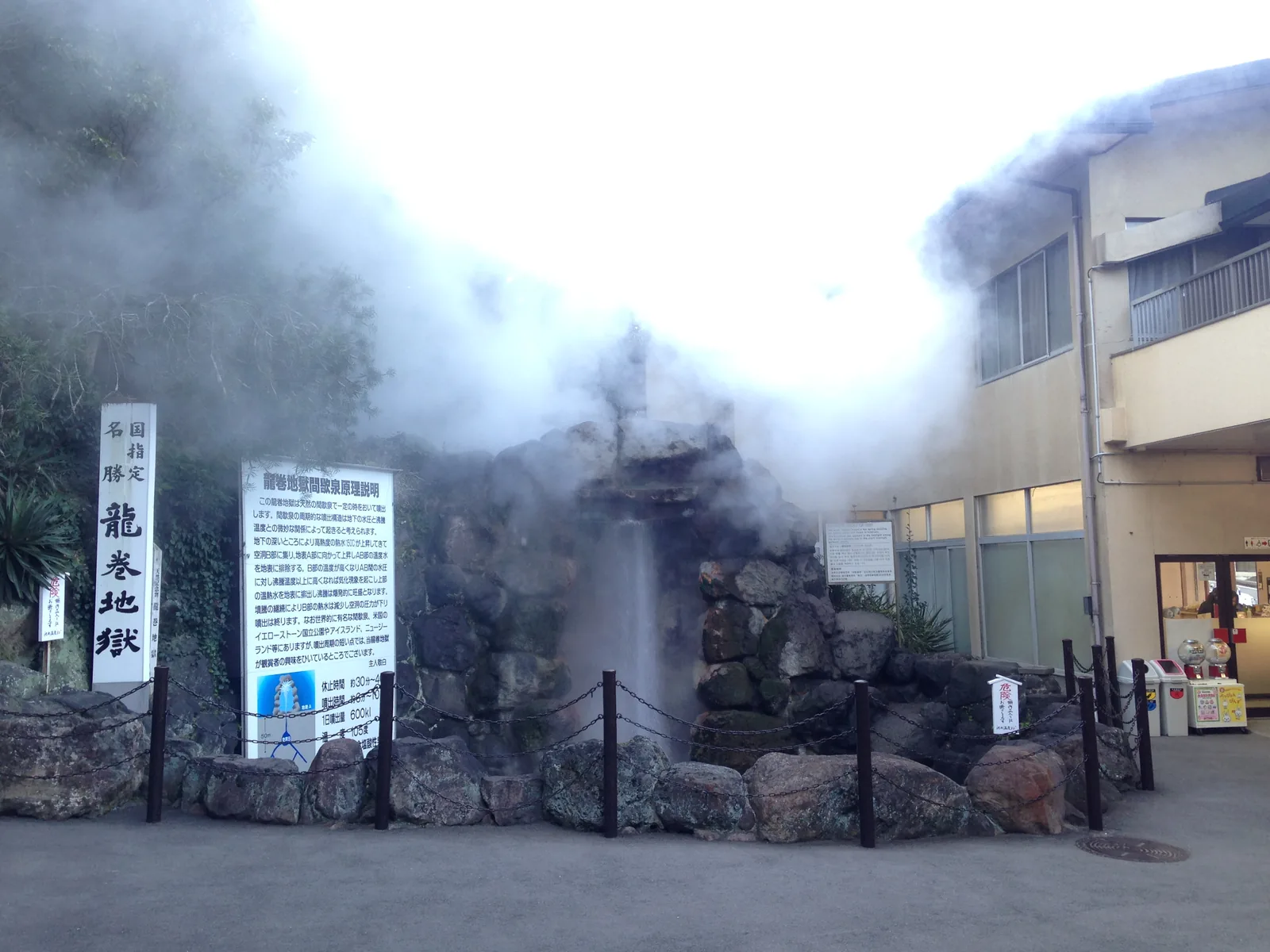

When you reach the entrance, look first at the lamp above the sign. If it is red, an eruption is about to start or under way. If it is off, go next door to Chinoike first and come back. Leave yourself plenty of time to wait, and never put Tatsumaki right before a train you have booked.
Two travelers’ accounts show what happens otherwise. The Taiwanese travelers reached Beppu Station at about 12:40, left their bags and set off. Tatsumaki was their last stop, and they arrived just after an eruption; with no time to wait 30 to 40 minutes for the next, they gave up. A traveler who posted in July 2026 had started the trip on a 09:55 departure from Tokyo’s Haneda and toured the hells in the afternoon. After lingering at the first few, they realized the buses only ran until evening, hurried, and only noticed back at the hotel that they had skipped Tatsumaki entirely. Both days started in the afternoon.
Plan lunch too. A traveler going round Kannawa in mid-March 2025 found a two-hour wait at Jigoku Mushi Kobo Kannawa, the restaurant known for food steamed over the hot springs, and had fried chicken at a nearby shop instead. For lunch in Kannawa, we would go early, before the noon rush, or see Chinoike first and come back for a late lunch.
Four hells have foot baths: Umi, Chinoike, Oniishibozu and Kamado. Bring a small towel if you plan to use them. According to the official website on 7 October 2026, staff feed the crocodiles at Oniyama at 10:00 on Saturdays and Sundays. It helps to know either way, whether you want to watch it or avoid it.
Kannawa to Chinoike: bus, walk or taxi, by group size
There are three ways across the 3 km between Kannawa and Chinoike.
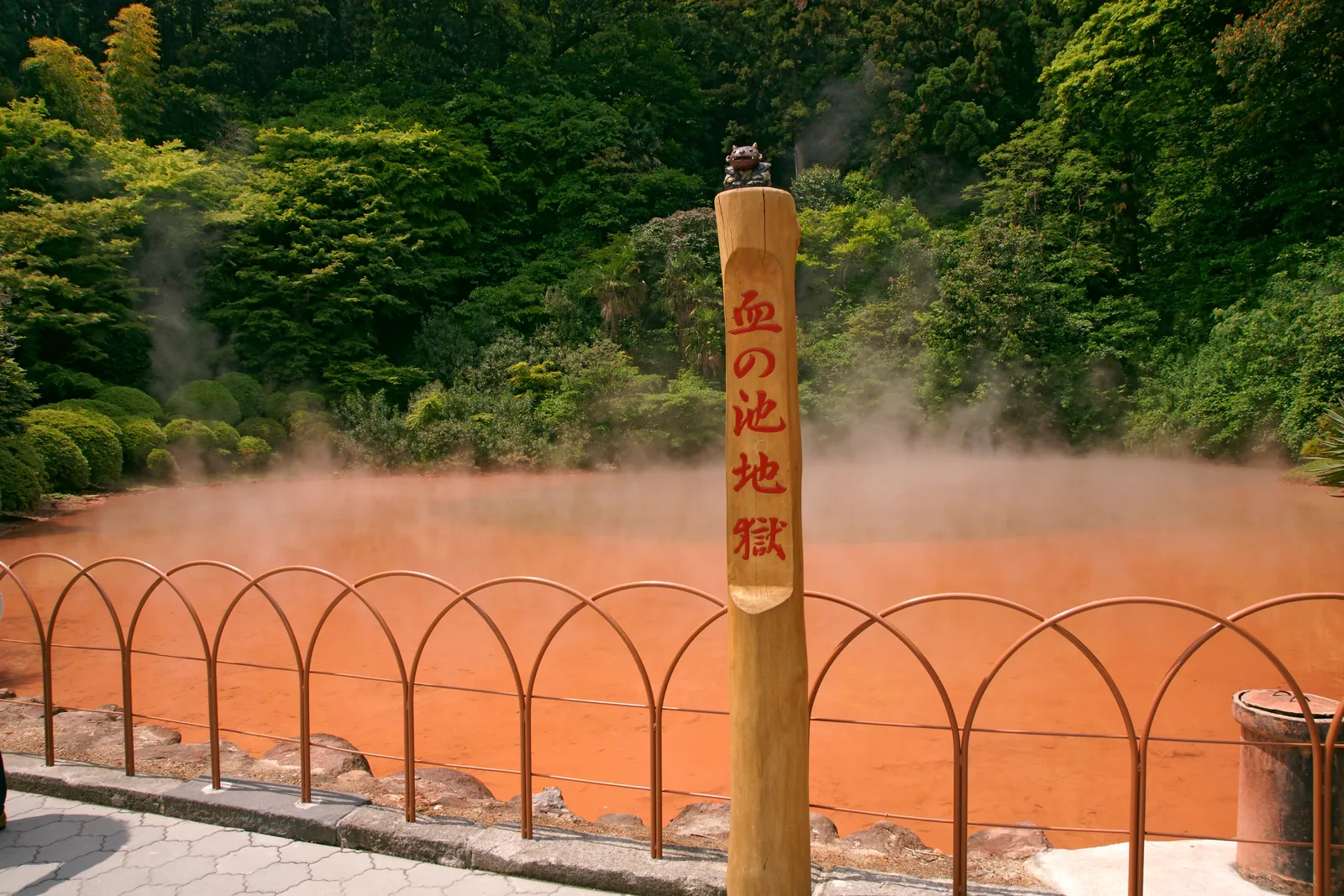

- Bus: ¥220 a person, 6 minutes. Every 30 minutes in the morning.
- Walk: about 2.2 km from Shiraike, a little over 30 minutes. Downhill toward Chinoike.
- Taxi: our estimate is about ¥1,250 in a standard taxi from Shiraike to Chinoike, or about ¥1,450 from Umi Jigoku. The road for cars loops a little further than the footpath, about 2.6 km. Calling a taxi by phone or app adds a ¥300 dispatch fee.
We estimated the taxi fares with the Oita tariff that took effect on 1 July 2026 (¥650 for the first 1.0 km, then ¥100 for every 299 m) and road distances. They assume traffic is moving freely.
| Adults | Middle leg by bus | Middle leg by taxi | Whole route by bus | Sightseeing bus (admission included) |
|---|---|---|---|---|
| 1 | ¥220 | about ¥1,250 | ¥1,070 | ¥4,500 |
| 2 | ¥440 | about ¥1,250 | ¥2,140 | ¥9,000 |
| 4 | ¥880 | about ¥1,250 | ¥4,280 | ¥18,000 |
For four people, a taxi across the middle costs only ¥370 more than four bus fares and cuts out up to 30 minutes of waiting. It is an easy call. On your own, take the bus or walk. Taking a taxi for every leg (station to Umi Jigoku, Shiraike to Chinoike, Chinoike back to the station) runs to about ¥6,500–6,900 a car, still around ¥600 a head more than the bus for a group of four. Slow traffic pushes the fare higher.
When the ¥4,500 sightseeing bus is worth it
Kamenoi’s regular sightseeing bus takes about three hours to cover all seven hells with a bus guide. It leaves Beppu Station-mae stand 4, on the east side, at 09:20 and 14:00, and the Kitahama bus center ten minutes earlier. The adult fare of ¥4,500 includes admission; junior-high students pay ¥3,500 and elementary students and younger ¥2,300. Seating is first come, first served, but you can book from 10:00 two months before the day, and passengers with a booking board first if the bus is full. In Kannawa the group walks the five hells behind the guide for about an hour. Kamenoi’s page presents the tour through the story of its start in 1928 and a line of the rhythmic Japanese patter its guides once used. It mentions no other languages.
On your own with the coupon ticket and single fares, the day costs ¥3,270, so the sightseeing bus costs an adult about ¥1,230 more. What the extra money buys is not having to read timetables or work out connections. It suits a day when your flight or train is fixed for the afternoon and you want all seven done within the three hours of a morning tour. Kamenoi does warn that traffic and the timing of Tatsumaki’s eruptions can delay arrival, and asks passengers to leave a margin before onward buses, trains or ferries. It does not suit anyone who wants to linger at Umi Jigoku or wait for a second eruption at Tatsumaki.
How we would spend the day
We would take a bus in the nine o’clock hour and start at Umi Jigoku. Even leaving out Oniyama and Shiraike that is five hells, so we would buy the coupon ticket in cash and tap a card on the buses. If the lamp at Tatsumaki is off, Chinoike comes first, and lunch in Kannawa stays clear of noon. On a day with an afternoon train or flight already fixed, we would drop all this arithmetic and book the morning sightseeing bus.
Before you go, check two things again. The coupon is valid until 31 March 2027, and the bus timetables are the edition of 14 March 2026. Open the timetable list and pick the weekday or weekend version for your date.
Sources & verification
A source-based guide. Check the linked operator information again before you travel.
- Beppu Jigoku Association: hours and combined ticket prices (from 1 February 2025)Sources checked:
- Beppu Jigoku Association: website coupon for the combined ticket (valid to 31 March 2027)Sources checked:
- Kamado Jigoku: single admission, the same at every hellSources checked:
- Chinoike Jigoku: hours and single admissionSources checked:
- Umi Jigoku: single and combined admissionSources checked:
- Beppu Jigoku Association: access and the two hell areasSources checked:
- Beppu Jigoku Association: Tatsumaki Jigoku and its eruption lampSources checked:
- Beppu Jigoku Association: Tatsumaki geyser notice (15 January 2026)Sources checked:
- Beppu Jigoku Association: Oniyama JigokuSources checked:
- Beppu Jigoku Association: Shiraike JigokuSources checked:
- Kamenoi Bus: stands and route numbers to the main sightsSources checked:
- Kamenoi Bus: timetables (as of 14 March 2026)Sources checked:
- Kamenoi Bus: route 2 timetable, weekdays (PDF)Sources checked:
- Kamenoi Bus: routes 16 and 16A timetable, weekdays (PDF)Sources checked:
- Kamenoi Bus: routes 16 and 16A timetable, weekends and holidays (PDF)Sources checked:
- Kamenoi Bus: route 29 timetable, weekdays (PDF)Sources checked:
- BusDoko-Oita: route and fare searchSources checked:
- Kamenoi Bus: My Beppu Free day passesSources checked:
- Kamenoi Bus: paper-pass benefits (not valid with digital passes)Sources checked:
- Kamenoi Bus: FAQ on paying fares and IC cardsSources checked:
- Kamenoi Bus: child and infant fares (PDF)Sources checked:
- Kamenoi Bus: contactless card payment on all local routes from 21 March 2026Sources checked:
- Kamenoi Bus: web day passes on sale from 1 November 2025Sources checked:
- Kamenoi Bus: Umi Jigoku-mae stop moved until 31 March 2027Sources checked:
- Kamenoi Bus: full buses and waiting for the next oneSources checked:
- Kamenoi Bus: regular sightseeing bus, Beppu hells courseSources checked:
- Oita Prefecture Taxi Association: fares from 1 July 2026Sources checked:
- Beppu Tabi Kobo: BEPPU ROUND TOUR PASSPORTSources checked:
- Beppu Tabi Kobo: Round Tour Passport facilities and standard pricesSources checked:
- Beppu City tourism: Wander Compass BeppuSources checked:
- Klook: Beppu Jigoku Onsen Ticket (activity 29063)Sources checked:
- Klook: Kamenoi bus day pass with Fukuoka Airport pickup (activity 86979)Sources checked:
Help us keep this note useful
A quick response helps us decide what to clarify or recheck. No account or email is needed.