For Chuseok holiday departures from the Seoul capital area, the tickets decide the schedule first. Train guides put the booking opening about 2 weeks before the holiday on the routes they describe, and seats may be hard to secure without advance booking, while a first-hand bus account reports tickets for the holiday period selling out well in advance. On timing, morning first trains going out and anything but the last evening coming back leave more room, and on distance, one way within 2 hours works as a day trip and beyond that as an overnight stay (checked September 2026). Lock in train and bus tickets, lodging and reservation-based programs early; markets and central-city streets are the zones you can enter without reservations.
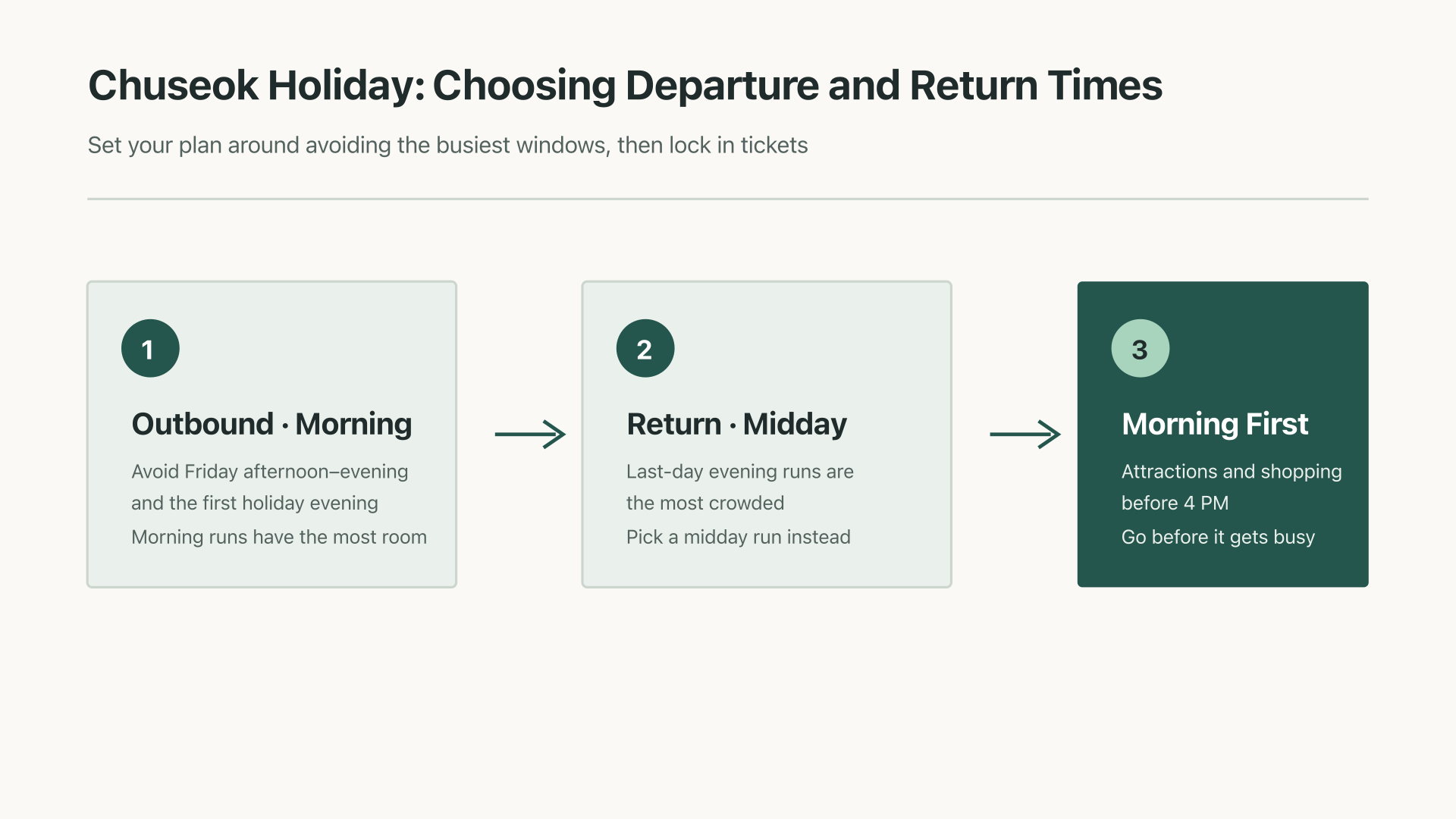
Train and bus tickets: when to book
Treat about 2 weeks before the holiday as the baseline for train tickets. The guide for KTX service from Jeonju Station to Seoul Station has Lunar New Year and Chuseok holiday trains on that route opening for booking about 2 weeks before the holiday, and notes that without advance booking on Korail, seats may be hard to secure. The same source adds that temporary trains are added during the holiday stretch, with the exact timetable to be confirmed on Korail’s booking screen for your departure date.
Several guides size up how fierce the competition gets. A timetable guide for the Gyeongju direction warns that on weekends and holidays popular KTX and SRT trains can sell out early and recommends booking at least 1–2 weeks ahead, and another route guide notes train tickets go on sale up to 2 months before the travel date. For Gangneung, a guide treats weekend bookings 2 weeks ahead as practically required and reports frequent sellouts. One caveat for the budget, checked September 2026: after the KTX and SRT integration, fares may change by up to 10%, so base the cost estimate on the booking screen as well.
Buses show the same squeeze. A first-hand account of bus travel between Seoul and Sokcho reports that fall foliage weeks and Chuseok and Lunar New Year travel are especially competitive, with tickets often gone well in advance, and suggests buying at the terminal a few days ahead in those periods.
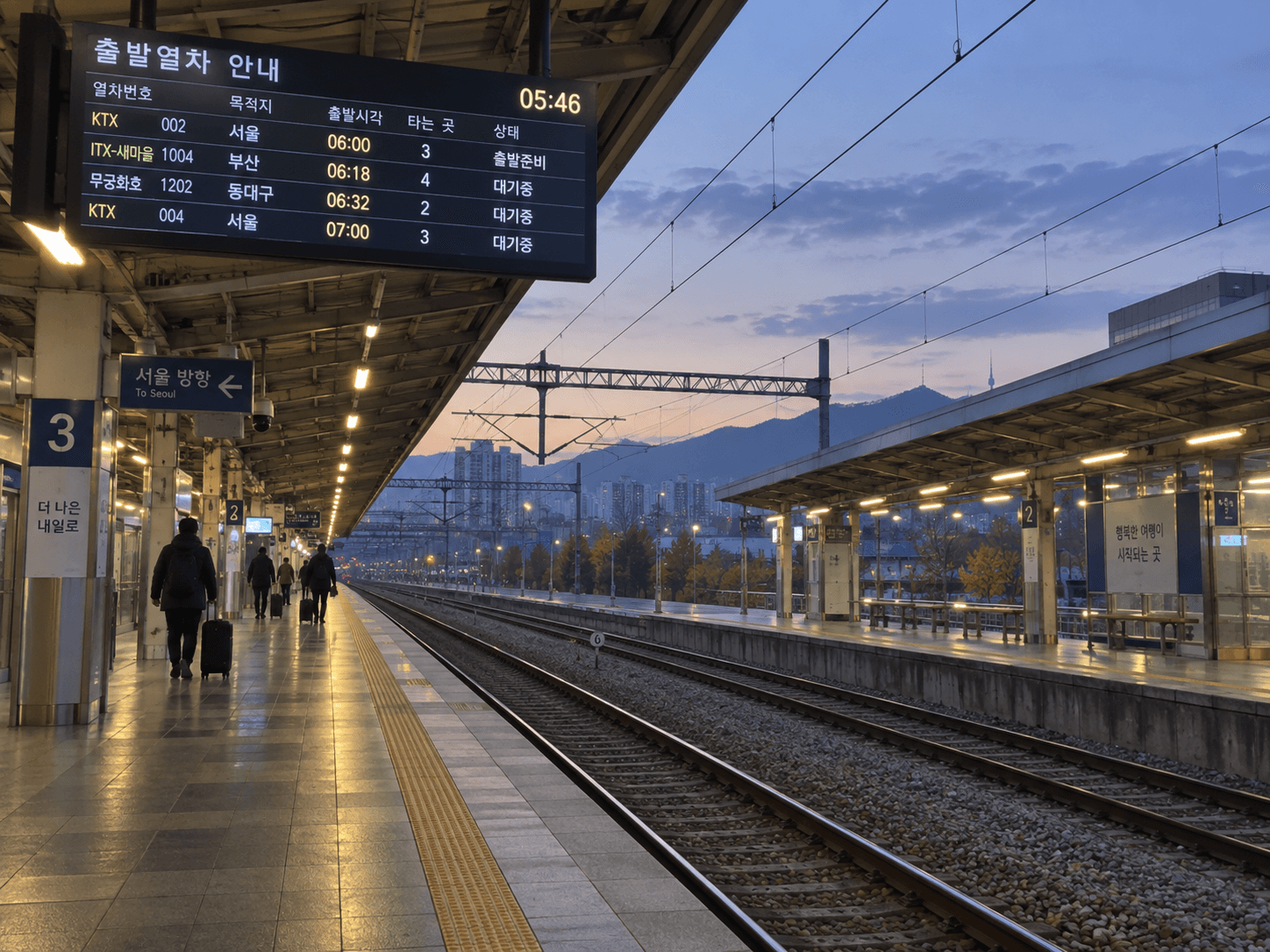
Departure day and return day: which time slots have room
For trains, the congestion pattern repeats by weekday and time of day. The Jeonju Station KTX guide lists Friday afternoon to evening and Sunday afternoon as the most crowded, and says a weekday or a morning departure makes for a relaxed ride. Buses point the same way: the same first-hand record has Seoul to Sokcho departures fullest on Friday evenings and Saturdays, and Sokcho to Seoul on Sunday evenings. The same record adds that Chuseok and Lunar New Year travel is even more competitive than this general pattern.
Applied to the holiday, the records favor avoiding evening slots in both directions. Plan the outbound leg around morning first trains, and for the return pick a midday run instead of the last evening departure on the final day, which keeps a wider margin from the most crowded window. Build this rule into the round-trip booking from the start, and dividing your hours gets easier.
The hours when central attractions fill up are also worth factoring in. A visitor record on Namsan Tower notes that weekends and holidays get crowded from 4 pm to 9 pm, that cable car waits on those evenings passed 40 minutes, and that weekday mornings are the quietest (checked September 2026).
Time-slot guidance for the central shopping districts runs the same way. A Seongsu-dong shopping route guide says the crowds are thinnest right after the 10:00 opening and up to just before the 12:00–14:00 congestion peak (checked September 2026). For central sights and shopping, these records put the morning side of the day ahead of midday.
Day trip or one night: where to split
Travel time alone draws the line. A day-trip guide calls one way within 2 hours ideal and says 4 hours of round-trip transport plus 6–8 hours on site is enough without wearing yourself out, while one way over 3 hours tips the balance toward an overnight stay (checked September 2026). A region comparison helps the same call: the Seoul capital area has good public transit access and suits day-trip schedules.
Using one-way travel times from Seoul Station and Yongsan Station as the yardstick, the table reads as follows, checked September 2026.
| One-way travel | Example (from Seoul) | Call |
|---|---|---|
| About 1 hour | Chuncheon | Comfortable as a day trip; Nami Island, Gangchon Rail Bike and cafe courses are the classic case |
| About 1 hour 40 minutes to about 2 hours | Jeonju, Gangneung, Gyeongju | A day trip is possible, but book both ways with holiday ticket competition in mind |
| Over 3 hours one way | Regions farther out | Split into an overnight stay |
Day-trip cases fit inside that range (checked September 2026). Chuncheon is introduced as a day course combining a Nami Island stroll, Gangchon Rail Bike and cafes, 1–2 hours from Seoul. Gangneung is laid out as a same-day KTX itinerary that strings together Anmok Coffee Street, Gyeongpo and Jungang Market. Step up to an overnight and rail-inclusive packages exist; a 1-night, 2-day Gyeongju KTX package from Seoul is listed at KRW 264,000–289,000. During the holiday, extra temporary trains make a same-day round trip an option, but the premise that popular trains sell out early stays the same.
What to lock in early, what to walk into
A short list of early bookings protects the holiday schedule (checked September 2026). Train and bus tickets follow the booking windows above, and for lodging a hotel guide puts early bookings 2–3 weeks out at an advantage in peak season, with Friday and Saturday nights priced higher. When comparing rooms, look past the one-night rate to the total with tax, whether breakfast is included, and the cancellation terms. Reservation-based programs are tighter still: Seoul’s guided walking tour (도보해설관광) is reservation-based with applications due at least 5 days ahead, and the official notice says bookings for weekends, holidays and the spring and autumn peaks close early.
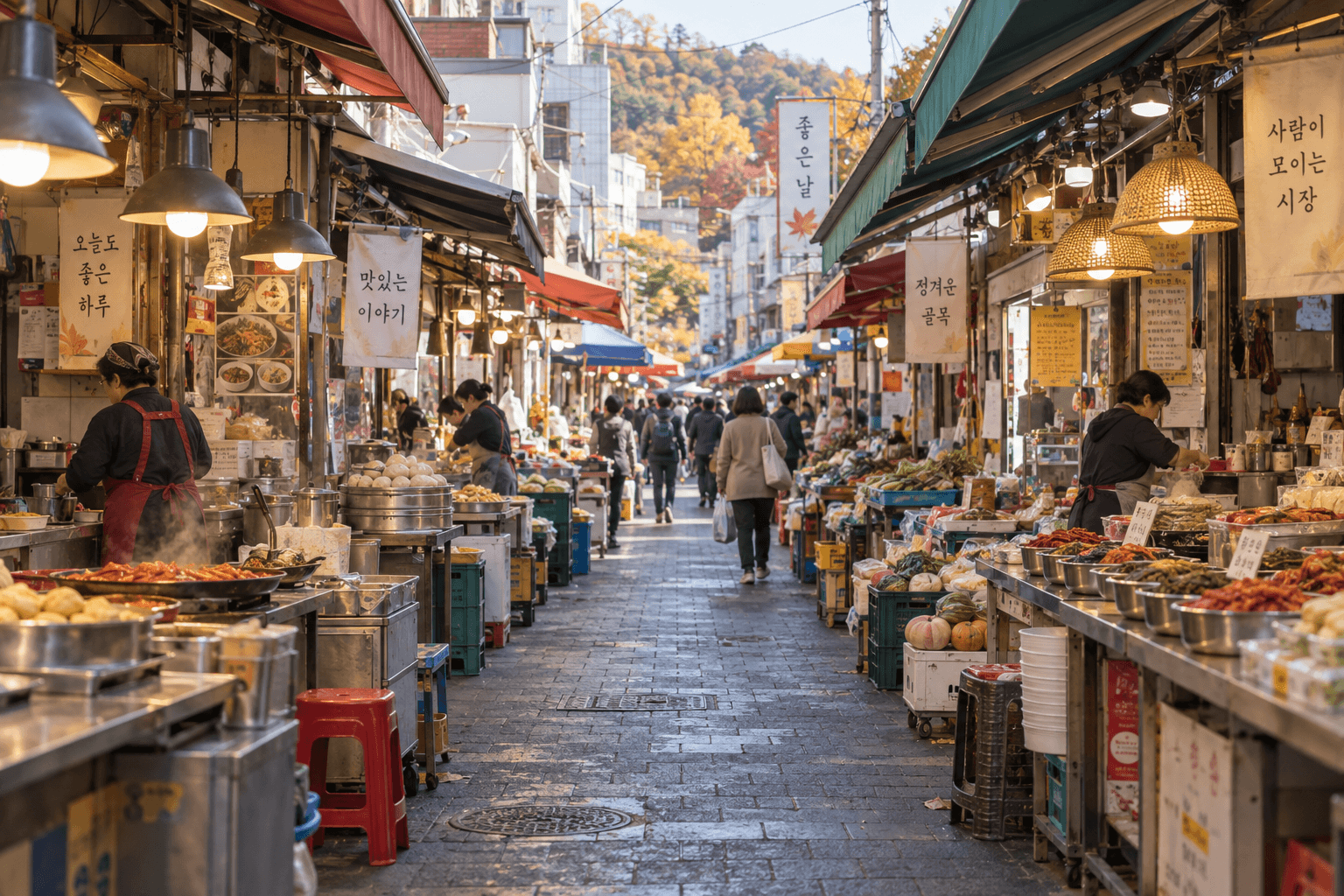
Some places clearly work without reservations. The Namdaemun Market guide says the market mostly keeps normal hours on public holidays, but individual buildings may take discretionary days off, so checking whether a specific building is open before you go is the safe move (a record based on the merchant association’s notices). Another visitor impression calls the same market less a planned shopping space than an old market that kept its everyday-life texture, which makes it an easy zone to walk with fewer plans. Indoor culture spaces such as the Starfield Library at COEX are introduced as walk-in courses, but one notice says holiday-period closing schedules may change during Chuseok, so put the operating status of your visit date on the list of things to ask.
Choices inside a day itinerary follow the same logic. The day-trip advice says famous restaurants, ticketed attractions and experience programs bring long waits if you show up unannounced at peak hours, so reserve what can be reserved ahead. Handle this reservation list on the day you lock in the holiday tickets, and the preparation is done.
Sources and scope
This is an editing guide built from the evidence bundle created on 2026-09-13. Operating details, fares and booking-window figures remain subject to re-verification; the dates shown in the text mark when the figures were checked, not each source’s own confirmation date. The 2026 Chuseok holiday dates and highway congestion forecasts are not in this evidence bundle and are not covered.
- LACHA Guide, train and bus access to Korea’s regional cities: https://lacha.co.kr/korea-guide/ko/korea-regional-cities-train-bus-access/
- Supportimes, Namdaemun Market opening hours: https://travel.supportimes.com/2026/08/namdaemun-market-hours-parking.html
- Mustard Data, Jeonju Station to Seoul Station KTX: https://train.mustarddata.com/KTX/schedule/route/%EC%A0%84%EC%A3%BC-%EC%84%9C%EC%9A%B8/
- Rapael blog, Seoul-departure transit destination comparison: https://rapael1004.com/entry/%EB%9A%9C%EB%B2%85%EC%9D%B4%EB%8F%84-%EC%99%84%EB%B2%BD%ED%95%98%EA%B2%8C-%EC%A6%90%EA%B8%B0%EB%8A%94-%EB%8C%80%EC%A4%91%EA%B5%90%ED%86%B5-%EA%B5%AD%EB%82%B4-%EC%97%AC%ED%96%89%EC%A7%80-%EC%B6%94%EC%B2%9C-BEST-4
- Trainfo Bebop, Gyeongju to Seoul trains: https://trainfo.bebop81.com/route/gyeongju-seoul/
- Koreacharts, Gyeongju to Seoul timetable: https://info.koreacharts.com/traintime/10311/10007/contents.html?date=2026-09-12
- Seoul Now, Namsan Tower access and crowding: https://seoul-now.net/news/namsan-tower-n-seoul-tower-how-to-get-cable-car-bus-fare-guide
- The Girl with a Big Bag, Seoul–Sokcho bus guide: https://thegirlwithabigbag.com/seoul-to-sokcho-seoraksan-bus-guide/
- Namane Card blog, Seongsu-dong shopping guide: https://blog.namanecard.com/seongsu-dong-shopping-guide-2026-kbeauty-fashion-ko/
- WHEREVER, domestic day trips in Korea: https://wherever.kr/%EA%B5%AD%EB%82%B4-%EB%8B%B9%EC%9D%BC%EC%B9%98%EA%B8%B0-%EC%97%AC%ED%96%89/
- Manye Tour, Gyeongju 1-night KTX package listing: https://mntour.tistory.com/5928
- Korean regional travel notes, region-by-region comparison: https://travelkorearegions.com/korean-regional-travel-naejangsan-foliage/
- KM Journal, a COEX outing during the Chuseok holiday: https://www.kmjournal.net/news/articleView.html?idxno=3916
- Trip.com guide, Chuncheon day course: https://kr.trip.com/guide/destination/chuncheon-day-trip-itinerary.html
- Helloktrip, Gangneung day-trip guide: https://helloktrip.com/guide/gangneung-day-trip-from-seoul?lang=ko
- Visit Seoul, Seoul guided walking tour: https://english.visitseoul.net/accessible-seoul/SeongsuCourse/ENNysm1n0
- Visit Seattle Korean portal, Myeongdong hotel guide: https://visitseattle.co.kr/792
- BookingTag, getting around Namdaemun Market: https://bookingtag.com/13395
- HotelPing, Seoul hotel guide: https://hotelping.net/magazine/seoul-hotel-guide-2026
How to decide
- Outbound on a morning first train on day one of the holiday; return by midday on the last day instead of the evening.
- Set a reminder for train and bus tickets 2 weeks before the holiday; lock lodging and reservation-based programs the same week.
- Within 2 hours one way, go for the day; beyond that, split into an overnight, and keep only markets and central streets reservation-free.
Images are examples to aid understanding.
Last checked: 2026-09-13
Sources & verification
A source-based guide. Check the linked operator information again before you travel.
- Mustard Data, Jeonju Station to Seoul Station KTXSources checked:
- The Girl with a Big Bag, Seoul–Sokcho bus guideSources checked:
- Trainfo Bebop, Gyeongju to Seoul trainsSources checked:
- WHEREVER, domestic day trips in KoreaSources checked:
- Seoul Now, Namsan Tower access and crowdingSources checked:
- Visit Seoul, Seoul guided walking tourSources checked:
- Supportimes, Namdaemun Market opening hoursSources checked:
- Namane Card blog, Seongsu-dong shopping guideSources checked:
Illustrations are examples to aid understanding, not photographs taken on site. Actual photographs have separate source credits.
Continue planning
Chuseok KTX Tickets Sold Out? An Order for Finding Alternatives from Seoul
Chuseok KTX sold out? Re-check other train classes and the SRT channel, move to the bus apps and fare classes, and choose destinations by the arrival terminal's access to downtown.
Seoul to Gangneung: KTX or car — when to take which
KTX or car to Gangneung? If the plan stays near the station, Gyeongpo and Anmok, take the KTX-Eum; for Jumunjin, Jeongdongjin or heavy luggage, drive.
Autumn in Seoul: From Gyeongbokgung's Fall Foliage to a Stroll in Bukchon Hanok Village
A one-day autumn walk in Seoul: Gyeongbokgung's late-October foliage, free palace entry in hanbok, then Bukchon Hanok Village, Samcheong-dong and Insadong.
Help us keep this note useful
A quick response helps us decide what to clarify or recheck. No account or email is needed.