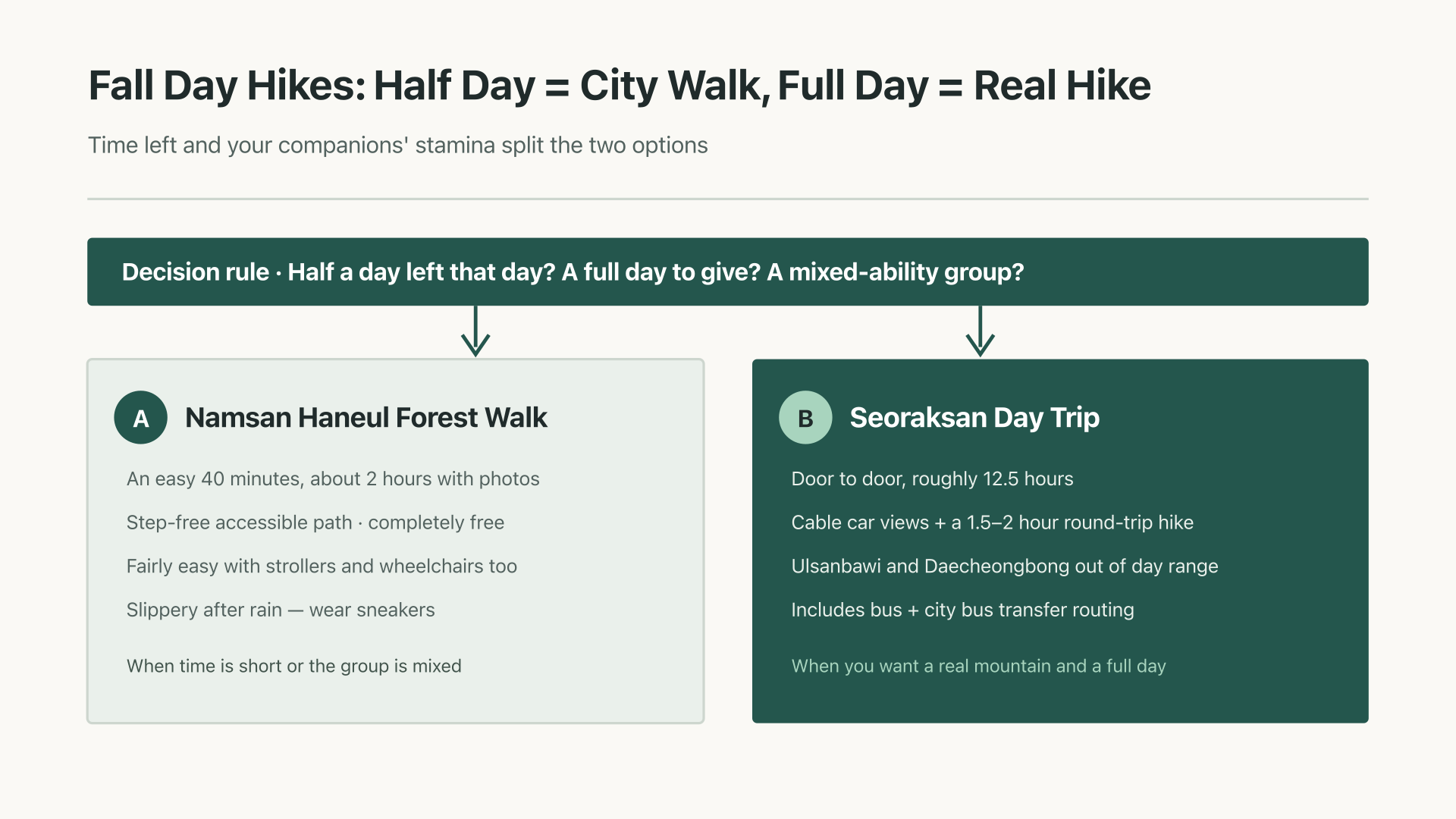
An autumn foliage mountain is easier to choose once you split the options by how much of the day you can actually clear: a half day, or the whole day. When time is short or your group is mixed, the right pick is a city walk like the Namsan Sky Forest Trail (남산 하늘숲길); if you want a proper mountain and can clear the whole day, it is the Seoraksan (설악산) day trip from Seoul. One limit comes first: Bukhansan (북한산), Namhansanseong (남한산성) and Soyosan (소요산), the original comparison candidates, are left out of this comparison because the sources this post can use carry little hiking detail on them, and for Soyosan only Korail’s official listing of the Gyeongwon Line (Line 1) section, Soyosan–Cheongnyangni, is confirmed.
The split: how much day you have, and who is walking with you
Ask both options the same question and the answers point in opposite directions. The Namsan Sky Forest Trail is sized at 40 minutes for a light walk and 1 hour for a relaxed one, and the guidance that covers the trail says a lot of photo stops stretch it to 50–70 minutes. A Seoraksan day trip works out to about 12.5 hours door to door, and the source that lays out the schedule describes the day as realistic but tight. The table numbers are from the September 2026 check and copy the source guidance, so they remain guidance values, not measurements.
| Item | Namsan Sky Forest Trail | Seoraksan day trip |
|---|---|---|
| Time needed | 40 minutes for a light walk, 1 hour if relaxed | about 12.5 hours door to door |
| Physical demand | many stair-free sections, manageable with a stroller or wheelchair | even the easy trails are a 1.5–2 hour round trip |
| Access | bus 402 or 405 from Seoul Station, about 12 minutes | express bus to Sokcho, transfer to city buses 7 or 7-1 |
| Foliage | an autumn foliage walking course | starts late September, peaks mid-October in a typical year |
Reading the time row alone mostly settles which option fits the day you actually have.
Namsan Sky Forest Trail: how many hours it takes and who it fits
The trail runs 1.45 km with a gentle zigzag layout graded at 4.6 degrees or less, it is stair-free and barrier-free, and it is completely free to walk (as of the September 2026 check). Because stair-free sections dominate, guidance says strollers, wheelchairs and older visitors can get around fairly easily, but the Namsan guidance also advises choosing only part of the route when you walk with a stroller or a companion whose knees are weak. Budget about 2 hours if photo stops and rest are included, and leave meals or cafe time as a separate slot.
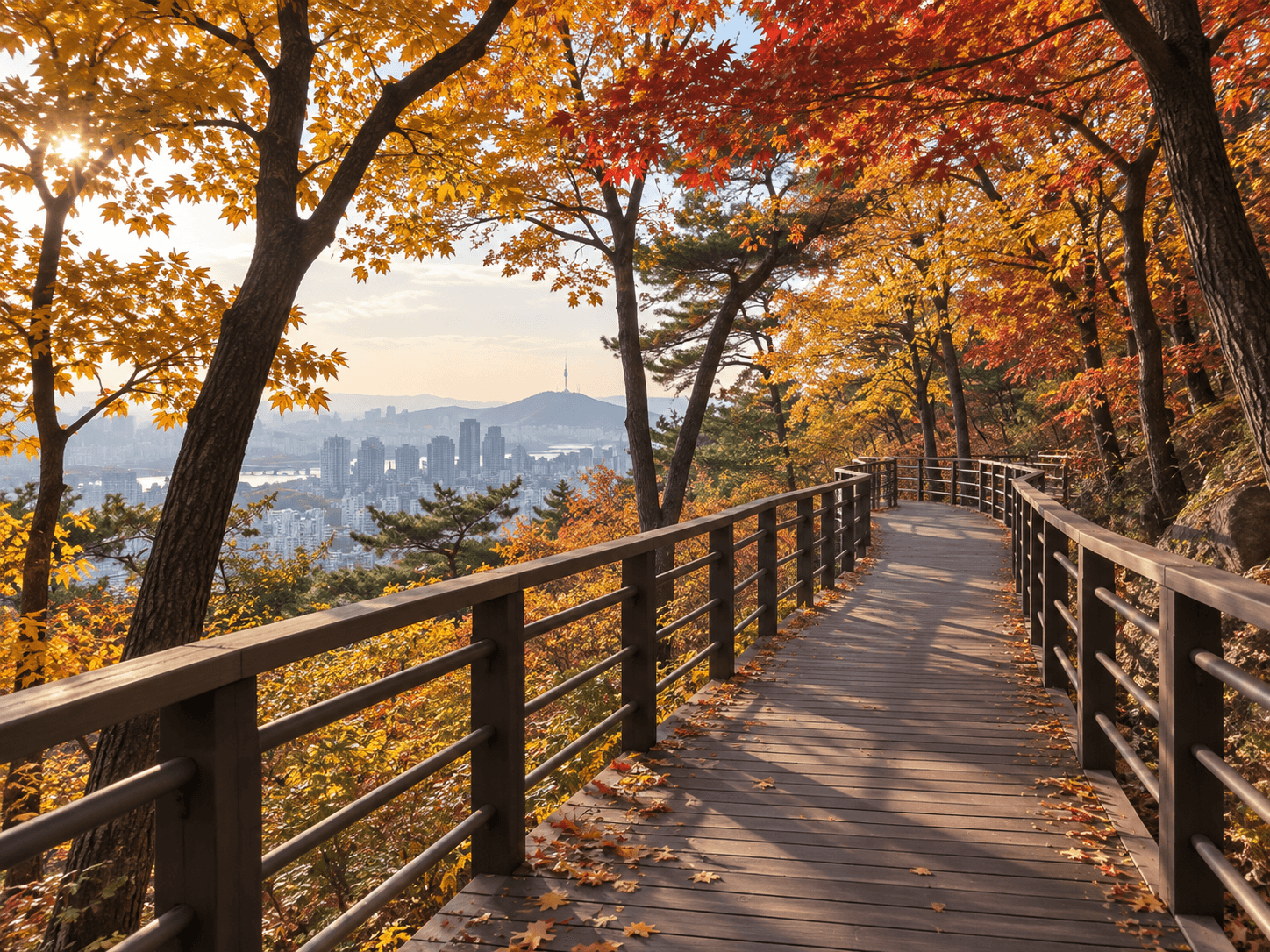
Autumn improves the terms. The trail is picked out as a walking course for the fall foliage season, and seasonal guidance also calls Namsan comfortable in spring and fall. The trade-off is that Namsan is strongly affected by weather, and the paths turn slippery after rain or snow. A use tip confirms that shoes with good grip are the safe choice on the deck paths after rain, so decide on your shoes before you leave.
Getting to Namsan: where to get off and what to board
From Seoul Station, the route leaves Exit 4 of Seoul Station on subway Line 1, boards bus 402 or 405 at the bus transfer center, and gets off at the Namsan Library (남산도서관) stop in about 12 minutes (as of the September 2026 check).
Coming from Chungmuro Station or Dongguk University Station (동대입구역), the introduced way is to move to the Yejang bus transfer lot (예장버스정류장), board Namsan Circular Bus 01A or 01B, and get off at the Palgak Information Center, about 25 minutes. The same source splits the entrances by walking length: the short and easy course runs toward Sowol Garden (소월정원), the longer but view-rich course toward Geonangwon Garden (건강정원), so pick the entrance that matches the walk you want.
The circular bus operating conditions also line up with the official N Seoul Tower notice: the 01A and 01B circular buses board at Chungmuro Station (Lines 3 and 4) and Dongguk University Station (Line 3), run 06:30–23:00, and cost KRW 1,500 with transfers allowed (as of the September 2026 check). General passenger cars have been restricted on Namsan since May 1, 2005, so the circular bus takes over from driving up.
On a travelogue’s accounting, bus 02 boards at Chungmuro Station Exit 2 or Dongguk University Station Exit 6, and bus 03 comes up from the Seoul Station, Itaewon and Hangangjin side. From Myeongdong Station, a guide also introduces the free inclined elevator Namsan Oreumi (남산 오르미), which puts you at the cable car boarding platform with a 5 minute walk plus a 2 minute ride. Decide the entrance direction first and save the matching stop in a map app; that finishes the preparation.
A Seoraksan day: how far it goes and what to leave out
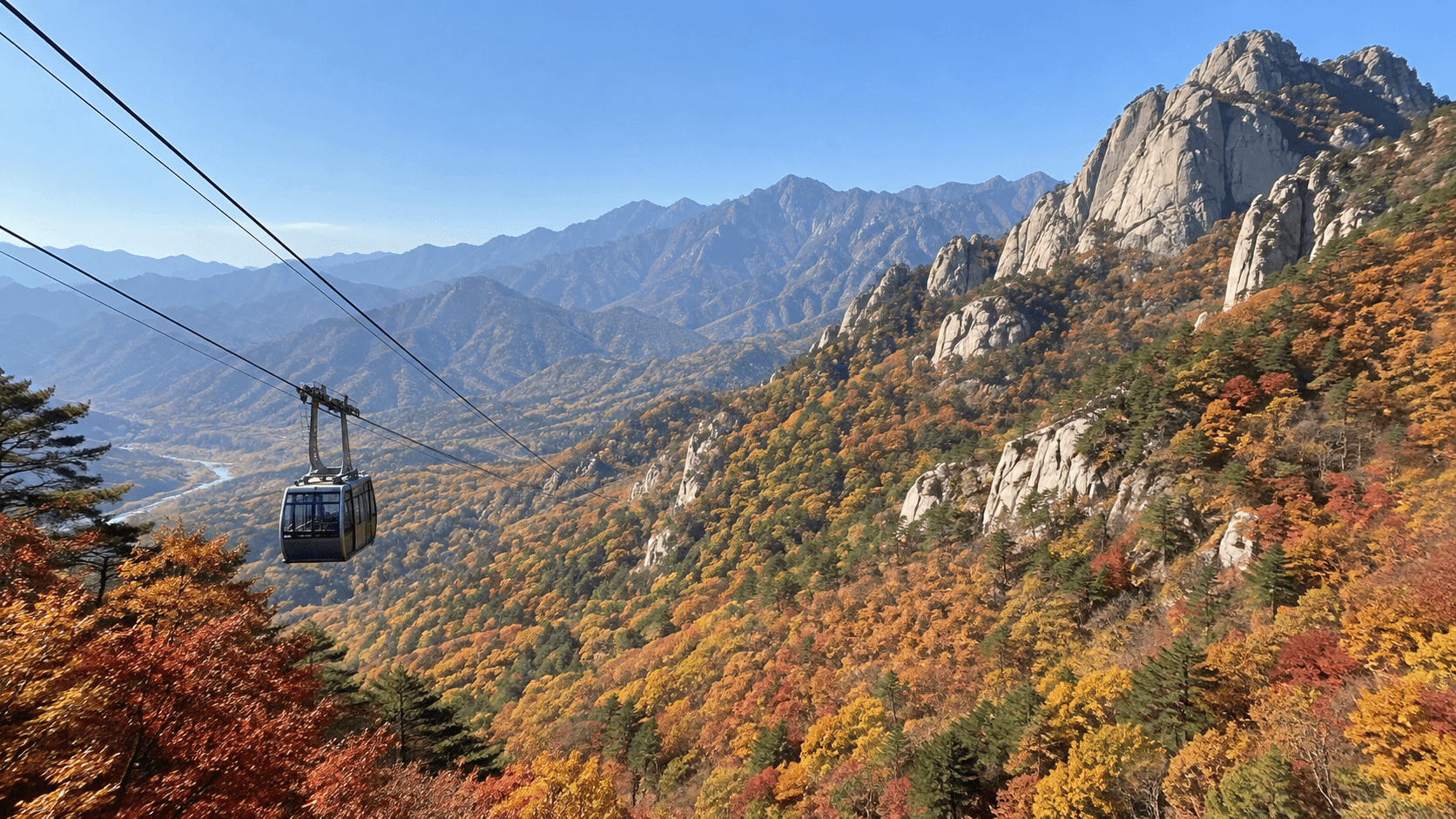
The standard shape of a Seoraksan day trip is this combination: city bus 7 or 7-1 from Sokcho to the Seorak entrance, the cable car up Gwongeumseong (권금성) with a 5 min ride and 30 min at the top, one easy walk after coming back down with Biryong Falls (비룡폭포) or the Heundeulbawi (흔들바위) stroll chosen as a 1.5–2 hour round trip, then back at Sokcho Bus Terminal around 15:00, departing Sokcho at 17:00 and reaching Seoul at 19:30 (as of the September 2026 check). Buses for Sokcho leave the East Seoul and Gangnam express bus terminals in Seoul frequently.
The same source is also clear about the limits: the Ulsanbawi (울산바위) round trip of 4–5 hours does not fit a day schedule, and the Daecheongbong (대청봉) summit is an 8–10 hour day on its own, impossible as a day trip from Seoul, per the source’s own summary.
Targeting Daecheongbong tightens the conditions. The walk from the entrance to Huiungak Shelter (희운각) takes roughly 6–8 hours, and in autumn the shelter check-in deadline can move up to sunset from the posted 6 pm. Even the log of an experienced hiker who visited Seoraksan more than a dozen times judges the Osaek (오색) starting Daecheongbong day course to be a very long day with almost no slack, and records that most hikers prefer the 2-day version that leaves room to recover.
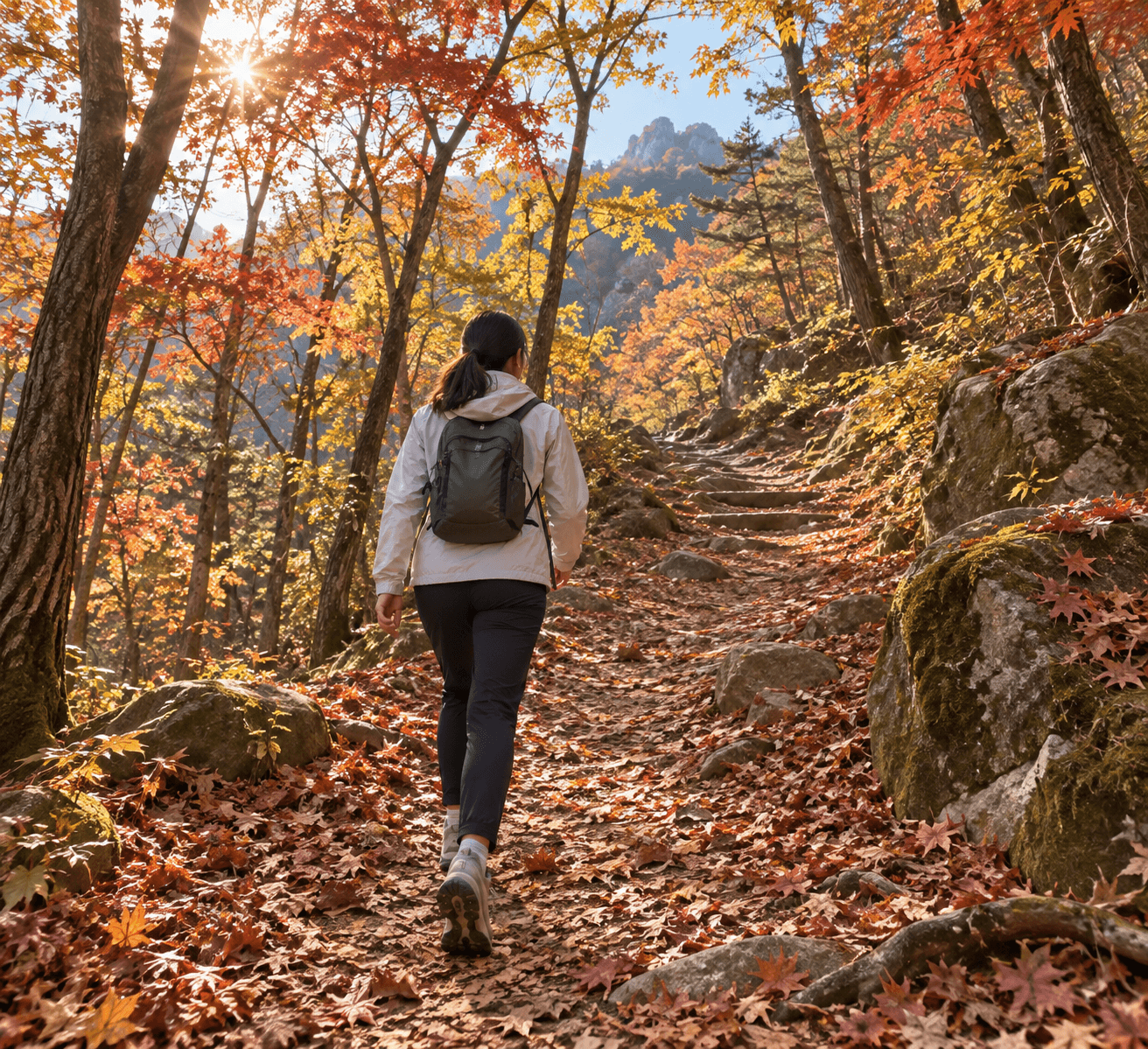
Two conditions repeat across preparation and booking: autumn can still bring cold and rain, so pack comfortable shoes with good grip and an outer layer, and the guidance warns that foliage season draws the biggest crowds in the country, so brace for competition over parking and shelter reservations. Travelers on a day tour need to arrive at the meeting point 5 to 10 minutes early, and latecomers and no-shows cannot be refunded (as of the September 2026 check). Building the day around the cable car plus one easy round trip and saving summit ambitions for another visit is the allocation this evidence supports.
Foliage timing: different by mountain, different by year
The regional split in foliage timing shows directly in the sources. Seoraksan foliage arrives first in South Korea: in a typical year it starts on Daecheongbong in late September and peaks at Cheonbuldong (천불동) in mid-October (typical-year basis, source checked September 2026). In the city, the area around Gyeongbokgung (경복궁) is picked as most beautiful from mid-October into early November, and foliage inside the palace usually peaks around the last week of October.
The peak periods for Bukhansan, Namhansanseong and Soyosan, the remaining original candidates, are absent from this post’s sources. Guidance elsewhere notes that foliage is generally best from late October into early November but varies every year with temperatures, so the timing call comes from searching the official announcements for the region you target in the week you travel, not from this post.
Choosing by situation: the criteria for deciding today
Guidance notes that itineraries starting with regions whose routes are simple tend to satisfy more, and a regional comparison pointing the same way says Seoul and the capital area work well as transit-centered day trips. Applying that standard to the two branches makes it concrete. If your group includes a stroller or someone with weak knees, or you can only clear half a day, narrow it to the Namsan Sky Forest Trail and add a plan to walk only part of it. If you can clear the whole day and accept the crowds, narrow it to the Seoraksan day trip, and given that even a veteran judged the day long, start from the easy courses.
For Soyosan, the only confirmed fact is Korail’s metropolitan line listing of the Gyeongwon Line (Line 1) as Soyosan–Cheongnyangni. Hiking time or foliage timing for it is absent from this post’s sources, which is why it stays out of the table and the recommendation, and no source at all turned up for Namhansanseong. Instead of forcing one of the three mountains the search started with, fix whether today’s free time is a half day or a whole day, and the choice settles on its own.
Sources (for readers):
- Jjangbat, Namsan Sky Forest Trail guide: https://jjangbat.tistory.com/13
- 24 Travel, Namsan trail and Myeongdong route notes: https://garaknoraebang.kr/namsan-myeongdong-walk-route/
- Awesomble, N Seoul Tower guide: https://www.awesomble.com/ko/Aosdin/kr-seoul-namsan-tower-guide/
- N Seoul Tower official traffic information: https://www.nseoultower.co.kr/visit/traffic.asp
- Beyond The Bay, Seoul travel log (Namsan circular buses): https://www.beyondthebay.co/southkorea/seoulday1
- Ggudol Information, Myeongdong Station to the Namsan cable car: https://information.ggudol.com/2026/05/blog-post_82.html
- HeySeorak, Seoraksan day trip itinerary: https://heyseorak.com/blog/seoraksan-day-trip-from-seoul
- Discover Real Korea, Seoraksan Daecheongbong guide: https://discoverrealkorea.com/seoraksan-daecheongbong-hike/
- Sandogam, Seoraksan seasonal guide: https://sandogam.com/m/seoraksan/
- The Girl with a Big Bag, Seoraksan itineraries (visit log): https://thegirlwithabigbag.com/seoraksan-itinerary/
- The Korea Traveler, Seoraksan and Sokcho tour from Seoul: https://thekoreatraveler.com/seoul-mt-seorakcablecar-optionsokcho-fish-marketbeach/
- KUT SEOUL, best time to visit Gyeongbokgung: https://kutseoul.com/ko/blog/best-time-to-visit-gyeongbokgung-palace
- Jaeng Trip, Ganghwa Island autumn course: https://travel-lab-1.tistory.com/71
- Korean Regional Travel, regional travel characteristics: https://travelkorearegions.com/korean-regional-travel-naejangsan-foliage/
- Korea Railroad (Korail) customer FAQ: https://info.korail.com/info/selectBbsNttList.do%3Bjsessionid%3DXCvgds3MTlmqwtV44AOTmvYL7WnC7pmuvTpMeKLQZykg3lw6lAzO1Pp4zO38DRZZ?bbsNo=205&integrDeptCode=&key=817&pageIndex=3&pageUnit=10&searchCnd=all&searchCtgry=&searchKrwd=
Pick like this
- Half a day free, or a mixed group: the Namsan Sky Forest Trail, starting from the short Sowol Garden side entrance.
- A whole day to spend: the Seoraksan day trip, cable car plus one easy round-trip walk.
- Foliage timing: settle it with the official announcements for your target region in the week you travel.
Images are examples to aid understanding. Last checked: 2026-09-13
Sources & verification
A source-based guide. Check the linked operator information again before you travel.
- Jjangbat, Namsan Sky Forest Trail guideSources checked:
- N Seoul Tower official traffic informationSources checked:
- HeySeorak, Seoraksan day trip itinerarySources checked:
- Discover Real Korea, Seoraksan Daecheongbong guideSources checked:
- The Girl with a Big Bag, Seoraksan itineraries (visit log)Sources checked:
- KUT SEOUL, best time to visit GyeongbokgungSources checked:
- Korean Regional Travel, regional travel characteristicsSources checked:
- Korea Railroad (Korail) customer FAQSources checked:
Illustrations are examples to aid understanding, not photographs taken on site. Actual photographs have separate source credits.
Continue planning
Seoraksan Fall Foliage with Your Parents: Picking a Gentle Course
The stairs decide the course: the cable car to Gwongeumseong plus a flat Sinheungsa walk covers Seoraksan foliage with your parents, best between mid-October and early November.
Chuseok holiday from the Seoul capital area: when to leave, when to return
When Chuseok train and bus tickets open and sell out around the Seoul capital area, which departure and return time slots leave more room, and where the day-trip line falls.
Chuseok KTX Tickets Sold Out? An Order for Finding Alternatives from Seoul
Chuseok KTX sold out? Re-check other train classes and the SRT channel, move to the bus apps and fare classes, and choose destinations by the arrival terminal's access to downtown.
Help us keep this note useful
A quick response helps us decide what to clarify or recheck. No account or email is needed.