Say you are flying into Tokyo and spending several nights in Kyoto. Then you open the map and Hiroshima catches your eye. If you add a day trip from Kyoto, does the JR Pass finally pay for itself?
The short answer is: partly. With Kyoto as your base, a Hiroshima day trip pushes the cost of individual Nozomi tickets ¥1,420 above the 7-day pass. Take the same three cities in a different order, sleeping one night in Hiroshima and riding straight back to Tokyo, and the individual tickets come out ¥4,730 cheaper than the pass. Same three cities. The order alone flips the answer.
So this guide looks at the order of your journeys before the names of your cities. If you are only going between Tokyo and Kyoto, leave the pass out of your budget. Once Hiroshima enters the plan, it is time to run the numbers.
Since October 2026 the same pass has two prices
For purchases from 1 October 2026, only the price at overseas JR-designated agencies went up. What counts is the date you buy, not the date you travel, and it follows the local time where you buy. The official online store, JAPAN RAIL PASS Reservation, holds its price for now, and JR says it will announce when that period ends.
| Pass | Official online | Overseas agency |
|---|---|---|
| 7 days | ¥50,000 | ¥53,000 |
| 14 days | ¥80,000 | ¥84,000 |
| 21 days | ¥100,000 | ¥105,000 |
Adult, ordinary car, from the official price table checked on 7 October 2026. A child (6 to 11) pays ¥25,000 for the 7-day pass online, with age judged on the online payment date or the exchange order issue date.
The official store charges in yen. An overseas agency, such as a travel agent in your home country, converts the yen price into your currency at the bank selling rate on the day it issues the exchange order, and prints that amount and rate on the order. So when you compare the local-currency price an agency quotes, remember before you even look at exchange rates that its 7-day pass already costs ¥3,000 more in yen.

Six itineraries, added up with individual tickets
The comparison uses fares from smartEX, the online booking service of JR Central, JR West and JR Kyushu. The totals use one-way adult fares for a reserved ordinary seat in the regular season, taken from the 1 April 2025 fare table that smartEX still links as current on 7 October 2026, with each leg added separately. With individual tickets you can choose the fastest train, the Nozomi, so the table uses Nozomi fares; the Hikari fares a pass holder would ride come later.
| Itinerary | Nozomi tickets total | Against the 7-day pass (¥50,000) |
|---|---|---|
| Tokyo to Kyoto and back | ¥27,940 | Pass costs ¥22,060 more |
| Tokyo to Shin-Osaka and back | ¥29,040 | Pass costs ¥20,960 more |
| Tokyo, Kyoto, Hiroshima (overnight), back to Tokyo | ¥45,270 | Pass costs ¥4,730 more |
| Tokyo to Kyoto, Hiroshima day trip from Kyoto, back to Tokyo | ¥51,420 | Pass is ¥1,420 cheaper |
| Tokyo, Kyoto, Hiroshima, Hakata, fly home from Fukuoka | ¥35,140 | Pass costs ¥14,860 more |
| The same plus Hakata back to Tokyo by train | ¥58,750 | Pass is ¥8,750 cheaper |
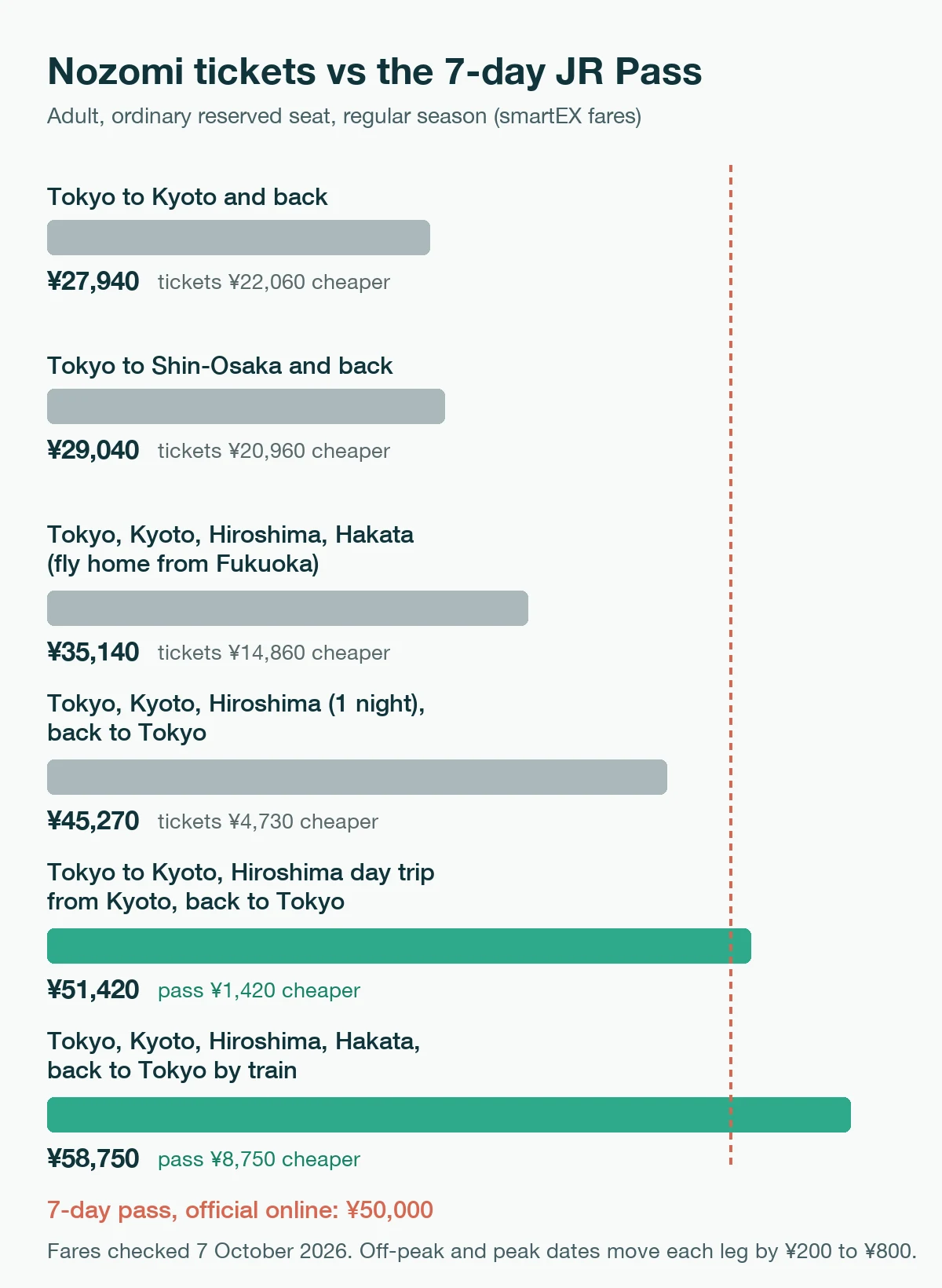
The pass wins on only two rows: the Hiroshima day trip with your bags left in Kyoto, and the trip down to Kyushu and back to Tokyo by train. Both cover the same stretch of track twice.
If your flights land in Tokyo and leave from Fukuoka, look at the fifth row. You only travel one way, from Tokyo down to Hakata, so even with stops in Kyoto and Hiroshima the tickets total ¥35,140. A trip can feel train-heavy and still fall well short of the pass if it never doubles back.
The ¥1,420 flips with the season and the train
That ¥1,420 on the day-trip itinerary depends on the season. smartEX fares drop in the off-peak season and rise in the peak season, and the swing is twice as large on Kyoto–Hiroshima because it crosses from the Tokaido to the Sanyo Shinkansen. Recalculated, the same trip costs ¥50,220 off-peak, ¥52,620 in the peak season and ¥53,820 in the top season. The smartEX season calendar tells you which band your dates fall in.
There is one more thing. A pass holder cannot ride the Nozomi and takes the Hikari instead. Bought as individual Hikari tickets, the same trip costs ¥49,500 in the regular season, so this time the tickets win by ¥500. Add the seasons and the pass ranges from ¥1,700 worse than off-peak Hikari tickets to ¥3,820 better than top-season Nozomi tickets. The money at stake is small. What you are really choosing between is the Nozomi on individual tickets and the Hikari on a pass for about the same money.
If I were planning this, I would weigh a night in Hiroshima before I weighed the pass. The day trip covers Kyoto–Hiroshima twice in one day. Stay one night and go straight back to Tokyo, and even on Nozomi tickets you spend ¥6,150 less than on the day trip. That night also leaves room for Miyajima. It does more for the trip than the ¥1,420 a pass would save.

Rides the pass covers, and rides it does not
When the numbers are close, it is tempting to add every short ride in town. First check whether the line is JR. The pass covers JR trains, most local JR Bus routes, the JR Miyajima ferry and the Tokyo Monorail. JR highway buses are not included. The Tokyo Monorail between Haneda Airport and Hamamatsucho in central Tokyo counts if you ride it within your pass dates. The ¥100 Miyajima visitor tax is paid separately.
Subways and private railways that are not JR charge their own fares. When a JR train runs through onto a private line, that section is extra too. Counting subway fares you would have paid anyway as money the pass “saved” only makes the math look better on paper. Add only the JR rides you will actually take, such as a JR line out of the city or the Miyajima ferry.
A 7-day pass runs for seven days from the start date you choose. If you spend your first few days in Tokyo, it is usually better not to start the pass yet. Starting it early just to cover the airport train can push your return from Hiroshima outside the pass dates.
If you buy, start with the official store
If the math says the pass fits your trip, there are three reasons to buy it from the official online store.
The first is price. Right now it is ¥3,000 cheaper for the 7-day pass.
The second is booking seats before you leave. Only passes bought on the official site can reserve Shinkansen and limited express seats on that same site in advance. If you buy an exchange order from an agency, you reserve at a station after swapping it for the pass in Japan. Seat reservations cost nothing extra, but the pass itself does not guarantee you a seat. If you want your first train locked in on a busy day, such as in the autumn foliage season or over the year-end holidays, this difference matters.
The third is refunds. A pass bought online can be refunded on the site until 23:30 Japan time the day before it starts, for ¥560 per pass. If you have already collected it, you can in principle refund it at a pickup office up to the day before it starts for the same fee, and you need to show the physical card you paid with. If you do not request a refund by the deadline, you pay the full price. A pass exchanged from an agency order and refunded in Japan loses 10% of its sales price as a handling fee. If your dates are still moving, this gap is hard to ignore.
The pass and the seats open at different times. You can buy the pass from 04:00 Japan time one month before its start date. Seat reservations open at 10:00 Japan time one month before the travel date, on the same day of the month. Japan is UTC+9, so those are 03:00 and 09:00 in Taipei or Hong Kong. For dates that do not exist in the previous month, such as 29 to 31 March, booking opens on the 1st of that month.
You pay with a credit card in the purchaser’s own name, and the site accepts VISA, Mastercard, JCB, AMEX, Diners and Discover. The purchaser must be one of the travelers, and every companion must meet the eligibility rules too. The official FAQ says one purchase can cover up to six passes, adults and children combined. Registering takes an email address; buying takes the passport number of every traveler.
If you buy from an agency, keep two dates in mind. The exchange order must be swapped for a pass within three months of its issue date, and the swap is possible from one month before the start date. Buy too early and the three-month limit can run out before the exchange window opens.
Paying is not the same as boarding
Whether you bought online or from an agency, you collect a physical pass after you arrive in Japan. For an online purchase, the purchaser and all companions go to the pickup office together with the reservation number and every traveler’s passport. Once you have the pass, a reserved-seat machine prints your seat tickets after you scan the QR code or enter the reservation number and then your passport number.
Pickup offices are at airports and major stations. The official list includes Narita, Haneda and Kansai airports as well as Kyoto and Shin-Osaka stations, and opening hours differ by office. If you land late at night, find your airport’s office on the official list before you fly. The official guide also warns that exchange counters can take time when busy, so leave a margin if you plan a long train ride on your arrival day.
No passport stamp, no pass
The pass is only for foreign visitors who enter Japan for sightseeing with Temporary Visitor status. Automated immigration gates leave no stamp or sticker in your passport, so use a staffed booth or ask an officer for the stamp. Registered Trusted Traveler Program users show their registered user card instead. Without that stamp or sticker, you cannot collect a pass you have already paid for.
Japanese nationals living abroad have separate conditions and cannot buy from the official online store.
Riding the Nozomi changes the pass math
The Nozomi and Mizuho are the fastest Shinkansen trains, but the pass alone does not cover them, not even in non-reserved seats. Pass holders must buy a separate Nozomi/Mizuho ticket before each ride. It costs ¥4,960 one way for Tokyo–Kyoto or Tokyo–Shin-Osaka and ¥6,500 for Tokyo–Hiroshima.
Riding the Nozomi from Tokyo to Kyoto and back adds ¥9,920 in these tickets, which takes the 7-day pass bought online to ¥59,920. Even before any Nozomi ticket for Kyoto–Hiroshima, that is ¥8,500 more than the whole day-trip itinerary on individual Nozomi tickets at ¥51,420. If you insist on the Nozomi, the pass looks even worse. Each train sells a limited number of these tickets, and they can sell out while seats are still empty.
During major peak periods set by JR Central, every Nozomi seat becomes reserved. The Hikari and Kodama keep their non-reserved cars, but they can be crowded, and JR Central advises booking ahead.
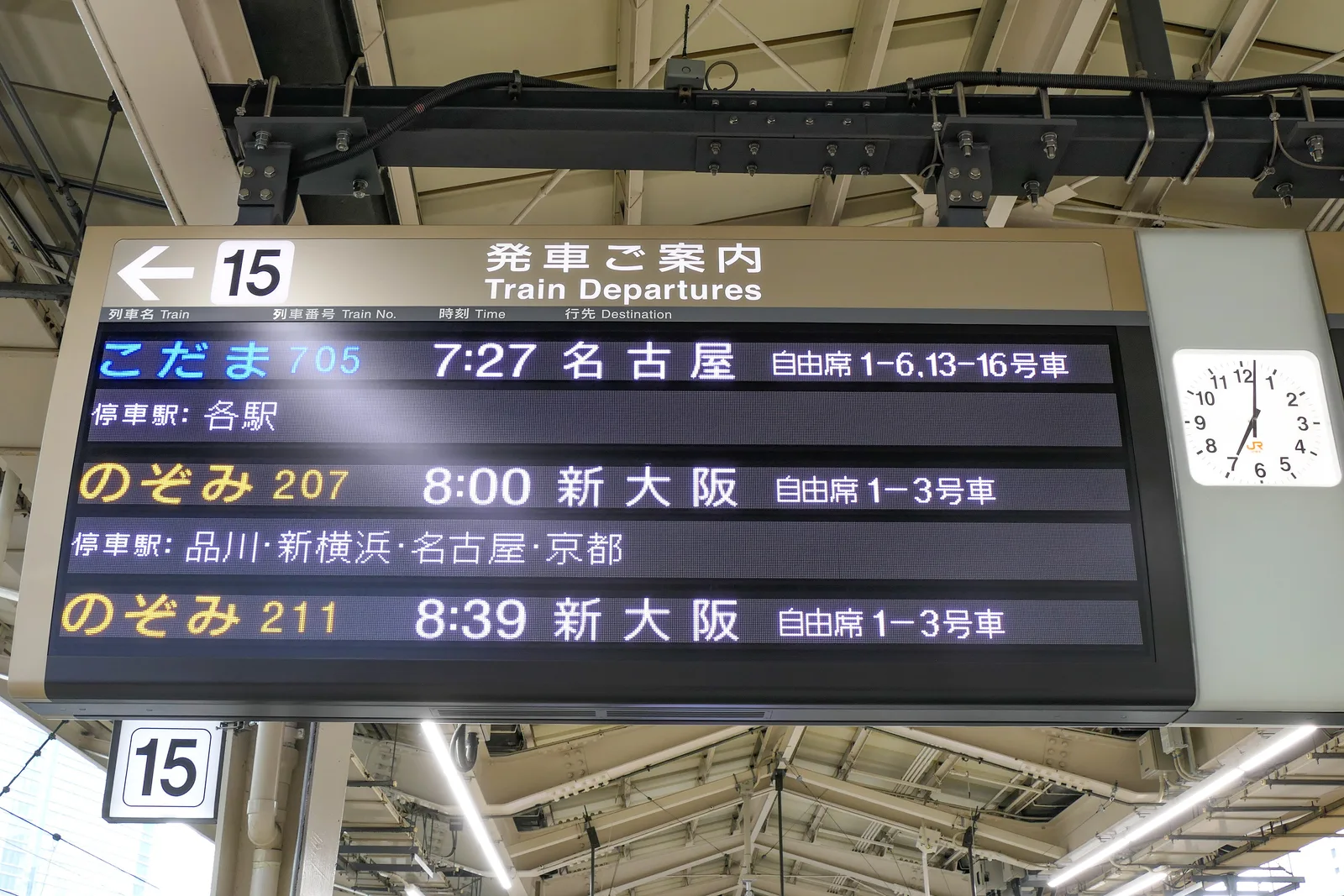

Where to buy individual tickets
If you go with individual tickets, smartEX is the most direct route. You sign up with an email address and a credit card that passes 3D Secure authentication. You must be 18 or older to register. You board with a QR ticket or a registered IC card.
Booking opens at 05:30 Japan time one year before the travel date, and trains and seats booked that early are confirmed after 08:00 Japan time one month before. You can change a booking as many times as you like without charge until departure, as long as you have not passed the gate, which suits a trip whose dates are not yet fixed. Canceling before departure costs ¥320. You cannot break the journey midway, and regular train fares to and from the Shinkansen station are extra.
smartEX charges in yen. If signing up or paying in yen is a hassle, Klook also sells Tokyo–Kyoto Shinkansen tickets. When checked on 28 September 2026, prices showed in US dollars, and the 06:00 Nozomi 1 on 4 October started at US$95.28 per adult, one way. You get a QR code, swap it for a paper ticket at a JR machine, and see the refund terms at checkout. It is not a product for JR Pass holders.
By itinerary
If you are only going between Tokyo and Kyoto or Osaka, skip the pass. Even with every leg on the Nozomi, you keep more than ¥20,000.
If you want Hiroshima, add it as an overnight stay and buy individual tickets. Squeezing it in as a day trip to make the pass work swings by a few thousand yen either way, depending on the season, and it means covering the same stretch twice in one day.
If you are going from Tokyo down to Kyushu and coming back to Tokyo by train, that is when the pass wins. In that case buy it online and reserve the seat on your first long ride before you leave.
Either way, choose the cities you want and where you will sleep first. Pick the pass only after the plan gives you the numbers.
Sources & verification
A source-based guide. Check the linked operator information again before you travel.
- Japan Rail Pass: types and pricesSources checked:
- JR Group: Japan Rail Pass price revision notice, 9 April 2026 (PDF, Japanese)Sources checked:
- smartEX: reserved-seat fares, as of 1 April 2025 (PDF)Sources checked:
- smartEX: service conditions and season pricingSources checked:
- smartEX: how to registerSources checked:
- Japan Rail Pass: scope of validitySources checked:
- Japan Rail Pass: conditions for useSources checked:
- Japan Rail Pass: purchase onlineSources checked:
- JAPAN RAIL PASS Reservation: frequently asked questionsSources checked:
- Japan Rail Pass: purchase at a travel agency overseasSources checked:
- Japan Rail Pass: eligibility for useSources checked:
- Japan Rail Pass: Nozomi and Mizuho ticketsSources checked:
- Japan Rail Pass: exchange and sales officesSources checked:
- JR Central: all-reserved Nozomi in peak periodsSources checked:
- Tokyo Monorail: access to Haneda AirportSources checked:
Help us keep this note useful
A quick response helps us decide what to clarify or recheck. No account or email is needed.